Why Curb Appeal Starts with Your Stormwater System
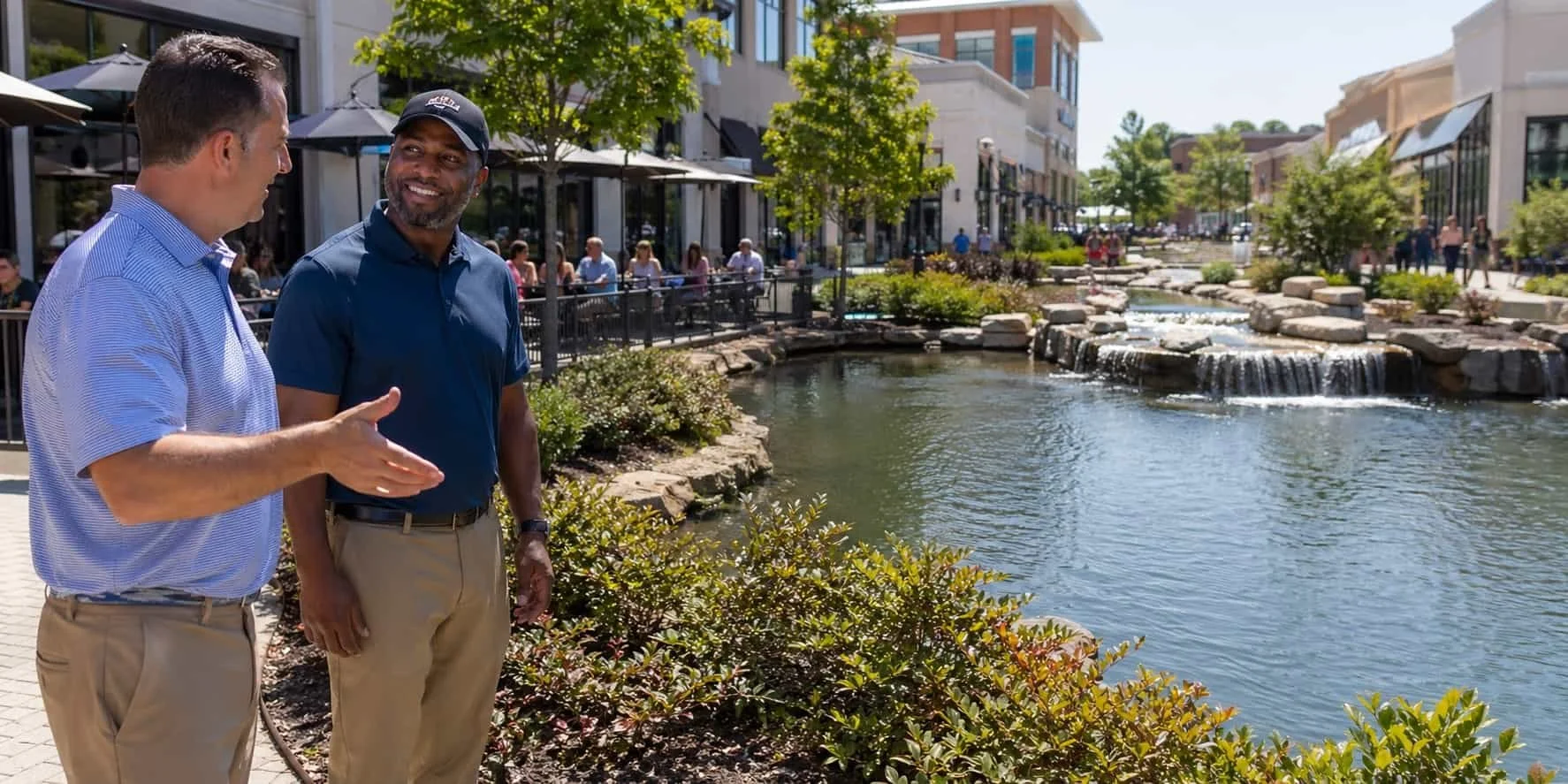
A retail center usually gets judged before anyone opens a door.
Not by a lease packet. Not by a tenant roster. Not by the polished renderings from the development brochure. It gets judged from the parking lot.
A customer pulls in, looks for a clean walkway, notices whether the landscaping feels cared for, checks whether the patio seating feels pleasant, and quietly decides whether this place feels worth their time. That decision happens fast. Almost unfairly fast.
And one of the easiest ways to lose that first impression is also one of the easiest systems to overlook: stormwater.
A pond with green scum on the surface. Standing water near the curb line. A sour odor near the restaurant patio. Trash collecting around an inlet. Algae making pavement slick near a sidewalk. A water feature that was supposed to feel like an amenity, but now looks like the back corner of a neglected fishing camp.
That is not just a maintenance issue. For retail centers, it is a brand issue.
Retail property managers, commercial owners, HOA boards, golf course managers, and industrial property owners all deal with the same underlying reality: water on a property does not stay politely in the engineering folder where it started. It shows up in front of customers, tenants, residents, vendors, inspectors, and visitors. When it is managed well, it can support curb appeal, drainage, compliance, and long-term property value. When it is ignored, it becomes visible fast.
For retail centers across the Charlotte Metro, Lake Norman, Piedmont Triad, Catawba Valley, and surrounding North Carolina Piedmont communities, stormwater management is not only about satisfying a requirement. It is about protecting the experience people came there to have.
Clearwater Lake, Pond and Stormwater Management Services helps retail center managers and commercial property owners keep stormwater ponds, SCMs, drainage areas, and water features functioning properly while also presenting the property in a way that reflects the quality of the businesses on site. That matters because customers rarely know the difference between an engineered stormwater system and a decorative pond.
They only know whether it looks clean, smells fine, drains properly, and feels like somebody is paying attention.
The Retail Problem: Water Features Are Either an Amenity or a Warning Sign
Retail centers often use water features, landscaped basins, ponds, bioretention areas, and green space to soften the amount of asphalt around a property. That is smart. A clean water feature can make a shopping center feel calmer, more walkable, and more intentionally maintained.
But the same feature can work against the property if it is not serviced regularly.
A stormwater pond near an outdoor dining area should support the atmosphere, not compete with it. A bioretention cell at an entrance should look like part of the landscape plan, not a forgotten construction requirement. A drainage swale behind a retail building should move water safely, not collect sediment, weeds, and trash until it becomes a tenant complaint waiting for a rainy Friday afternoon.
EPA guidance on green infrastructure notes that properly designed systems can capture and absorb stormwater, filter pollutants, improve water quality, and reduce runoff.† That is the technical value. For retail properties, there is also a human value: clean, functional stormwater areas help the entire site feel more cared for.
Customers may not compliment a well-maintained outlet structure. Nobody is taking a selfie with a stabilized pond bank unless things have gone badly sideways. But they do notice the total environment.
That is the quiet power of stormwater maintenance in retail settings. Done right, it disappears into the brand experience. Done poorly, it becomes the thing people notice for the wrong reason.
Why Standing Water Hurts More Than the Landscaping Budget
A retail center can spend money on seasonal flowers, pressure washing, monument signage, parking lot striping, and patio furniture. All of that helps. But if customers have to step around stagnant water near the curb or smell pond odors near an outdoor dining area, the property has already introduced friction.
Standing water can make a site feel poorly managed even when the storefronts are strong. Odors near restaurants or fitness tenants can create an obvious disconnect between what the tenant is trying to sell and what the property is communicating outside. Excess algae growth, shoreline erosion, clogged structures, and sediment buildup can make a pond or SCM look like a maintenance afterthought.
For a retail center, that can affect more than aesthetics.
Tenants care about foot traffic. Restaurants care about patio comfort. Medical, wellness, and boutique tenants care about customer trust. National brands care about the environment surrounding their storefront because it shapes the customer’s impression before their own staff ever gets involved.
This is where property management gets unfair. The stormwater system may not be the tenant’s responsibility, but if it looks bad, the tenant feels the consequences.
That is why a Retail Curb Appeal Site Walk is a practical first step. Instead of waiting for a complaint, Clearwater can walk the property and identify visible stormwater issues before they become bigger operational problems. That might include stagnant water, clogged inlets, algae growth, nuisance vegetation, shoreline erosion, sediment buildup, odors, trash accumulation, failing vegetation in bioretention areas, or areas where drainage patterns are beginning to affect pedestrian experience.
Not glamorous. Very useful. The best property maintenance usually is.
Compliance Still Matters, Even When the Problem Looks Cosmetic
Some stormwater issues look like simple curb appeal problems. In North Carolina, they may also connect to inspection and maintenance obligations.
The North Carolina Department of Environmental Quality states that stormwater control measures require regular operation and maintenance to function properly over the long term. NC DEQ also notes that SCMs should be inspected at least quarterly and after larger storm events exceeding one inch in a 24-hour period.‡
That matters for retail centers because many commercial properties rely on SCMs such as wet ponds, bioretention cells, stormwater wetlands, swales, permeable pavement areas, and other engineered systems. These systems are not decorative extras. They are built to manage runoff and water quality from impervious surfaces like roofs, parking lots, sidewalks, and loading areas.
Retail centers have a lot of impervious surface. That is the whole game. Parking, access, visibility, and convenience are the point. But when rain hits asphalt and concrete, it moves quickly. It can carry sediment, nutrients, oil, trash, and other pollutants into the stormwater system. EPA notes that runoff from impervious surfaces can carry pollutants such as nutrients, sediment, pathogens, and heavy metals into downstream waters.§
Regular maintenance helps keep those systems doing their job.
For a property manager, the practical question is not, “Do we have stormwater infrastructure?” The better question is, “Is our stormwater infrastructure still functioning the way it was designed to function, and does it look acceptable to the people using the property?”
Those are related questions. A clogged inlet, overgrown basin, failing outlet, or sediment-loaded pond edge can create both performance problems and curb appeal problems. The compliance side and the customer experience side are not separate silos. They are two views of the same asset.
Clearwater Lake, Pond and Stormwater Management Services works with property owners and managers to help connect those views. The goal is not just to make the pond look nicer for a week. The goal is to help the system function, meet maintenance expectations, and support the property’s day-to-day use.
What Retail Center Managers Should Look For During a Site Walk
A useful stormwater site walk does not need to start with panic. It starts with observation.
Walk the property the way a customer, tenant, inspector, and maintenance professional would walk it. Each one notices something different.
A customer notices odor, standing water, trash, bugs, algae, muddy edges, and whether a sidewalk feels pleasant.
A tenant notices whether the front of the store looks clean, whether patio seating is usable, whether drainage affects customer access, and whether recurring complaints are being handled.
An inspector or qualified professional looks for whether the SCM appears to be functioning, whether vegetation is appropriate, whether structures are blocked or damaged, whether erosion is occurring, and whether maintenance records line up with actual site conditions.
A property manager has to see all of it.
For retail centers, the most common visual warning signs include:
Persistent standing water near curbs, sidewalks, patios, dumpster pads, or tenant entrances
Strong odors around ponds, water features, drains, or low-lying areas
Excessive algae or duckweed covering the pond surface
Sediment buildup at forebays, inlets, curb cuts, or pond edges
Trash and debris collecting near storm drains or outlet structures
Shoreline erosion or bare slopes around ponds and basins
Overgrown vegetation blocking visibility, access, or designed flow paths
Dead or failing plant material in bioretention areas
Water leaving stained, slimy, or slick areas on pedestrian surfaces
Evidence that stormwater structures are clogged, damaged, or difficult to access
None of these signs automatically means the property has a major failure. But each one is a signal. The sooner those signals are reviewed, the easier it is to separate routine maintenance from a developing repair issue.
That is especially important in high-traffic retail environments, where small issues become public quickly. A pond tucked behind an industrial facility may go unnoticed for a while. A stagnant water feature beside a restaurant patio does not get that luxury.
The Tenant Quality Problem: Your Pond Reflects Their Brand, Too
Retail center managers know this better than anyone: tenants do not only lease square footage. They lease the environment around the square footage.
A boutique, restaurant, medical office, fitness studio, salon, coffee shop, or specialty retailer wants the surrounding property to reinforce the promise they are making inside. Clean storefronts. Good lighting. Safe walking paths. Attractive landscaping. Easy parking. A general sense that the property is managed by adults.
Stormwater can support that promise or undermine it.
When a pond is clean, vegetation is managed, drainage is working, and water features are maintained, the property feels intentional. When there is stagnant water, odor, algae, or erosion, the site starts sending the wrong message. It does not matter that the issue may be technical. The public reads it as neglect.
That is why stormwater should be part of retail brand management, not just facilities maintenance.
This is also where commercial property owners, HOAs, golf courses, and industrial facilities overlap. An HOA pond affects resident confidence and resale perception. A golf course water feature affects playability and the visual experience of the course. An industrial site with poor drainage can affect safety, truck access, and compliance risk. A retail center with visible stagnant water can affect tenant satisfaction and customer dwell time.
Different audiences. Same principle.
Water is part of the property experience.
The Maintenance Plan: Small, Regular Work Beats Big, Expensive Surprises
Stormwater systems age like everything else on a property. The difference is that many of their problems accumulate quietly until they become very visible.
Sediment builds up. Vegetation gets out of balance. Inlets clog. Banks erode. Algae blooms show up when nutrients, sunlight, temperature, and slow-moving water line up at the wrong time. Outlet structures become blocked. Bioretention media may not drain as intended. Trash finds the lowest point because, apparently, cups and plastic bags have an advanced degree in hydrology.
A regular maintenance plan helps prevent those smaller conditions from becoming expensive disruptions.
NC State Extension notes that SCMs need annual, and sometimes more frequent, inspection and maintenance to perform as intended. Maintenance can involve hydrologic function, water quality function, landscape function, and human health and safety considerations.¶ That is a helpful way to frame the work because retail sites need all four.
Hydrologic function means the system moves and stores water properly.
Water quality function means the system helps filter pollutants and reduce downstream impacts.
Landscape function means the visible areas look appropriate for the property.
Health and safety considerations mean the site does not create avoidable problems for customers, tenants, staff, vendors, or visitors.
For retail centers, the right maintenance plan may include routine inspections, algae and aquatic vegetation management, shoreline and bank stabilization review, inlet and outlet checks, sediment monitoring, trash and debris removal, plant health review, drainage observation after storm events, and documentation for property records.
The exact mix depends on the property and the SCMs on site. A center in Mooresville near Lake Norman may have different site pressures than a retail property in Greensboro, a shopping center in Charlotte, or a commercial corridor in Hickory. Soil, slope, surrounding development, tenant mix, impervious area, tree cover, and stormwater design all matter.
That is why a practical site walk is more useful than a generic checklist pulled from the internet. The checklist helps. The site tells the truth.
A Better Way to Think About Retail Stormwater: Front-of-House and Back-of-House
Restaurants understand front-of-house and back-of-house. The customer sees the dining room, service, lighting, and plating. The operation depends on the kitchen, storage, prep, dishwashing, and systems most customers never see.
Retail stormwater works the same way.
The front-of-house side is what customers and tenants notice: clean ponds, pleasant water features, healthy vegetation, no odors, no obvious stagnant water, and walkways that feel usable after rain.
The back-of-house side is what keeps the property functioning: designed drainage patterns, maintained SCMs, clear inlets and outlets, stable banks, inspection records, sediment control, vegetation management, and regulatory alignment.
If the back-of-house work gets ignored, the front-of-house experience eventually suffers.
That is the core issue for retail center managers. Stormwater is not separate from curb appeal. It is one of the systems that makes curb appeal believable.
A property can have beautiful signage and still feel neglected if the pond is covered in algae. It can have strong tenants and still lose atmosphere if odors drift across outdoor dining. It can have fresh landscaping and still look poorly managed if water is standing at the entrance after every storm.
The customer does not grade effort. The customer grades experience.
How Clearwater Helps Retail Centers Protect the Experience
Clearwater Lake, Pond and Stormwater Management Services helps property managers and owners turn stormwater from a recurring complaint into a managed property asset.
For retail centers, that usually starts with a site walk focused on visible conditions, drainage performance, maintenance needs, and curb appeal risk. The goal is to identify what is normal, what needs service, what should be monitored, and what may require repair or a more detailed professional inspection.
From there, Clearwater can help with lake and pond management, algae and aquatic weed control, stormwater maintenance, SCM management, repairs and restoration coordination, vegetation review, and ongoing service planning. For properties across Charlotte, Concord, Mooresville, Statesville, Hickory, Salisbury, Winston-Salem, High Point, Greensboro, Lake Norman, the Piedmont Triad, and the Catawba Valley, that regional familiarity matters.
North Carolina Piedmont properties deal with real rainfall, real clay soils, real slope, real heat, and real development pressure. Stormwater systems are not theoretical here. They are working assets.
Retail owners and managers do not need to become pond scientists. They need a dependable partner who can help them know what they are looking at, what matters now, what can wait, and what should be handled before the next complaint or inspection.
That is where a Retail Curb Appeal Site Walk makes sense. It gives the property team a practical read on the visible and functional condition of the water assets on site.
You can also call Clearwater at (704) 450-1598 to request a quote or ask about stormwater maintenance for a retail center, commercial property, HOA community, golf course, or industrial site.
The Bigger Property Lesson: Pretty Water Still Has a Job
Water features can be beautiful. Ponds can become attractive landscape anchors. Bioretention areas can look intentional and natural. Green infrastructure can support better drainage, water quality, and community experience when it is designed and maintained well.
But water on a commercial property is never just decorative.
It has a job.
It receives runoff. It holds water. It filters pollutants. It protects downstream areas. It supports compliance. It influences how people move through and perceive the property. It can make a retail center feel calmer and more polished, or it can make the same center feel neglected before the customer reaches the door.
For retail centers, curb appeal does not start at the storefront. It starts at the full property experience.
That includes the parking lot.
That includes the drainage path.
That includes the pond.
That includes the water feature beside the patio.
That includes the inlet at the curb that nobody thinks about until it clogs.
Regular stormwater service helps keep those details from becoming distractions. It protects tenant confidence. It supports customer experience. It helps the property stay ahead of visible issues, maintenance surprises, and compliance headaches.
Retail is hard enough without a pond making the first impression for you.
For retail center managers across the Charlotte Metro, Lake Norman, Piedmont Triad, Catawba Valley, and surrounding North Carolina Piedmont communities, the practical move is simple: walk the site, look at the water, and treat stormwater as part of the brand experience.
Clearwater Lake, Pond and Stormwater Management Services can help you do that with a practical, site-specific approach that keeps the system working and the property looking like it should.
To schedule a Retail Curb Appeal Site Walk, request a quote from Clearwater Lake, Pond and Stormwater Management Services or call (704) 450-1598.
-
Footnotes / Sources
† U.S. Environmental Protection Agency. “Benefits of Green Infrastructure.” EPA, updated December 9, 2025. Accessed April 28, 2026. https://www.epa.gov/green-infrastructure/benefits-green-infrastructure.
‡ North Carolina Department of Environmental Quality. “SCM Operation & Maintenance.” NC DEQ Stormwater Design Manual. Accessed April 28, 2026. https://www.deq.nc.gov/about/divisions/energy-mineral-and-land-resources/stormwater/stormwater-program/stormwater-design-manual/scm-operation-maintenance.
§ U.S. Environmental Protection Agency. “Environmental Benefits of Green Infrastructure.” EPA, updated December 30, 2025. Accessed April 28, 2026. https://www.epa.gov/green-infrastructure/environmental-benefits-green-infrastructure.
¶ North Carolina State University Biological and Agricultural Engineering Extension. “Stormwater Control Measure Inspection and Maintenance Certification.” NC State Extension. Accessed April 28, 2026. https://bae.ncsu.edu/workshops-conferences/stormwater-bmp/.
Town of Cary, North Carolina. “Stormwater Control Measures.” Town of Cary. Accessed April 28, 2026. https://www.carync.gov/services-publications/water-sewer-stormwater/stormwater/watershed-protection-and-nutrient-reduction/stormwater-control-measures.