Aeration vs. Fountains: Which Does Your Property Need?
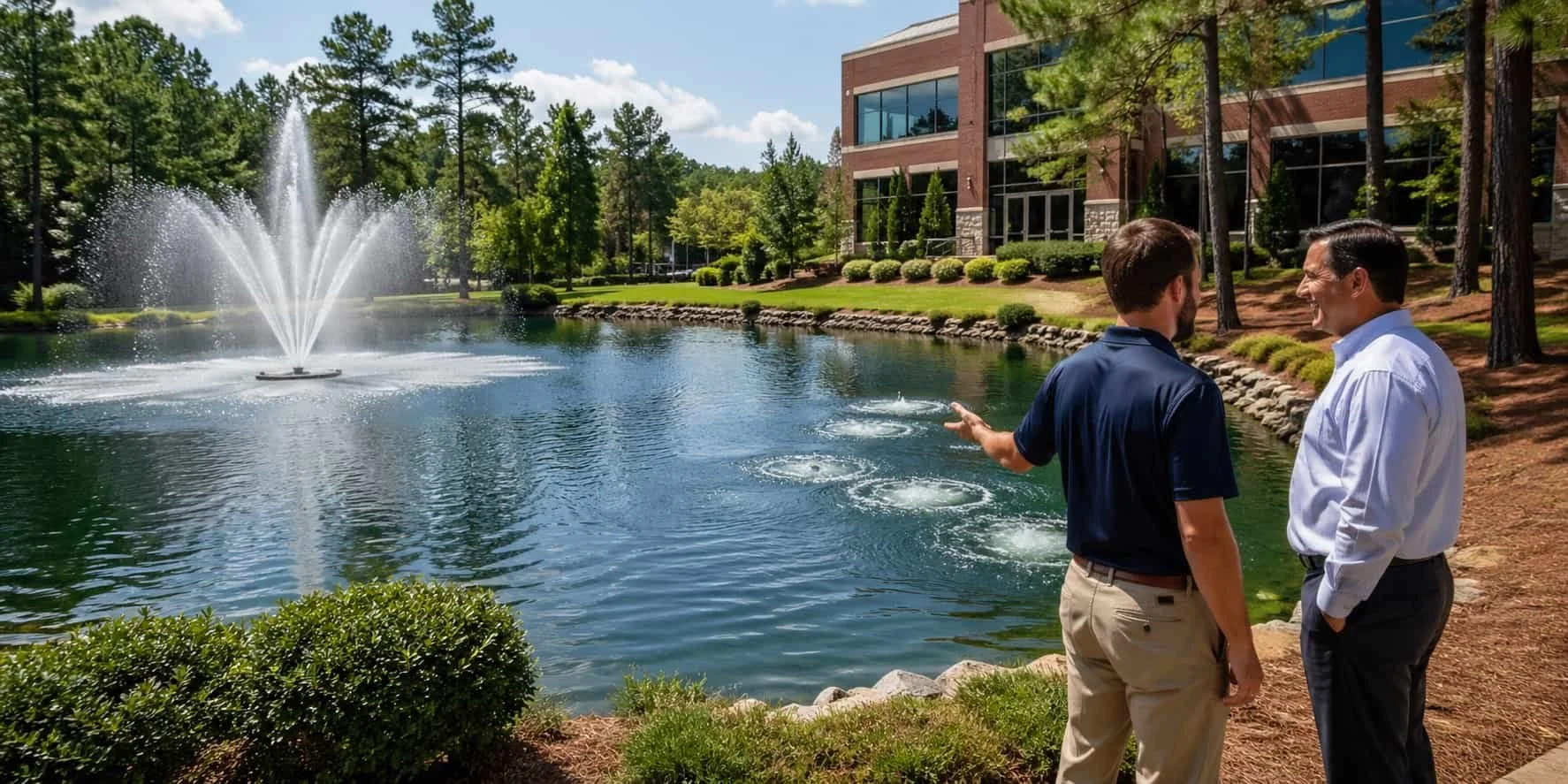
A pond can look alive from a distance and still be struggling under the surface.
That is the confusing part for many commercial property managers, HOA boards, office park owners, golf course superintendents, and industrial property teams. The water may have a fountain spraying nicely in the middle. The landscaping may look clean from the road. The pond may even photograph well enough for the leasing brochure.
Then summer arrives in North Carolina.
The water gets still. Algae thickens along the edges. A stale odor starts showing up near the walking path or parking lot. Tenants ask why the pond smells after rain. Residents complain that the water looks green. The golf course pond near a fairway starts losing clarity. An industrial site notices that the retention pond looks more like a neglected drainage pit than a working stormwater asset.
That is usually when the question comes up:
Do we need a fountain, or do we need aeration?
The honest answer is that they are not the same tool.
A fountain can improve beauty, surface movement, and visual appeal. It can help a pond look active, polished, and maintained. For an office park, commercial campus, retail center, HOA entrance pond, or golf course water feature, that matters. People judge a property quickly. A well-placed fountain can make water feel intentional instead of forgotten.
But a fountain is not always enough to solve the root cause of stagnant water.
Sub-surface aeration, often called bottom-diffused aeration, is designed to move oxygen through the water column from below. Instead of only disturbing the surface, it sends air through diffusers placed near the pond bottom. The rising bubbles help circulate deeper water upward, reduce stratification, and improve dissolved oxygen throughout more of the pond. EPA describes aerators as systems that pump air through the water column to disrupt stratification, often using diffusers near the bottom that create rising plumes and vertical circulation.†
That distinction matters.
For properties across the Charlotte Metro, Lake Norman, Piedmont Triad, Catawba Valley, and nearby North Carolina Piedmont communities, choosing between a fountain and an aeration system should not be based only on what looks better in a brochure. It should be based on what the pond is being asked to do.
Clearwater Lake, Pond and Stormwater Management Services helps commercial and community property owners understand that difference, inspect site conditions, and choose the right water movement strategy for the pond, stormwater control measure, or water feature on the property.
Sometimes that answer is a fountain.
Sometimes it is sub-surface aeration.
Sometimes it is both.
The key is knowing the problem before buying the equipment.
Water Movement Is Not Just About Looks
Still water creates problems.
That does not mean every calm pond is unhealthy. Some ponds are naturally quiet. But when a stormwater pond, commercial water feature, or community pond becomes persistently stagnant, the conditions can shift quickly. Warm weather, nutrient buildup, organic debris, lawn runoff, sediment, and limited circulation can all contribute to algae growth, odor, low oxygen, and poor water quality.
EPA notes that dissolved oxygen enters water through direct atmospheric absorption, and that turbulence can enhance that process.‡ That is why movement matters. Water that interacts with air can absorb oxygen more effectively than water sitting still with little circulation.
But oxygen is not distributed evenly by magic. In deeper ponds, especially during warm months, the upper and lower layers of water can separate. Warmer water sits near the surface. Cooler, denser water settles near the bottom. When those layers do not mix well, the deeper water can become oxygen-poor.
That condition can become a real problem for ponds that receive stormwater runoff, organic matter, sediment, or nutrients from surrounding land.
EPA’s stormwater wet pond and wetland guidance notes that nutrients such as nitrogen and phosphorus can accumulate in stormwater ponds and wetlands without proper maintenance, contributing to low dissolved oxygen, algae blooms, odors, and unsightly conditions.§
That is the practical issue for office parks and commercial properties. A pond is not just a landscape feature. It is a living, changing water system that reacts to heat, rainfall, runoff, debris, and maintenance decisions.
A fountain may make the surface look better. Sub-surface aeration may help the whole pond function better.
Those are related benefits, but they are not identical.
What a Fountain Does Well
A fountain is the more visible option. That is part of its value.
For office parks, commercial campuses, retail centers, HOAs, golf courses, apartment communities, and hospitality properties, a fountain can make a pond feel finished. It adds movement, sound, and visual interest. It shows tenants, visitors, residents, and guests that the water feature is being managed. In the right setting, a fountain can turn a pond from background infrastructure into part of the property experience.
That can be useful for curb appeal.
A commercial office park in Charlotte may want a pond near the entrance to feel polished for tenants and visitors. A medical office campus in Winston-Salem may want the grounds to feel calm and professional. An HOA in Mooresville or Statesville may want the neighborhood entrance pond to look maintained. A golf course near Lake Norman may want water features to complement the playing experience. A retail or mixed-use property in Greensboro may want water movement near outdoor seating or pedestrian areas.
Fountains help with that.
They disturb the water surface. They improve visual circulation. They can add some oxygen at the surface through spray and turbulence. They can reduce the appearance of still, flat water. They can also help discourage some surface stagnation near the fountain’s zone of influence.
But fountains have limits.
Most floating fountains pull water from relatively shallow depths and throw it into the air. That means they are often strongest at surface movement and visual effect, not whole-pond circulation. If the deeper water is oxygen-poor, if the pond is stratified, or if the problem is coming from bottom muck, nutrient loading, organic decay, or limited circulation in the lower water column, a fountain alone may not address the full issue.
That does not make fountains bad. It makes them specific.
A fountain is like a nice front entrance sign. Valuable, visible, and worth doing correctly. But if the building’s HVAC is not working, the sign will not fix the air inside.
Same pond logic.
What Sub-Surface Aeration Does Differently
Sub-surface aeration works from the bottom up.
A typical bottom-diffused aeration system uses an on-shore compressor, weighted airline, and diffusers placed near the pond bottom. Air moves through the diffuser and rises as bubbles. As those bubbles rise, they carry deeper water upward and help circulate the pond vertically.
That is why sub-surface aeration is usually the better option when the problem is stagnant water, odor, stratification, low dissolved oxygen, or poor circulation throughout the pond.
The purpose is not to create a dramatic spray pattern. The purpose is to move and oxygenate the water column.
EPA explains that aeration systems can disrupt stratification by pumping air through diffusers near the bottom of a water body, creating rising plumes and circulation cells.† That movement can help reduce the conditions that allow deeper water to become oxygen-depleted.
Dissolved oxygen is one of the basic health indicators of a pond. EPA describes dissolved oxygen as oxygen gas incorporated into water and available for aquatic life.‡ It also notes that dissolved oxygen levels can drop at night because photosynthesis stops while plants and aquatic organisms continue consuming oxygen.∥ In warm months, that cycle can matter more because warmer water holds less oxygen than cooler water.
For commercial and community ponds, the value of sub-surface aeration is not abstract. It can help support healthier pond conditions, reduce stagnant zones, improve circulation, and address some of the underlying conditions associated with odor and algae pressure.
It is not a cure-all. No reputable pond management company should tell you aeration magically fixes every issue. Nutrient sources, sediment accumulation, shoreline erosion, excessive vegetation, poor design, failing structures, and untreated runoff may still require attention.
But when the pond is suffering because the water is not moving and oxygen is not reaching enough of the water column, sub-surface aeration is often the more functional tool.
That is why Clearwater looks at the pond first, then recommends equipment. The right question is not, “Which product looks nicer?”
The right question is, “What is the water doing?”
The Normal Office Park Problem: The Pond Looks Fine Until It Smells
Office parks often have stormwater ponds that double as landscape features. The pond may sit near an entrance road, shared green space, walking path, or tenant-facing outdoor area. For most of the year, nobody thinks about it. Then one summer, the water starts to smell.
The property team may first notice it after several hot days. A tenant mentions it. A visitor notices it on the way into the building. The pond surface looks dull or green. The waterline collects debris. Maybe there is already a fountain, but the smell is still there.
That is a common moment of confusion.
The fountain is moving water. So why does the pond still smell stagnant?
Because the fountain may be moving the surface without properly circulating deeper water. If organic material is breaking down at the bottom, if the lower water column is low in oxygen, or if the pond is stratified, the surface spray may not be enough.
For an office park in Charlotte, Concord, Greensboro, High Point, or Winston-Salem, that matters because tenant experience is part of the property’s value. A pond that smells bad near a walking path or entry area makes the property feel less professional, even if the buildings are well maintained.
Clearwater Lake, Pond and Stormwater Management Services can help assess whether the issue is primarily aesthetic, functional, or both. That may include checking pond depth, circulation patterns, visible algae, shoreline conditions, organic buildup, equipment placement, and whether existing fountains or aerators are doing the job the property expects them to do.
A Fountain & Aeration Inquiry is a practical way to start that conversation before replacing equipment blindly.
The Commercial Property Problem: Water Features Must Match the Brand
Commercial properties often use ponds and water features as part of the site experience. That includes office campuses, business parks, mixed-use properties, apartment communities, shopping centers, and managed common areas.
The pond is not always the headline amenity, but it still sends a message.
Clean water movement says the property is cared for.
Stagnant water says the opposite.
That can create a brand problem. A commercial property owner may invest in signage, landscaping, lighting, asphalt repair, lobby renovations, and exterior paint, only to have a neglected pond pull down the first impression.
This is especially true when the water feature is visible from parking areas, entrances, patios, walking trails, or tenant windows. People do not need to understand the difference between dissolved oxygen and stratification to know when a pond looks unhealthy.
For commercial properties, fountains and aeration often serve two different parts of the brand experience.
The fountain supports appearance.
The aeration system supports function.
When the pond is shallow, highly visible, and primarily decorative, a properly sized fountain may be appropriate. When the pond is deeper, stagnant, odor-prone, or showing signs of poor water quality, sub-surface aeration may be needed. When the property needs both visual appeal and better circulation, a combined approach may be the best fit.
That combination is common in higher-visibility settings. A fountain can create the look people expect. Sub-surface aeration can help address the deeper water movement that people never see.
Good property management often works that way. The visible experience depends on invisible systems doing their job.
The HOA Problem: Residents Want Pretty Water, But Boards Need Functional Water
HOA pond conversations often begin with appearance.
Residents see algae. Residents see stagnant water. Residents ask why the entrance pond does not look like it did when the community was first built. Someone asks for a fountain because fountains feel like a visible solution.
That request is understandable.
A fountain can make an HOA pond look better. It can create a sense of movement and make the entrance or common area feel more maintained. For a community in Mooresville, Statesville, Salisbury, Hickory, or the Lake Norman area, the entrance pond may be one of the first things residents and guests see.
But HOA boards also have to think beyond appearance.
If the pond is part of the stormwater system, it has a job to do. NC DEQ describes stormwater control measures as permanent structural devices designed, constructed, and maintained to remove pollutants from stormwater runoff before that runoff reaches streams and drinking water supply reservoirs.¶ Wet ponds are one example of those SCMs.
That means the HOA pond may be both a community amenity and a regulated stormwater asset.
In that situation, buying a fountain only because residents want to see movement may not solve the underlying problem. The board may need to understand pond depth, oxygen conditions, algae pressure, nutrient sources, sediment accumulation, outlet function, and maintenance obligations.
Clearwater can help HOA boards separate the visual request from the functional need. Sometimes the board needs a fountain. Sometimes it needs sub-surface aeration. Sometimes it needs vegetation management, algae control, inspection, sediment review, or a longer-term maintenance plan before equipment decisions make sense.
That is a better way to spend community money. Not louder. Just smarter.
The Golf Course Problem: Water Is Part of Play and Presentation
Golf course ponds have a different kind of pressure.
They are not just stormwater features. They are part of the playing experience, the visual identity of the course, and sometimes the irrigation or drainage conversation. Golfers notice water. They notice clarity. They notice odor. They notice algae blooms near greens, tees, cart paths, and fairways.
A fountain may be useful in a clubhouse pond or high-visibility water feature because it adds movement and polish. But on the course itself, the functional needs may be broader.
If a pond is deeper, stratified, or slow-moving, sub-surface aeration may help create better circulation throughout the water column. If the issue is nutrient loading from surrounding turf, fertilizer, sediment, or organic debris, aeration may be one part of a larger management strategy.
For golf course management, the practical question is not just whether the pond looks nice from the cart path. It is whether the water feature supports the standard of the course.
A course can be beautifully maintained and still have a pond that looks neglected during peak heat. That visual mismatch is frustrating because water features are often in places golfers see repeatedly. A pond near a signature hole, clubhouse, or event area carries more reputational weight than a tucked-away drainage basin.
Clearwater can help golf course teams evaluate where fountains make sense for appearance and where sub-surface aeration may be needed for deeper circulation and water quality support.
The Industrial Property Problem: Function Comes First
Industrial properties usually care less about decorative water features and more about performance, compliance, and site functionality.
That does not mean appearance is irrelevant. A poorly maintained stormwater pond near an industrial facility can still create problems with inspectors, neighbors, employees, vendors, and corporate property standards. But the main concern is usually whether the stormwater system is functioning as intended.
Industrial sites often have large impervious areas, including roofs, truck courts, loading areas, paved storage, and access roads. Runoff volume can be significant. If a pond becomes stagnant, clogged, sediment-loaded, or difficult to maintain, the issue can move from cosmetic to operational.
A fountain may not be the priority on this kind of property. Sub-surface aeration may be more relevant if the pond is holding stagnant water, developing odor, or showing water quality stress. But aeration is still only one part of the larger stormwater management picture.
Industrial properties may also need inspection support, sediment review, inlet and outlet checks, vegetation management, and maintenance documentation. NC DEQ emphasizes that SCMs must be maintained to function properly over the long term.¶
For an industrial property in the Catawba Valley, Charlotte Metro, or Piedmont Triad, a functional stormwater pond is not a decorative decision. It is part of the property’s operating infrastructure.
Clearwater can help assess whether aeration is appropriate and whether other maintenance needs should be addressed first.
The Decision Framework: Fountain, Aeration, or Both?
A simple way to think about the choice is this:
Choose a fountain when the priority is visibility, sound, surface movement, and curb appeal in a shallow or highly visible pond.
Choose sub-surface aeration when the priority is deeper circulation, oxygen movement through the water column, odor reduction support, stagnation control, and long-term water quality management.
Consider both when the pond needs to look good and function better below the surface.
That framework works for many office parks, HOAs, golf courses, commercial properties, and industrial sites. But the final answer depends on site-specific details.
A pond’s size, depth, shape, electrical access, sediment level, nutrient inputs, sunlight exposure, existing equipment, intended use, and stormwater function all matter. A narrow pond may circulate differently than a round pond. A shallow basin may need different equipment than a deeper wet pond. A highly visible pond at an office entrance may need different treatment than a back-of-site industrial stormwater pond.
This is why Clearwater does not treat fountains and aeration systems as interchangeable accessories.
They are tools.
Tools work best when matched to the job.
If your property has a pond that looks stagnant, smells unpleasant, grows algae quickly, or no longer reflects the quality of the property around it, request a quote through Clearwater’s Fountain & Aeration Inquiry or call (704) 450-1598.
What to Look For Before Asking About Equipment
Before deciding on a fountain or aeration system, walk the pond and look for signs of what the water is actually doing.
For commercial and community properties, useful observations include:
Does the pond smell stale, sulfur-like, or unpleasant during warm weather?
Is algae concentrated along the shoreline, across the surface, or around stagnant coves?
Is the water moving only near an existing fountain, while the rest of the pond remains still?
Does the pond look worse after heavy rain?
Are grass clippings, leaves, trash, or sediment collecting around inlets?
Are there visible signs of shoreline erosion?
Is the pond shallow from sediment buildup?
Are tenants, residents, golfers, employees, or visitors complaining about odor or appearance?
Is there already a fountain that looks good but does not seem to improve water quality?
Is the pond part of a required stormwater control measure?
These questions help clarify whether the issue is mainly cosmetic, functional, or both.
A fountain can improve the look of a pond quickly. Sub-surface aeration can help address deeper circulation problems. But neither option should be selected without understanding what is happening on site.
For example, if a pond is too shallow because sediment has accumulated over time, aeration may help circulation but not solve the storage or depth issue. If nutrients are entering the pond from fertilizer, exposed soil, erosion, or untreated runoff, equipment alone may not stop algae pressure. If the shoreline is eroding, the pond may need stabilization in addition to water movement.
A good diagnosis saves money.
That is true in healthcare, car repair, marketing, and ponds. Nobody wants to buy the shiny thing only to learn it was not the problem.
Why This Matters More in the North Carolina Piedmont
The North Carolina Piedmont is not a low-maintenance environment for ponds.
Properties across Charlotte, Concord, Mooresville, Statesville, Hickory, Salisbury, Winston-Salem, High Point, Greensboro, Lake Norman, the Piedmont Triad, and the Catawba Valley deal with heat, humidity, seasonal storms, clay soils, development density, slope, sediment movement, and heavy impervious surface coverage.
Those conditions can make pond management more active than property owners expect.
Warm weather can reduce oxygen availability in water.∥ Storm events can carry sediment and nutrients into ponds. Commercial landscapes can contribute organic matter. Large parking lots and roofs can send runoff quickly into stormwater systems. If circulation is weak, the pond may show signs of stress during peak heat or after repeated storms.
That does not mean every pond needs expensive equipment.
It means each pond needs to be evaluated as a system.
A fountain may be a great fit for one commercial pond. Bottom-diffused aeration may be the better fit for another. A third property may need vegetation management, algae treatment, stormwater maintenance, and then aeration. A fourth may need the existing fountain relocated, resized, repaired, or supplemented.
The right answer starts with the pond, not the catalog.
The Clearwater Approach: Practical Advice Before Equipment Decisions
Clearwater Lake, Pond and Stormwater Management Services helps property owners and managers make informed decisions about fountains, aeration, and pond management.
That means looking at both the visible problem and the underlying water movement.
For an office park, that may mean improving the pond near a tenant entrance so it looks polished and does not create odor complaints.
For a commercial property owner, it may mean deciding whether a fountain will improve curb appeal or whether sub-surface aeration is needed to support deeper circulation.
For an HOA, it may mean helping the board explain to residents why the community may need more than a decorative fountain.
For a golf course, it may mean matching equipment to the visibility and function of specific ponds across the property.
For an industrial property, it may mean focusing on stormwater function, maintenance access, and water quality stress before aesthetics.
Across all of those settings, the goal is the same: keep the pond healthy, functional, and aligned with the property’s needs.
Clearwater can help with pond and lake management, stormwater maintenance, SCM management, algae and aquatic weed control, fountain and aeration planning, inspections, and long-term service recommendations.
If the water is stagnant, the pond smells, the fountain is not doing enough, or the property team is not sure which option makes sense, the next step is simple. Request a Fountain & Aeration Inquiry or call (704) 450-1598.
The Bottom Line: Beauty Moves the Surface. Aeration Moves the System.
Fountains and aeration systems both move water, but they do not solve the same problem in the same way.
A fountain is often the right choice when the property needs beauty, sound, surface movement, and a stronger visual experience.
Sub-surface aeration is often the right choice when the pond needs deeper circulation, oxygen movement, and support against stagnant conditions throughout the water column.
For many office parks, commercial properties, HOAs, golf courses, and industrial sites, the best answer may be a thoughtful combination of both.
The important thing is not to confuse movement with circulation or spray height with pond health.
A pond can sparkle on top and still struggle below.
That is why the science of water movement matters. It helps property owners make better decisions, spend maintenance dollars more wisely, and protect the experience their property is supposed to provide.
For commercial and community ponds across the Charlotte Metro, Lake Norman, Piedmont Triad, Catawba Valley, and surrounding North Carolina Piedmont communities, Clearwater Lake, Pond and Stormwater Management Services can help determine whether your property needs a fountain, sub-surface aeration, or a more complete pond management plan.
To get started, request a quote from Clearwater Lake, Pond and Stormwater Management Services or call (704) 450-1598.
-
† U.S. Environmental Protection Agency. “Control and Treatment.” Nutrient Pollution Policy and Data, archived January 19, 2017 snapshot. Accessed April 28, 2026. https://19january2017snapshot.epa.gov/nutrient-policy-data/control-and-treatment_.html.
‡ U.S. Environmental Protection Agency. “Dissolved Oxygen.” CADDIS Volume 2: Sources, Stressors & Responses, updated October 3, 2025. Accessed April 28, 2026. https://www.epa.gov/caddis/dissolved-oxygen.
§ U.S. Environmental Protection Agency. Stormwater Wet Pond and Wetland Management Guidebook. Washington, DC: U.S. Environmental Protection Agency, 2009. Accessed April 28, 2026. https://www.epa.gov/sites/default/files/2015-11/documents/pondmgmtguide.pdf.
∥ U.S. Environmental Protection Agency. “Dissolved Oxygen Fact Sheet.” EPA, July 2021. Accessed April 28, 2026. https://www.epa.gov/system/files/documents/2021-07/parameter-factsheet_do.pdf.
¶ North Carolina Department of Environmental Quality. “SCM Operation & Maintenance.” NC DEQ Stormwater Design Manual. Accessed April 28, 2026. https://www.deq.nc.gov/about/divisions/energy-mineral-and-land-resources/stormwater/stormwater-program/stormwater-design-manual/scm-operation-maintenance.