Your Pond Has a Goose Problem. Here's What Actually Works (and What's Just Lawn Decor).
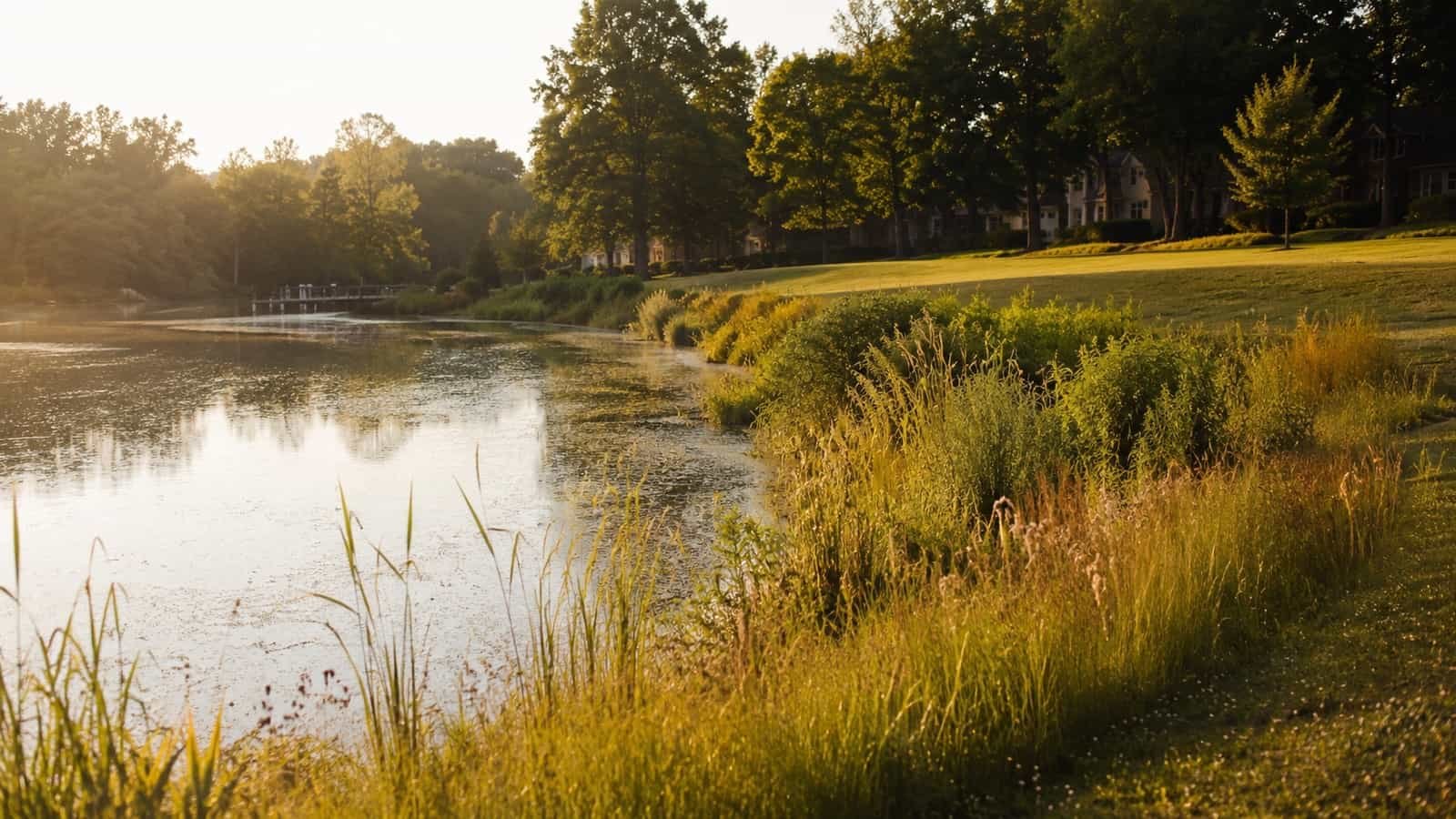
It usually starts with one resident counting geese. A dozen on the common, maybe more down by the retention pond. Then they count what the geese leave behind — and that's the email the board actually gets. By late June this isn't a passing nuisance. It's molting season, when adult Canada geese drop their flight feathers and spend several weeks grounded. They can't fly off to bother someone else's pond. Yours is the pond. They're staying.
A single Canada goose can produce a pound or more of droppings a day. Multiply that by a resident flock, by a holiday weekend, by every walking path and dock between the clubhouse and the water, and you understand why “the geese” climbs to the top of the agenda every single summer.
Why your pond looks like a goose resort
Geese aren't choosing your property at random. We built it for them, mostly by accident. Canada geese want four things: water, food, safety, and a clear line of sight. A typical community or commercial pond delivers all four — open water, tender mowed turf they can graze, and a manicured lawn running straight to the shoreline so they can spot a coyote or a loose dog coming from a hundred feet away.
That last part matters more than people expect. Geese are prey animals. They love short grass next to water because it's a buffet with a security system. Take away the sightline and you take away most of the appeal. That one idea — break the line of sight — is the entire strategy, and it's why most of the gadgets sold to “scare geese off” stop working in about a week.
First, the part that surprises everyone: you can't just remove them
Before anyone on the board orders a roundup, here's the rule that trips up a lot of well-meaning communities. Canada geese are protected under the federal Migratory Bird Treaty Act. You cannot legally harm them, relocate them, or destroy a nest or eggs on a whim — and that includes the year-round “resident” geese that never migrate anywhere. Population-control measures like egg addling or removal are sometimes permitted, but they generally require authorization from the U.S. Fish and Wildlife Service and coordination with the North Carolina Wildlife Resources Commission, often inside a specific seasonal window.
Translation for a board: the lawful, durable path is habitat modification — making the pond less attractive — not vigilante goose removal. That's good news, actually. The legal route and the route that actually works long term are the same route.
It's not just the mess
The droppings are the complaint, but they're also a water-quality problem. Goose waste loads the pond with nitrogen and phosphorus — the exact nutrients that fuel the summer algae blooms and odors your residents complain about next. A heavy resident flock and a green, smelly pond aren't two separate problems; they're the same problem feeding itself. Which is the other reason the real fix earns its keep: done right, it cuts the geese and filters the runoff at the same edge.
What actually works (ranked honestly)
Here's the menu, sorted by how well it holds up across a full season. Notice that the most effective option is also the lowest-maintenance one — it doesn't need batteries, a dog handler, or anyone remembering to move it on Tuesdays.
| Method | How it works | Effectiveness | Notes |
|---|---|---|---|
| Vegetated shoreline buffer | Removes the open sightlines geese rely on to spot predators | High (long-term) | The single most effective, lowest-maintenance fix |
| Habitat & grading changes | Stops mowed turf from running right to the water's edge | High | Pairs naturally with a buffer |
| Trained dogs / active hazing | Repeated harassment makes the site feel unsafe | Moderate | Labor that never ends; geese return when it stops |
| Decoys, flags, balloons, tape | Visual scare devices | Low | Geese habituate within days to weeks |
| Egg addling / population control | Slows flock growth over time | Moderate | Requires federal and state authorization |
| No-feeding policy & signage | Removes the easy food reward | Moderate | Only works if the whole community complies |
The pattern is hard to miss. The methods that change the place the geese are standing in work. The methods that try to startle a prey animal that lives happily on open golf courses and airport medians do not. Geese habituate to a plastic owl about as fast as your residents do.
The buffer playbook
A vegetated shoreline buffer is exactly what it sounds like: a band of taller native plants along the water's edge instead of mowed grass. It works because it does three jobs at once — it blocks the sightline geese depend on, it makes the walk from water to lawn feel unsafe to them, and it filters nutrient runoff before it feeds the algae you're also fighting. Here's what a buffer that actually deters geese looks like, versus a decorative strip that doesn't:
Tall enough to matter — generally 18 to 30 inches or more, so an adult goose can't comfortably see over it.
Wide enough to be a barrier, not a garnish — a few feet of planted edge, not a token row of plants.
Native and NC-appropriate — sedges, rushes, native grasses, and hardy perennials that establish in the Piedmont without babysitting.
Continuous — geese will find the one mowed gap and use it like a front door, so the weak point is usually the access path, not the plants.
There's a timing wrinkle worth knowing. The best window to establish a buffer in the Piedmont is the cooler shoulder seasons, when plants root in without summer heat stress. So the smart move right now, in the thick of goose season, is to plan and quote the buffer now and install it this fall — so next summer the geese show up, take one look at your shoreline, and keep flying.
If the flock’s already settled in for the molt, we can build a plan that pairs the lawful short-term tactics with the long-term shoreline fix. Request a quote or call us at (704) 450-1598.
What to skip
To save your reserve fund some grief: the low-effectiveness row is exactly where most communities waste money first. Decoys, flags, reflective tape, balloons, and the floating coyote that lasts right up until the geese notice it never moves. Hazing with trained dogs genuinely works while it's happening, but it's labor with no finish line — stop the harassment and the geese come right back. None of these change why the geese like your pond, so none of them last.
What to tell your residents
A goose problem is partly a people problem, and the board can defuse a lot of it with a short, friendly notice. Three messages do most of the work. First: please don’t feed the geese — bread and handouts are exactly what convinces a flock to move in and stay, and they’re bad for the birds besides. Second: please don’t chase or harass them yourselves — beyond being illegal to harm, a stressed goose guarding goslings is how people get hurt, and it doesn’t move the flock anyway. Third: here’s the plan and the timeline — residents are far more patient about a shoreline that looks a little shaggy for a season once they know it’s the fix, not neglect.
That last point is worth leaning on. A naturalized buffer looks different from a golf-course edge, and someone will call it “weeds” before they call it landscaping. Getting ahead of that with a sentence or two — this is an intentional native planting that keeps the geese off and the water cleaner — saves the board a second round of emails later.
A realistic timeline
Set expectations honestly, because geese don’t read service agreements. During the molt — roughly several weeks in mid-to-late summer — the resident flock is grounded, and tactics like hazing have limited payoff because the birds literally can’t leave. Once they can fly again, harassment and a less-welcoming shoreline start nudging them elsewhere. The buffer, planted in the cool season, is what changes the math for next year: the geese come back on their summer schedule, find a shoreline they can’t see over, and treat your pond as a fly-over instead of a home. This is a season-over-season fix, not an overnight one — which is exactly why starting the plan now, before the fall planting window, is the move.
How Clearwater helps
This is shoreline work, and shoreline work is what we do. We assess the pond and the way water, turf, and access combine to roll out the welcome mat, then design and establish a native buffer sized to actually block the sightline — not a decorative ribbon. Where population control is genuinely warranted, we help you go through the proper channels with the state and federal agencies instead of around them. The goal isn't a one-summer scare. It's a pond that stops being goose-friendly, permanently, while looking better and shedding fewer nutrients in the bargain.
Ready to make your pond a little less hospitable to geese — and a lot less of a board headache? Request a quote or call (704) 450-1598. We serve communities across the Charlotte Metro, Lake Norman, the Catawba Valley, and the Piedmont Triad.
-
U.S. Fish and Wildlife Service. “Migratory Bird Program: Managing Canada Geese.” fws.gov.
North Carolina Wildlife Resources Commission. “Canada Geese.” ncwildlife.gov.
The Humane Society of the United States. “Solving Problems with Canada Geese.” humanesociety.org.
Cornell Lab of Ornithology. “Canada Goose.” All About Birds. allaboutbirds.org.
NC State Extension. “Vegetated Riparian Buffers and Shoreline Plantings.” content.ces.ncsu.edu.