

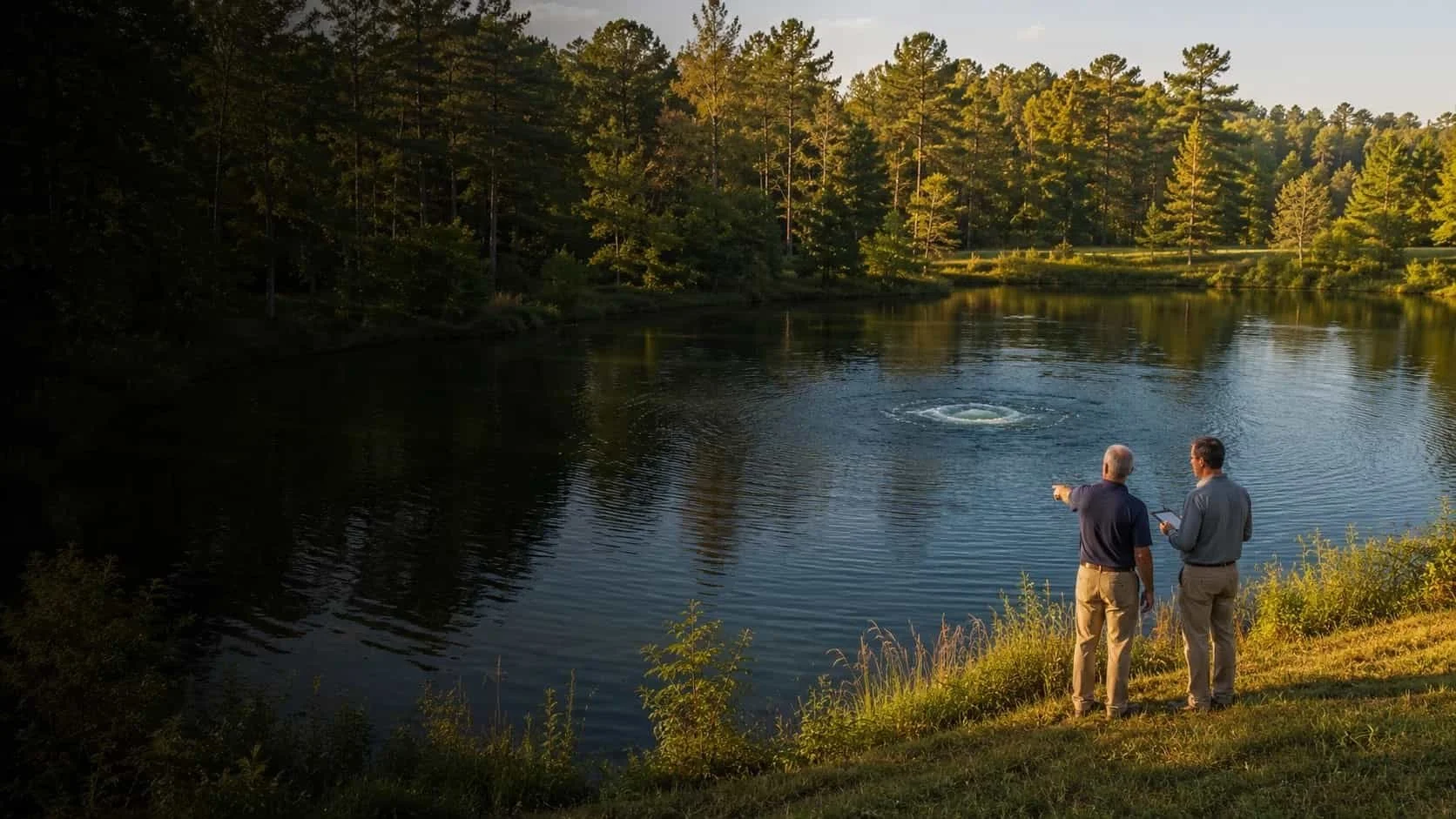
Pond & Lake Aeration Systems
A Pond Without Oxygen Is a Pond Holding Its Breath.
Pond Lake And Stormwater Management Services
We size the system, run the power, install the equipment, and commission it — then we keep it running. Most Piedmont ponds are under-aerated for their volume. We fix that with math first, equipment second. Aeration system design, sizing, and installation for ponds and lakes across the NC Piedmont — diffused, surface, and hybrid systems engineered around your specific water body's depth, volume, and goals.
Stratification Is What Kills Fish on Hot Nights. Aeration Stops Stratification.
Aeration is the single most under-deployed and most cost-effective intervention available to pond and lake owners. Dissolved oxygen drives fish health, slows algae growth, prevents the bottom-water anoxic conditions that release sediment-bound phosphorus, and extends the functional life of a water body by decades. The math behind it is unambiguous. The implementation, less so. Most aeration systems installed by general contractors, landscape companies, or kit-purchased online are undersized for the water body they're meant to aerate — usually by 30% to 60%.
There are two primary aeration approaches and they do different jobs. Diffused aeration uses a compressor on shore to push air through tubing to weighted diffusers on the pond bottom, releasing fine bubbles that rise through the water column. The bubbles themselves transfer almost no oxygen — what does the work is the vertical water movement they create, breaking stratification and mixing surface oxygen down into the depths. Diffused aeration is right for most ponds deeper than 6 feet. Surface aeration uses a floating motor with an impeller or paddlewheel to splash water through the air. Lower capital cost, higher operating cost per unit oxygen, best for shallow ponds where bottom-up diffused systems can't generate enough vertical movement to be effective.
Aeration on lakes follows the same equipment and same install process, scaled up. A 5-acre HOA lake needs more diffusers and a larger compressor than a half-acre pond, but the engineering framework is identical: calculate pond volume, calculate stratification depth, size the system to break stratification under summer conditions, run electrical service to the shore equipment, anchor the diffusers, commission and verify. We work both pond and lake aeration as one discipline.
Dissolved oxygen is the foundation of pond and lake health. Fish, water clarity, sediment chemistry — all of it rides on DO.
Stratification traps nutrients and anoxic water at the bottom. Aeration breaks stratification and keeps the whole water column working.
Diffused aeration works from the bottom up. Fine bubbles rise and pull oxygen-rich surface water down through the whole column.
Pond depth, volume, and shape determine system size. Most off-the-shelf installs are 30–60% undersized for the water they're meant to aerate.
Aeration is a year-round system, not a summer accessory. Winter operation prevents ice cap, fall turnover protects fish, spring startup heads off the bloom.
Electrical service at the shore is the most-skipped install consideration. Plan the power line before you plan the diffuser layout.
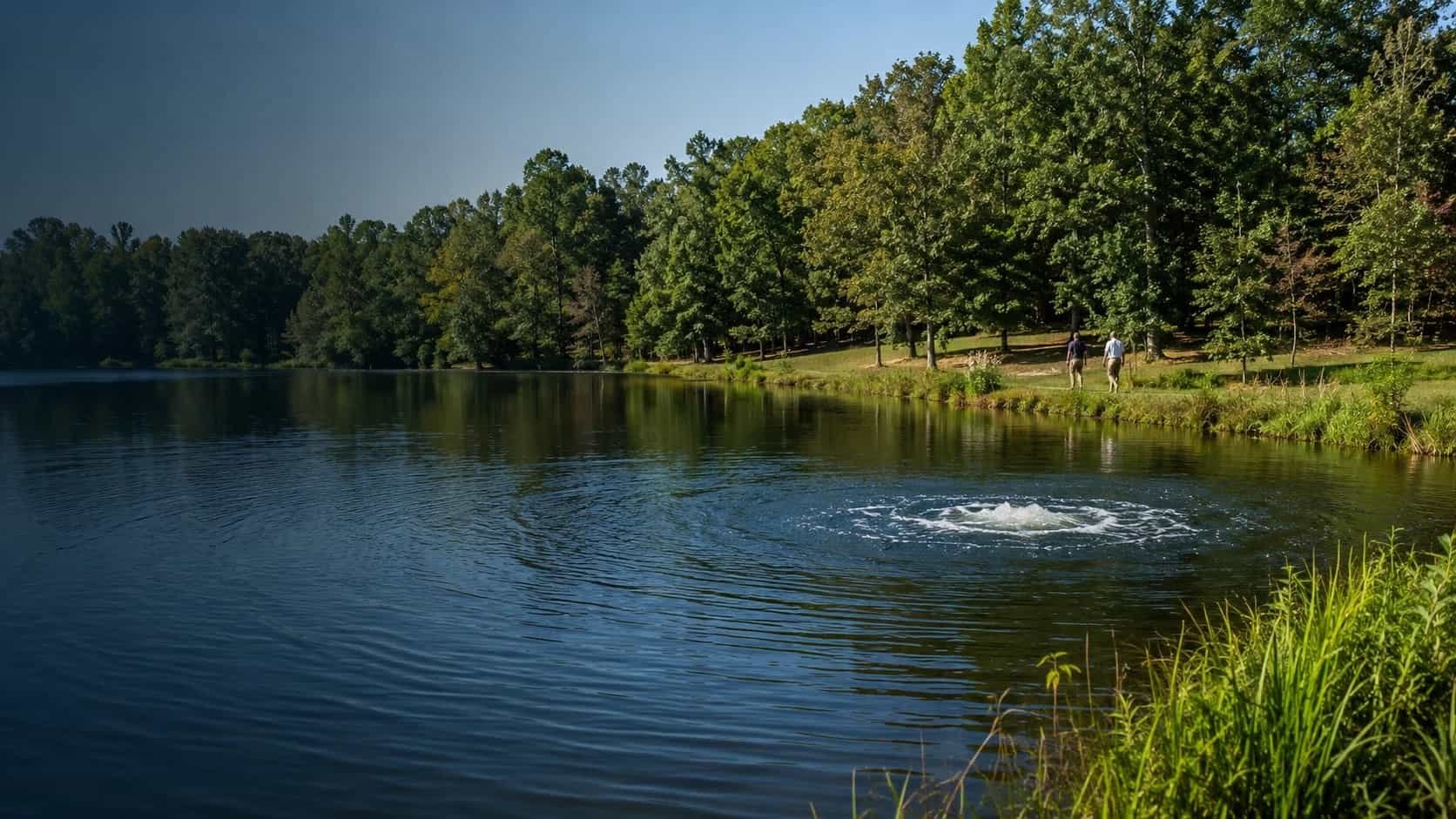
Pond and Lake Aeration Systems Services
Aeration installs span the Piedmont. We install diffused and surface aeration on HOA community ponds, private estate ponds, agricultural ponds, golf course features, commercial property ponds, and the larger HOA and private lakes throughout Iredell, Mecklenburg, Cabarrus, Rowan, Forsyth, Guilford, and Catawba counties. The equipment is the same; the scale changes.
Lake Norman shoreline properties with private cove ponds, multi-acre HOA community lakes, half-acre backyard ponds, and 5-acre farm ponds all use the same diffused aeration technology — sized correctly to volume and depth. We design, install, commission, and service the systems we install. Same crew, same engineering framework, from the smallest pond on a residential lot to multi-acre lakes.
Diffused Aeration Systems
Compressor-driven systems pushing air through tubing to weighted diffusers on the pond or lake bottom. The right approach for water bodies deeper than ~6 feet — it works the entire water column, not just the surface.
- Diffused aeration design and sizing
- Compressor selection (rotary vane, rocking piston, linear)
- Diffuser plate, disk, and membrane selection
- Weighted self-sinking tubing
- Multi-diffuser layouts for larger water bodies
- Sub-surface coverage modeling
Surface Aeration & Floating Systems
Floating motor-driven systems that splash water through the air — paddlewheels, impellers, and fountain-style aerators. Right for shallow ponds where diffused aeration can't generate enough vertical movement to be effective.
- Floating surface aerator selection
- Paddlewheel aerator sizing
- Fountain aerators with aeration utility
- Mooring and anchor system design
- Electrical service to floating equipment
- Backup-power and redundancy options
Aeration Design & System Sizing
The math behind the equipment. Pond volume, stratification depth, oxygen demand, climate conditions, fish load — all factor into sizing the system correctly. Most failures of installed aeration trace back to design errors at this stage.
- Pond volume and bathymetry assessment
- Stratification analysis
- Oxygen demand calculation
- System sizing recommendations
- Equipment specification documents
- Multi-option comparison for HOA approval
Aeration System Installation
Running power to the pond, building the compressor shelter, anchoring the diffusers, installing tubing, and commissioning the system under operating conditions. The install is where good designs become working systems — or don't.
- Electrical service coordination
- Compressor cabinet or shelter construction
- Tubing layout and weighted line installation
- Diffuser placement and anchoring
- System commissioning and testing
- Owner orientation and operating instruction
Hybrid & Integrated Aeration
When aeration combines with other systems — fountain-style with aeration utility, aeration integrated with chemical management for nutrient control, or backup-redundant systems for high-value fish populations.
- Fountain-and-aeration hybrid systems
- Aeration integrated with nutrient management
- Redundant compressor design for critical ponds
- Solar-powered aeration options
- Aeration as part of full management programs
- Specialty applications (koi ponds, aquaculture)

Ponds We Know by Name.
We plan service around Piedmont realities — Carolina clay, spring runoff, summer algae pressure, nutrient loading from managed landscapes, and stormwater obligations tied to local municipalities — across every property in the portfolio. Proudly serving Charlotte, Concord, Mooresville, Statesville, Hickory, Salisbury, Winston-Salem, High Point, Greensboro, Lake Norman, the Piedmont Triad, and Catawba Valley.

Pond and Lake Aeration Systems Services FAQ
Why does my pond need aeration?
Aeration drives dissolved oxygen, breaks summer stratification, prevents the anoxic bottom conditions that release sediment-bound nutrients and feed algae blooms, supports fish populations, and extends the functional life of the pond by decades. The strongest case for aeration is preventive — a pond with consistent aeration has fewer algae blooms, fewer fish kills, less muck accumulation, and less expensive management overall.
What's the difference between diffused and surface aeration?
Diffused aeration uses a compressor on shore to push air through tubing to weighted diffusers on the pond bottom. Fine bubbles rise and create vertical water movement that mixes oxygen-rich surface water down through the entire water column. Best for ponds deeper than ~6 feet. Surface aeration uses a floating motor with an impeller or paddlewheel to splash water into the air at the surface. Lower capital cost but higher operating cost per unit of oxygen transferred, and works only the upper portion of the water column. Best for shallow ponds where diffused systems can't generate enough vertical movement to be effective.
How much aeration does my pond need?
It depends on volume, depth, stratification depth, climate, and fish load. As a rough benchmark, diffused aeration typically requires 1–3 cubic feet per minute (CFM) of air output per surface acre of pond, with diffuser placement at the deepest points. A 1-acre pond with 10-foot depth and a fish population needs a meaningfully larger system than a half-acre shallow pond. We size every system off site-specific measurements, not catalog assumptions.
Can aeration prevent algae blooms?
Aeration is one of the strongest preventive tools for algae management. Breaking stratification disrupts the chemistry that feeds blue-green algae, increases dissolved oxygen at depth, and reduces the release of sediment-bound phosphorus that drives summer blooms. Aeration alone won't fix a pond with heavy ongoing nutrient input from the watershed — but combined with nutrient management, it's significantly more effective than either approach alone.
Will aeration save my fish during summer turnover events?
Properly sized aeration significantly reduces — and in many cases eliminates — the risk of turnover-related fish kills. Stratified ponds develop oxygen-depleted bottom layers that, when they mix with surface water during a sudden weather event, can crash dissolved oxygen across the entire water body. Aerated ponds don't stratify the same way, which means the oxygen crash mechanism that drives most warm-weather fish kills doesn't have the same setup conditions.
How much does pond aeration cost?
Equipment and installation for a typical 1-acre HOA or private pond diffused aeration system runs $2,500–$6,000 depending on depth, compressor specification, diffuser count, and electrical work required. Larger lakes scale up — multi-diffuser lake systems often run $8,000–$25,000+. Surface aeration is often less expensive upfront but more expensive to operate. Every quote follows a site assessment.
Does aeration work in winter?
Yes — and it should run year-round in most installations. Winter aeration prevents ice cap formation that traps gases and depletes oxygen under the ice, supports fish through cold months, and primes the pond for spring conditions. The one caveat: diffuser placement may shift to a shallower configuration in winter so aeration doesn't pull cold bottom water to the surface and cool the entire pond unnecessarily. We commission systems for both summer and winter operation.
Do I need electrical service to install aeration?
Yes, in almost every case. Diffused aeration requires 120V or 240V power to the compressor location on shore. Surface aeration requires power to a floating unit, with submersible cable rated for the installation. Most ponds don't have existing electrical service to the shore, and the run from the nearest panel to the pond is often the largest single line item in an aeration project. We coordinate with licensed electricians on the electrical scope before installation.
Will aeration help with pond smell or muck?
Yes, often significantly. Pond smell is typically caused by anaerobic bacteria at the sediment surface, producing hydrogen sulfide and other byproducts. Aeration introduces oxygen to the bottom of the pond, shifting the bacterial community to aerobic processes that break down organic matter without producing the same odor compounds. Muck reduction follows the same logic — aerobic decomposition reduces accumulated sediment slowly but continuously.
Do you install aeration on lakes or just ponds?
Both. The equipment is the same — same compressors, same diffuser technology, same install process. Lakes are larger, so they need more diffusers, larger compressors, more tubing, and proportionally larger electrical service. The engineering framework is identical. We've installed aeration from sub-acre private ponds up through multi-acre HOA community lakes.
-
NCDA&CS Pesticide Applicator License — Category N (Aquatic Pest Control)
Trained in NCSU SCM Inspection & Maintenance protocols
EPA-registered aquatic herbicide and algaecide application
NC DEQ Stormwater Control Measure (SCM) maintenance compliance
-
NC DEQ Stormwater Design Manual: https://www.deq.nc.gov/
NC DEQ SCM O&M: https://www.deq.nc.gov/
EPA NPDES: https://www.epa.gov/npdes
NC State Extension Pond Guide: https://content.ces.ncsu.edu/pond-management-guide
NC Wildlife Resources Commission: https://www.ncwildlife.org
NALMS (North American Lake Management Society): https://www.nalms.org
Duke Energy Lake Norman drawdown schedule: https://lakes.duke-energy.com/