

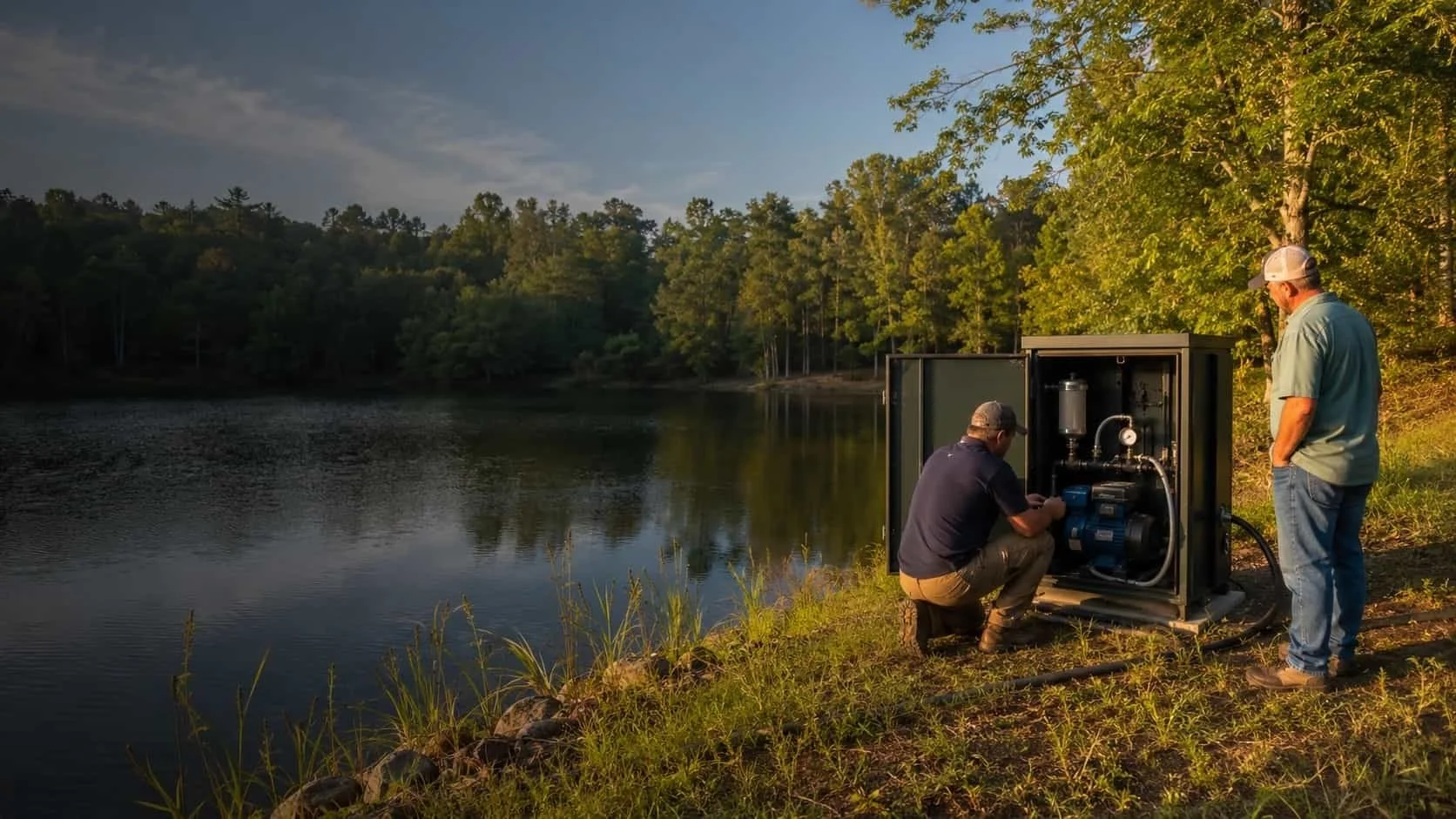
Aeration Repair and Maintenance
Aerators Don't Fix Themselves. We Wish They Did.
Pond Lake And Stormwater Management Services
Aeration system repair, compressor service, diffuser cleaning, and seasonal maintenance for pond and lake aerators across the central North Carolina — most brands, most ages, most failure modes. We diagnose first, repair second. Most aeration failures are diaphragms, filters, or diffusers — predictable parts with predictable service lives. Catching them before they cascade is the whole job.
Seasonal Service Costs Less Than Replacing the Compressor.
Aeration systems fail predictably. Compressor diaphragms wear out — typically every one to three years of continuous operation depending on the unit. Air filters clog with bugs, pollen, and dust until airflow drops below the diffusers' operating threshold. Diffuser membranes scale up or biofoul, restricting bubble production without producing obvious surface symptoms. Tubing develops cracks, especially at fittings or where animals have chewed it. Surface aerators have moving parts — motors, impellers, bearings — that wear and seize. GFI breakers trip when moisture finds the wrong path. None of this is mysterious. All of it is fixable.
What separates aeration systems that last 15 years from systems that fail at year four is whether someone is paying attention to the predictable parts at predictable intervals. Diaphragm and filter replacement on a typical pond compressor is a 30-minute service visit done once a year. Diffuser cleaning happens every two to three years. Tubing inspection happens at every visit. The compressor cabinet stays clean and ventilated. The electrical service stays dry and grounded. These are the differences between a 15-year system and an emergency replacement.
We work on aeration systems we installed and aeration systems we didn't. Most major brands — Vertex, Airmax, Kasco, Easy Pro, Hiblow, Becker, Gast, Thomas, and others — use compressor and diffuser components that we stock, service, or source quickly. When something is beyond economical repair, we say so. When seasonal service will keep a 10-year-old system running for another decade, we say that too. The goal is the same in either direction: keep aeration running so the pond and the fish keep working.
Compressor diaphragms have a service life — typically one to three years of continuous operation. Replace before failure, not after.
Air filters clog with pollen, dust, and insects until airflow drops below the diffusers' operating threshold. Cheap part, large consequence.
Clogged diffusers reduce bubble output silently. The compressor still runs. The pond still has surface ripple. The aeration is doing 30% of its job.
Surface aerators have motors, impellers, and bearings. They fail differently than compressors — and on a different timeline.
GFI breakers trip on moisture, not on bad outlets. A repeatedly tripping GFI usually means water has found the wrong path.
Winterization matters. Frozen condensate cracks tubing and ruins compressors that ran fine all summer.
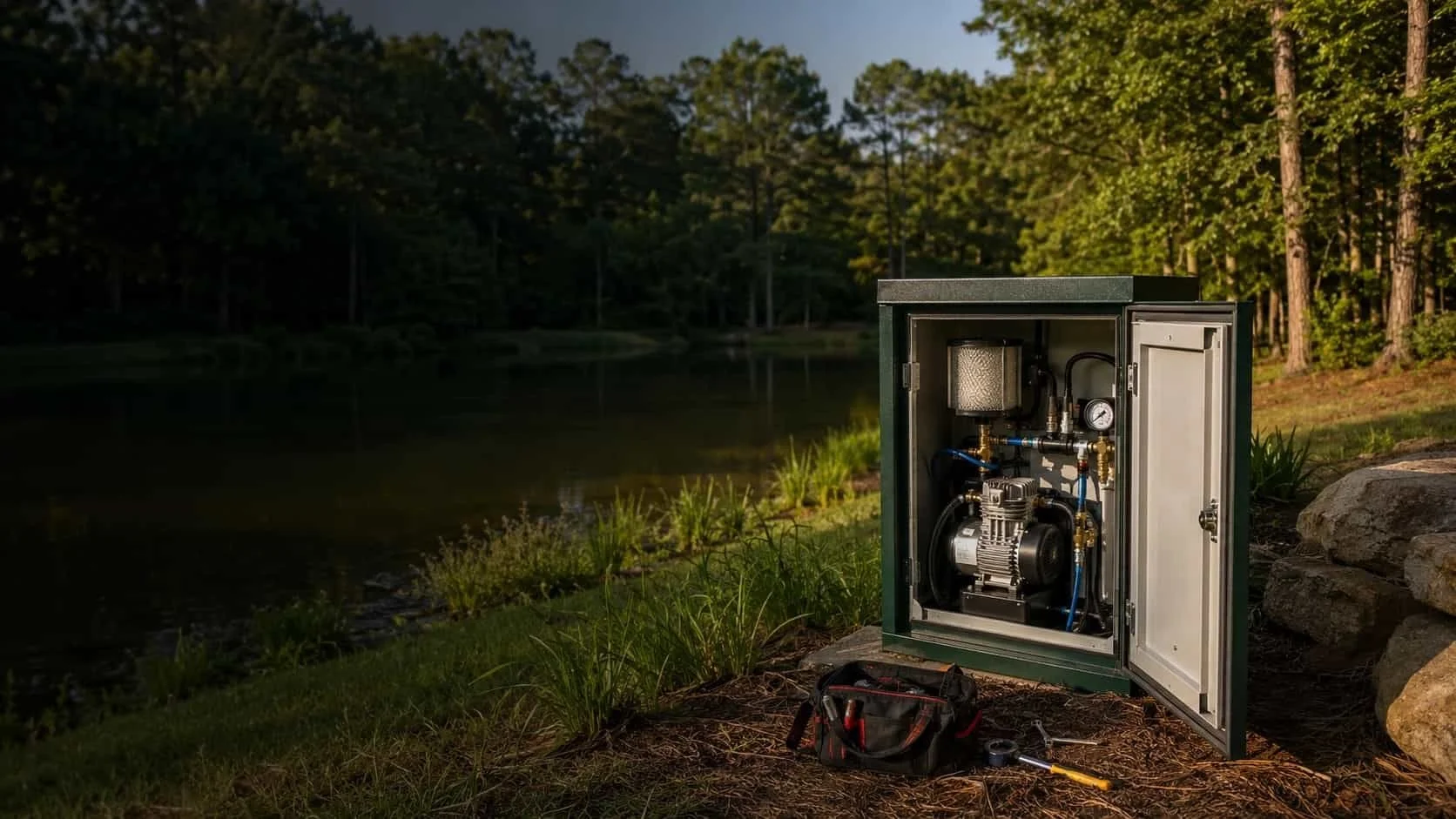
Aeration System Repair & Maintenance Services
Aeration service runs across the same geography as our installation work. We service aerators on HOA community ponds, private estate ponds, commercial property ponds, golf course features, agricultural ponds, and the larger HOA and private lakes throughout Iredell, Mecklenburg, Cabarrus, Rowan, Forsyth, Guilford, and Catawba counties. Both systems we installed and systems we didn't.
Annual service programs are most common in HOA portfolios and commercial property contexts where the property manager is overseeing multiple aerators across different sites. Single-property residential and estate owners often start with a diagnostic visit when something stops working, then move to scheduled service after the first repair. Either path is fine. The goal is the same: keep the equipment running through its full service life, not just until the next failure.
Compressor Service & Repair
Diaphragm replacement, air filter service, intake screen cleaning, valve check, electrical inspection, and full compressor diagnostic. Most aeration failures start at the compressor.
- Diaphragm and rebuild kit replacement
- Air filter service and replacement
- Intake screen and prefilter cleaning
- Valve and reed inspection
- Compressor cabinet ventilation check
- Electrical and capacitor inspection
Diffuser Cleaning & Replacement
Diffuser membranes scale, biofoul, and clog over time. Cleaning restores bubble output; replacement is the right call when membranes have hardened beyond cleaning. Either way, the diffusers come up, get inspected, and go back down working.
- Diffuser retrieval and inspection
- Membrane cleaning (acid wash, mechanical)
- Diffuser plate, disk, and tube replacement
- Weighted base inspection
- Tubing connection check
- Re-anchoring and depth verification
Tubing & Air Line Repair
Self-sinking weighted tubing develops cracks at fittings, gets chewed by muskrats, or pulls loose at connections. Line repair is on the diagnostic list for every system that's losing pressure.
- Pressure testing and leak detection
- Line inspection from shore to diffuser
- Fitting replacement and repair
- Tubing splicing and replacement
- Cable protection and rodent guards
- Line re-routing if needed
Surface Aerator & Floating Equipment
Floating aerators, paddlewheels, and fountain-aerators have moving parts that wear differently than diffused systems. Motor rebuilds, impeller replacement, bearing service, and floatation system repair.
- Motor diagnostic and rebuild
- Impeller and paddlewheel replacement
- Bearing and seal service
- Float and anchoring system repair
- Submersible cable inspection
- Spray pattern and balance adjustment
Annual Service Programs
Scheduled annual visits with full system inspection, parts replacement at appropriate intervals, and seasonal startup and shutdown work. Costs less than two emergency calls. Always.
- Scheduled annual or semi-annual visits
- Replacement parts at appropriate intervals
- Spring startup and commissioning
- Fall service and winterization
- Documented service history
- Priority scheduling for emergency repairs

Waterbodies We Know by Name.
We plan service around Piedmont realities — Carolina clay, spring runoff, summer algae pressure, nutrient loading from managed landscapes, and stormwater obligations tied to local municipalities — across every property in the portfolio. Proudly serving Charlotte, Concord, Mooresville, Statesville, Hickory, Salisbury, Winston-Salem, High Point, Greensboro, Lake Norman, the Piedmont Triad, and Catawba Valley.

Aeration System Repair & Maintenance Services
How do I know if my aerator is failing?
Common signs include reduced or missing surface boil pattern, compressor running hotter or louder than usual, GFI breaker tripping, condensate accumulation around the compressor cabinet, visible algae returning after a season of clear water, or fish behaving differently (gulping at the surface in the morning). If you're not sure whether something's wrong, a diagnostic visit costs much less than waiting until the system fails completely during a summer heat wave.
How often should I service my aerator?
Annual service is the right baseline for almost all systems. That typically includes diaphragm replacement (every 1–3 years depending on usage and brand), air filter replacement, intake screen cleaning, full system inspection, and a pressure test of the tubing. Some installations — high-runtime systems, harsh environments, or systems with prior issues — benefit from semi-annual service. We recommend cadence based on the specific system and history.
How long do aerator diaphragms last?
Typically one to three years of continuous operation, depending on compressor brand, model, runtime, and environmental conditions. Higher-quality diaphragms (Hiblow, certain Gast models) can run longer; budget compressors fail faster. Diaphragm failure is a wear-out mode, not a defect — it's expected and planned for. The cost of a diaphragm rebuild kit is a fraction of replacing the whole compressor, which is what happens when a failed diaphragm runs long enough to damage the rest of the unit.
Why does my GFI keep tripping?
Almost always moisture finding a path it shouldn't. Possibilities include water in the compressor cabinet, condensate accumulation in the tubing, a deteriorated electrical connection, damaged submersible cable on a surface aerator, or moisture wicking into the receptacle itself. A persistently tripping GFI is a safety signal worth diagnosing immediately — and it's protecting equipment and people from electrical hazards while it does so.
What does annual aerator service include?
A typical annual service includes: compressor diaphragm condition check (replacement if at end of service life), air filter replacement, intake screen and prefilter cleaning, valve inspection, electrical and capacitor inspection, pressure test of all tubing, diffuser inspection (full pull and clean every 2–3 years), check of all mounts and anchors, GFI and outlet test, cabinet ventilation and cleanliness check, and a written report with any deficiencies noted.
Can you repair any brand of aerator?
Most major brands, yes. Vertex, Airmax, Kasco, Easy Pro, Hiblow, Becker, Gast, Thomas, Stratus, and the components used by most regional aeration suppliers — we service all of these regularly. For older or very obscure systems, we may need to source parts, in which case we'll quote based on availability. We service systems we installed and systems we didn't.
How much does aerator repair cost?
Annual service for a typical pond aeration system runs $200–$450 depending on number of diffusers, system complexity, and what's needed during the visit. Diaphragm rebuild kits typically run $150–$400 for parts. Diffuser cleaning or replacement varies by configuration. Compressor replacement (when the unit is beyond economical repair) is project-based. Emergency visits carry a slightly higher rate than scheduled service. We quote based on diagnosis, not on assumption.
Should I replace my old aerator or repair it?
Depends on age, condition, and parts cost. As a rough guideline: if the compressor is less than 7 years old and the issue is diaphragms, filters, or tubing — repair. If the compressor is 10+ years old, the housing is showing significant wear, and the diaphragms have already been replaced multiple times — replacement is often more cost-effective long-term. We give an honest assessment at every diagnostic visit, with both options priced when both are reasonable.
Do you do emergency aerator repair?
Yes, especially during summer when an aerator failure carries real fish-kill risk. We prioritize emergency calls and aim for same-week response on most issues. Property managers and HOAs with multiple ponds under annual service programs receive priority scheduling during peak season. If your aerator is down and you have a stocked pond, call as soon as you notice.
Do you service surface aerators and paddlewheels?
Yes. Surface aerators have different service needs than diffused systems — motor diagnostics, impeller and bearing replacement, float and anchor work, submersible cable inspection — but we work both system types. Most properties end up with a mix of equipment over time, and consolidating service to one provider simplifies maintenance scheduling.
-
NCDA&CS Pesticide Applicator License — Category N (Aquatic Pest Control)
Trained in NCSU SCM Inspection & Maintenance protocols
EPA-registered aquatic herbicide and algaecide application
NC DEQ Stormwater Control Measure (SCM) maintenance compliance
-
NC DEQ Stormwater Design Manual: https://www.deq.nc.gov/
NC DEQ SCM O&M: https://www.deq.nc.gov/
EPA NPDES: https://www.epa.gov/npdes
NC State Extension Pond Guide: https://content.ces.ncsu.edu/pond-management-guide
NC Wildlife Resources Commission: https://www.ncwildlife.org
NALMS (North American Lake Management Society): https://www.nalms.org
Duke Energy Lake Norman drawdown schedule: https://lakes.duke-energy.com/