

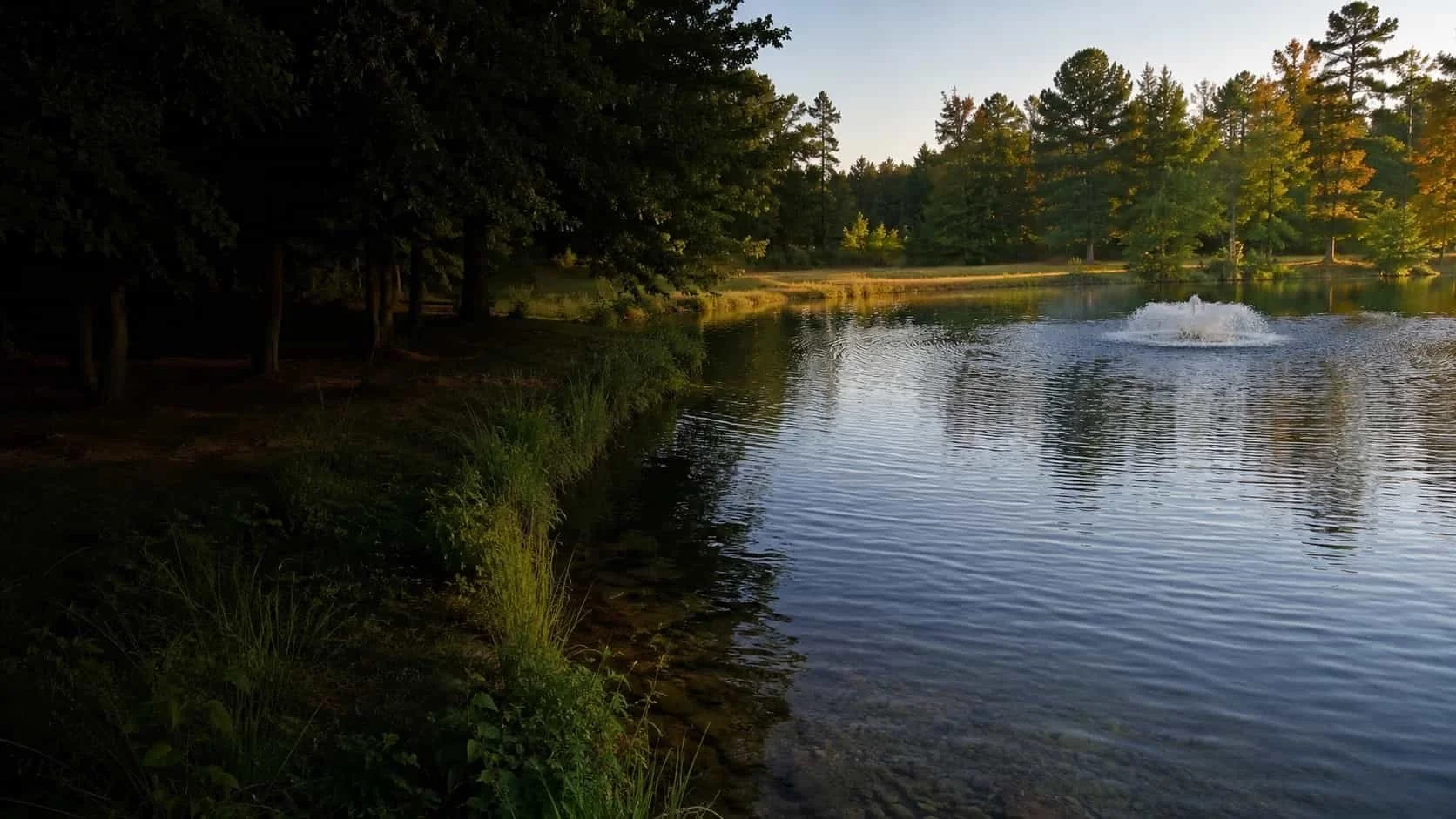
Pond Management Services
Ponds Don't Have to Be on a Map to Need Us.
Pond Lake And Stormwater Management Services
Pond management and maintenance for HOA communities, commercial properties, private estates, and agricultural sites across the NC Piedmont — water quality, aeration, algae and weed control, sediment, and the things ponds need that most owners never think about until they have to. We manage ponds across the Piedmont before the pond starts managing your weekend — testing, treatment, aeration, sediment, fish habitat, and the records to back it all up.
Ponds Don't Stay Ponds Without Help.
A pond is not a small lake. The dynamics are different. With less water volume to buffer nutrient loading, ponds shift from clear to green faster than lakes do — and crash faster when something goes wrong. With smaller surface area relative to surrounding watershed, ponds absorb a disproportionate load of fertilizer runoff, organic matter, and sediment from the property around them. Stratification and turnover events that pass quietly on a 1,000-acre lake can trigger fish kills on a 1-acre pond. Aeration that's optional on a deep lake is often essential on a pond of comparable depth.
Across the Piedmont, the pond-specific pressures are predictable. Heavy red clay soils contribute turbidity through every wet season. Surrounding lawns, agricultural drainage, and waterfowl all stack nutrients into a water body that can't dilute them. Summer heat in shallow water drives both algae and weed growth at rates that small ponds simply can't outpace without help. Sediment accumulation — silt washing in from the watershed plus organic matter settling from within the pond — fills the deeper sections steadily over years, and once it crosses a threshold the pond behaves like a much shallower pond, with everything that implies.
We work with HOAs, private property owners, golf courses, agricultural operations, and commercial property managers to build pond management programs around the specific pond — its size, depth, history, watershed, fish population, and what the owner wants it to do. Maintenance gets folded in. Annual programs cost less than emergency response, every time, without exception.
A pond stratifies in summer and turns over in fall. On a small pond that turnover is the moment fish kills happen if oxygen is short.
Every pond is filling in. Managed ponds fill in slower — sometimes 3–4x slower. The math compounds over decades.
Pond fish populations are stable until they're not. One bad summer can wipe out a decade of stocking.
Most ponds in the Piedmont are under-aerated for their volume. Aeration ROI is the most underrated math in pond ownership.
Small pond + big watershed = nutrient overload every spring. Address the source or treat the symptom forever.
Annual programs cost less than emergency treatment. Almost always. The math doesn't change because the pond is small.
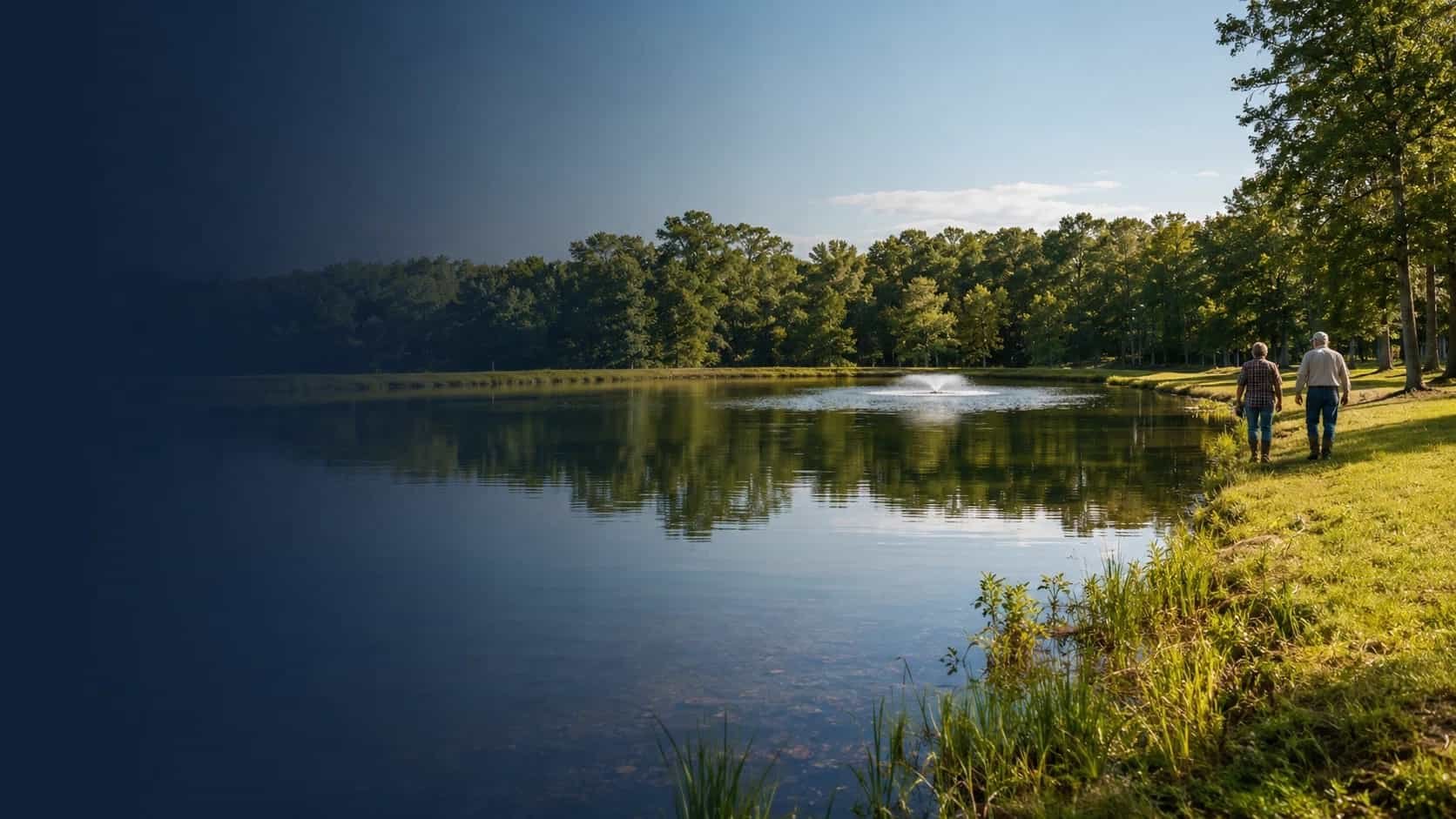
Pond Management Services
The majority of our pond work happens away from Lake Norman — on HOA community ponds, private estate ponds, agricultural ponds, golf course water features, and commercial property ponds throughout the Piedmont. Iredell, Mecklenburg, Cabarrus, Rowan, Forsyth, Guilford, and Catawba counties all have hundreds of these ponds scattered across residential developments, working farms, business parks, and private acreage.
The pressures are consistent across the region — heavy clay soils, summer heat, nutrient runoff from surrounding development or agriculture, watershed loading from upland drainage. The specific issues vary: a backyard pond on a 5-acre estate has different priorities than a 3-acre HOA pond with a board reporting requirement, which has different priorities than a 1-acre farm pond stocked for recreational fishing. We scope every pond individually.
Water Quality & Nutrient Management
Testing, monitoring, and treatment for what's actually in the water column — and what shouldn't be. Ponds are less forgiving than lakes on water quality drift.
- Water quality testing (DO, pH, ammonia, nutrients)
- Nutrient load assessment
- Phosphorus binding and clarification
- Sediment and turbidity diagnostics
- Lab analysis coordination
- Spring and fall baseline testing
Algae & Aquatic Weed Control
Licensed treatment for filamentous mats, planktonic blooms, cattails, lily pads, and the invasive species that take over small water bodies fastest.
- Filamentous algae ("pond scum") treatment
- Planktonic algae and blue-green algae control
- Cattail and emergent vegetation management
- Lily pad reduction and removal
- Submersed weed control
- Licensed aquatic herbicide application
Aeration, Oxygen & Fish Habitat
Dissolved oxygen is the single largest driver of pond health. Most Piedmont ponds are under-aerated for their volume and depth — and pay for it during summer turnover.
- Aeration system evaluation and sizing
- Diffused and surface aeration design
- Aeration installation and seasonal service
- Fish habitat and structure
- Fish stocking coordination
- Winter and summer oxygen monitoring
Sediment, Muck & Bank Care
Sediment accumulation is the slowest-moving threat to a pond, and the one most owners ignore. Bank monitoring catches erosion before it costs real money.
- Sediment depth surveys
- Beneficial bacteria and muck reduction
- Bottom-out and dredging coordination
- Bank erosion documentation
- Riprap and bioengineered repair
- Native shoreline buffer planting
Annual Pond Management Programs
Scheduled visits, written service reports, and a treatment calendar built around your pond's history, watershed, and the season ahead.
- Scheduled site visits (4–6 week cadence in season)
- Written service reports
- Photo documentation
- HOA board and owner reporting
- Regulatory documentation support
- Custom seasonal treatment calendars

Ponds We Know by Name.
We plan service around Piedmont realities — Carolina clay, spring runoff, summer algae pressure, nutrient loading from managed landscapes, and stormwater obligations tied to local municipalities — across every property in the portfolio. Proudly serving Charlotte, Concord, Mooresville, Statesville, Hickory, Salisbury, Winston-Salem, High Point, Greensboro, Lake Norman, the Piedmont Triad, and Catawba Valley.

Pond Management Services FAQ
What does a pond management program include?
A typical program includes scheduled site visits, water quality monitoring, seasonal algae and weed treatment, aeration evaluation, written service reports, and a management plan that adjusts based on what we find. Specifics depend on the pond's size, depth, fish population, watershed conditions, and what the owner wants the pond to do — not a fixed package.
How often does a pond need professional service?
Most NC Piedmont ponds benefit from visits every four to six weeks during the growing season — roughly April through October — with lighter monitoring through winter. Ponds with active fish populations, significant algae history, or HOA reporting obligations often need tighter scheduling during peak summer months.
Why is my pond turning green every summer?
Primarily nutrient loading from the surrounding watershed — lawn fertilizers, organic matter, stormwater runoff, waterfowl, and decomposing vegetation. Summer heat accelerates algae growth significantly. Small ponds turn green faster than large lakes because they have less water volume to dilute incoming nutrients. The pattern repeats every year because the underlying conditions haven't changed.
Can a pond be too small to manage professionally?
Almost never. Backyard ponds under a quarter-acre still benefit from licensed treatment, proper aeration sizing, and species-appropriate weed control. Some services scale down — a small pond doesn't need quarterly water quality lab work — but the diagnostic framework and treatment quality is the same. We work ponds from under half an acre to multi-acre HOA community ponds.
What's the difference between pond management and pond maintenance?
Maintenance is largely reactive — clearing debris, responding to visible problems, doing what's needed when it shows up. Management is proactive — monitoring water quality before problems surface, treating conditions at early stages, and planning around seasonal patterns. Most pond owners start with maintenance and shift to management after their first major algae bloom, fish kill, or weed takeover.
How long does a pond last?
Indefinitely with management. Ponds fill in over time as sediment accumulates, but managed ponds fill in 3–4x slower than unmanaged ponds. Sediment is removable. Aeration and bottom care extend pond life by decades. The ponds that need full dredging or reconstruction are almost always ponds that went 20+ years without active management.
Do you handle fish stocking and fish kill response?
Yes — fish stocking coordination is part of the habitat side of pond management. We work with regional hatcheries and design stocking around the pond's volume, existing population, and what the owner wants (bass/bluegill recreational fishery, ornamental, control of mosquito larvae, etc.). On fish kill events, we respond quickly to diagnose cause, document for the owner, and prevent recurrence — most pond fish kills trace to oxygen depletion during turnover, treatable algae conditions, or stocking density issues.
Will pond treatment hurt my fish?
Properly applied treatments do not harm fish populations. The risk during algae or weed treatment isn't direct toxicity — it's rapid vegetation decomposition consuming dissolved oxygen as treated organisms die off. In small ponds with dense growth, that oxygen drop can stress fish. We phase treatment specifically around this risk on every pond with established fish.
How much does pond management cost in NC?
It varies by pond size, condition, treatment complexity, and service frequency. Small to mid-size HOA and private ponds under an annual program typically run $200–$500 per visit. Larger or more complex ponds run higher. Every program is scoped after an on-site assessment.
Do you serve ponds outside Lake Norman?
Yes — the majority of our pond work is on HOA, commercial, and private ponds away from the major lakes. We work throughout Iredell, Mecklenburg, Cabarrus, Rowan, Forsyth, Guilford, and Catawba counties. Farm ponds, golf course water features, retention ponds, and private estate ponds across the Piedmont.
-
NCDA&CS Pesticide Applicator License — Category N (Aquatic Pest Control)
Trained in NCSU SCM Inspection & Maintenance protocols
EPA-registered aquatic herbicide and algaecide application
NC DEQ Stormwater Control Measure (SCM) maintenance compliance
-
NC DEQ Stormwater Design Manual: https://www.deq.nc.gov/
NC DEQ SCM O&M: https://www.deq.nc.gov/
EPA NPDES: https://www.epa.gov/npdes
NC State Extension Pond Guide: https://content.ces.ncsu.edu/pond-management-guide
NC Wildlife Resources Commission: https://www.ncwildlife.org
NALMS (North American Lake Management Society): https://www.nalms.org
Duke Energy Lake Norman drawdown schedule: https://lakes.duke-energy.com/