

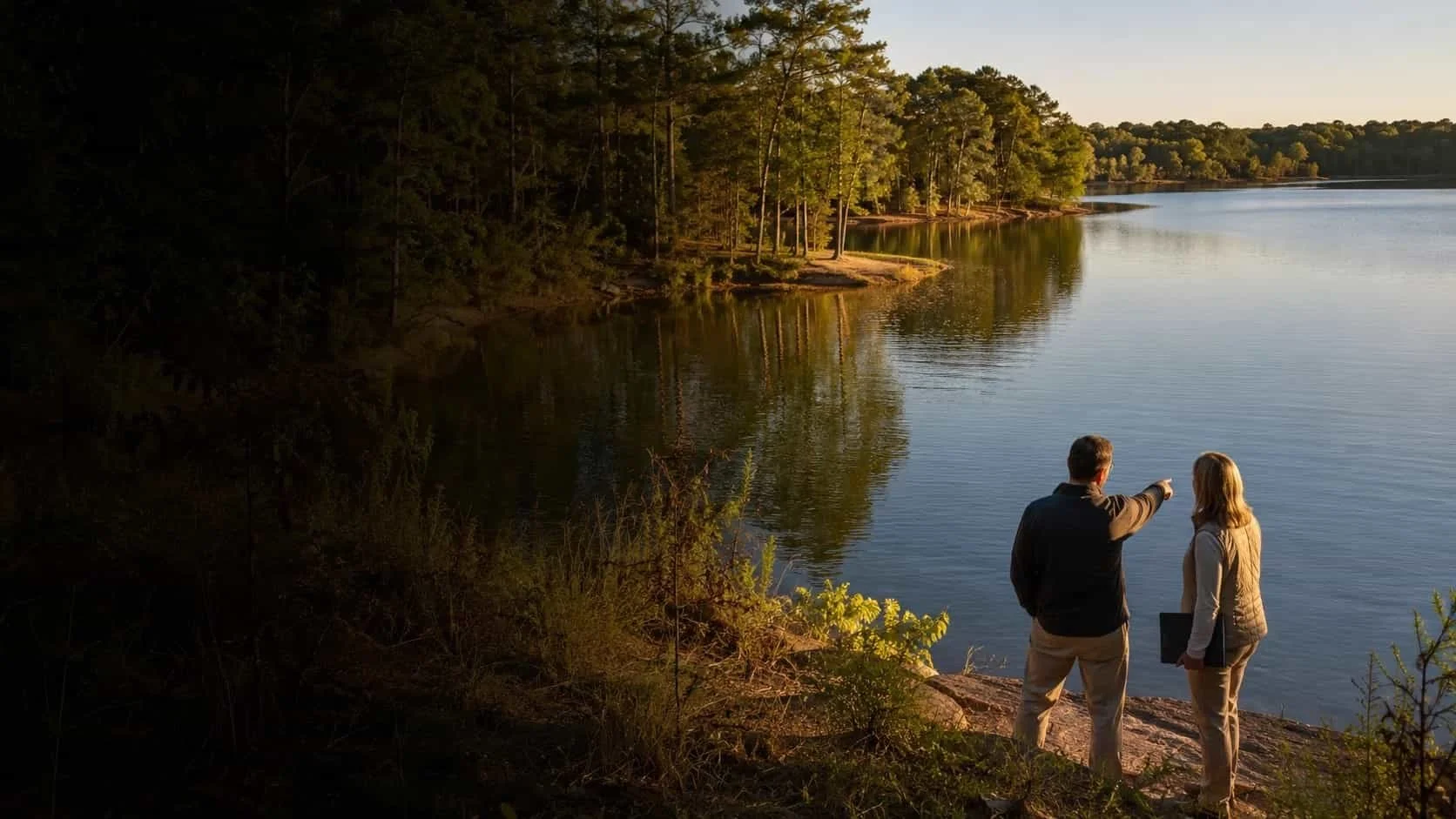
Lake Algae Control Services
Your Lake Is Sending a Message.
We Can Read It and Control The Algae Bloom.
Pond Lake And Stormwater Management Services.
We identify what's actually growing in your lake before we treat it — because the wrong product on the wrong algae makes the problem last longer, not shorter.
Green Doesn't Mean Healthy. It Usually Means the Opposite.
An algae bloom is the lake telling you what's been happening underneath it for the last six to eight weeks. The conditions that produce a visible bloom — elevated phosphorus and nitrogen, warm shallow water, low circulation, abundant sunlight — were building since April. The bloom in July is just the deadline.
Across the Piedmont, the species responsible vary. Filamentous algae forms stringy mats along shorelines and in shallow coves. Planktonic algae suspends in the water column and turns the lake pea-soup green. Blue-green algae — actually cyanobacteria, not true algae — is the most serious because some species produce toxins harmful to people, pets, and fish. The treatment for each is genuinely different. Misidentify the species and the wrong product can make conditions worse, especially in lakes with established fish populations or downstream water features.
We start with identification. What species, what growth stage, what's driving the bloom, and what the downstream effects of each treatment option look like for your specific water body. Aquatic algaecide application in NC requires a licensed pesticide applicator with the appropriate aquatic credential. We hold that license. The product selection, application window, and dosing all matter — and we get them right before we get anywhere near your lake with a sprayer.
Algae is a symptom. Nutrient loading is the cause. Treating only one guarantees a return visit by August.
Not every green lake is dangerous. Some are. Without species identification, you don't know which one you have.
Blue-green algae can produce toxins. The lake doesn't tell you which blooms are which. We test before we treat.
Filamentous, planktonic, blue-green, and chara all look different to a trained eye. The treatment hinges on the difference.
Surface algaecide is the last step, not the first. We start with what's feeding the bloom.
Most algae problems on Piedmont lakes peak between June 15 and September 1. Plan accordingly or fight it in August.
Lake Algae Control Services
Lake Norman is the most algae-prone managed lake in our service area — NC DEQ has documented harmful algal blooms there consistently, with peak activity running June through September. The pattern is predictable: winter drawdowns concentrate nutrients, spring rains add fertilizer runoff from surrounding development, summer heat gives blue-green algae exactly the conditions it needs. We treat blooms across Lake Norman every season, from the Troutman end through the Cornelius narrows.
Mountain Island Lake sits immediately downstream and serves as Charlotte's primary drinking water source. Algae management in that corridor isn't optional and isn't routine — every treatment is scoped against the downstream water quality risk. Beyond those two anchors, we work Lake Hickory on the Catawba chain, High Rock Lake along the Yadkin, and the HOA and private lakes across the Piedmont's larger watersheds. All of them see seasonal algae pressure. We treat all of them.
Blue-Green Algae & HAB Treatment
Cyanobacteria — actually bacteria, not true algae — and the most serious algae you can find in a Piedmont lake. Some species produce toxins. We treat early, document carefully, and test when there's reason to.
- Cyanobacteria identification and species verification
- Harmful Algal Bloom (HAB) treatment
- Toxin testing coordination with state labs
- Public health communication support (HOAs, municipal)
- Treatment timing to protect downstream water
- Post-treatment monitoring and re-treatment if needed
Filamentous Algae Control
The stringy green mats that accumulate along shorelines, in shallow coves, and around docks. Manageable with the right algaecide timing, but the second treatment is almost always avoidable with better timing on the first.
- Filamentous mat identification and mapping
- Targeted algaecide application
- Spot treatment for shoreline accumulation
- Reduction-strategy planning across the season
- Mechanical removal options for sensitive areas
- Annual filamentous management programs
Planktonic Algae Control
Suspended in the water column, planktonic algae turns a lake pea-soup green and reduces visibility to inches. It's also the type that crashes hardest when treated wrong — taking dissolved oxygen with it and risking fish kills.
- Planktonic algae density assessment
- Phased treatment to protect oxygen levels
- Coordination with aeration if installed
- Water clarity monitoring
- Treatment timing around weather patterns
- Long-term nutrient reduction planning
Nutrient Reduction & Source Control
Algaecide kills the bloom you have. Nutrient reduction is what prevents the next one. We assess where the phosphorus and nitrogen are coming from and what can actually be done about it.
- Nutrient source identification
- Phosphorus binding treatments (alum)
- Watershed-source recommendations
- Aeration-as-prevention evaluation
- Native vegetation buffers
- Annual nutrient management programs
Bloom Prevention & Annual Programs
Reactive algae treatment is more expensive than preventive management — every year, without exception. Annual programs combine early-season treatment, nutrient management, and monitoring to keep blooms from establishing in the first place.
- Spring pre-emergent treatment
- Scheduled monitoring through peak season
- Early-warning intervention
- Aeration integration
- HOA board reporting
- Documented treatment calendar

Lakes We Know by Name.
We plan service around Piedmont realities — Carolina clay, spring runoff, summer algae pressure, nutrient loading from managed landscapes, and stormwater obligations tied to local municipalities — across every property in the portfolio. Proudly serving Charlotte, Concord, Mooresville, Statesville, Hickory, Salisbury, Winston-Salem, High Point, Greensboro, Lake Norman, the Piedmont Triad, and Catawba Valley.

Lake Algae Control Services FAQ
What is the difference between blue-green algae and other algae?
Blue-green algae is actually cyanobacteria, not true algae. It's the most serious type because some species produce toxins (cyanotoxins) that can harm people, pets, and fish. Filamentous, planktonic, and green algae are true algae and don't produce those toxins. Visually, the differences are subtle — blue-green often forms paint-like surface mats with a strong earthy or musty odor. We test before we treat to confirm.
Is the green stuff in my lake dangerous to my dog?
It can be. If you see thick paint-like surface mats, pea-soup green water, or smell a strong earthy odor, keep dogs and other pets out of the water until it's been assessed. Blue-green algae toxins are particularly dangerous to dogs because they drink from the lake and groom contaminated fur. When in doubt, treat the water as suspect until a professional can confirm what's actually there.
What causes algae blooms on Lake Norman?
Primarily nutrient loading — nitrogen and phosphorus from lawn fertilizers, stormwater runoff, organic matter decomposing on the lake bottom, and seasonal waterfowl. Summer heat accelerates the process significantly. NC DEQ has documented harmful algal blooms on Lake Norman consistently, with peak activity June through September. Sheltered coves typically bloom earlier and last longer than the main body.
How quickly does algae treatment work?
It depends on the species and severity. Filamentous algae often shows visible results within a few days of targeted treatment. Planktonic algae can take one to three weeks depending on density and weather. Blue-green algae blooms are more complex — treatment reduces the active bloom, but full clearing depends on water temperature and weather following treatment. We provide a realistic timeline at the assessment, not an optimistic one.
Will algaecide harm fish in my lake?
Properly applied algaecides do not harm fish populations. The risk during treatment isn't direct toxicity to fish — it's rapid algae decomposition consuming dissolved oxygen as the bloom dies off. In smaller water bodies or dense blooms, that oxygen drop can stress or kill fish if treatment isn't phased. We scope treatment specifically around this risk in every lake with established fish populations.
Why does the algae keep coming back?
Because the conditions that produced it the first time are still there. Treatment controls the bloom you have. The nutrient loading, water temperature, sunlight, and circulation that fed the bloom haven't changed. Recurring algae is almost always a nutrient management issue, not a treatment quality issue. Annual programs that include nutrient reduction are significantly more effective long-term than emergency treatments.
How much does algae treatment cost?
Single-event treatment on a small HOA lake typically runs $300–$600 depending on lake size and bloom severity. Larger lakes or those needing phased treatment run higher. Annual prevention programs are scoped to the lake and run on a flat seasonal rate — usually 30–50% less per year than reactive single-event treatments over the same period. Every quote is based on a site assessment.
Do you need a permit for algae treatment in NC?
Not a permit specifically, but NC requires algae and aquatic weed treatments to be performed by an NCDA&CS-licensed pesticide applicator with the aquatic pest control credential. Clearwater holds that credential. Lakes near drinking water intakes or within certain regulatory zones may carry additional requirements — we flag those at the initial assessment.
Can aeration prevent algae blooms?
Aeration is one of the strongest preventive tools for algae management, particularly in deeper lakes or ponds where stratification concentrates nutrients in lower layers. Increasing dissolved oxygen at depth changes the chemistry that feeds blue-green blooms specifically. Aeration alone won't fix a lake with heavy nutrient input, but combined with nutrient management it's significantly more effective than either approach alone.
Do you serve Mountain Island Lake and other drinking-water reservoirs?
Yes — and with extra care. Mountain Island Lake serves as Charlotte's primary drinking water source. Algae management in that corridor follows tighter protocols on product selection, application timing, and treatment area scoping. We coordinate closely with property owners and HOAs along that shoreline on anything that could affect downstream water quality.
-
NCDA&CS Pesticide Applicator License — Category N (Aquatic Pest Control)
Trained in NCSU SCM Inspection & Maintenance protocols
EPA-registered aquatic herbicide and algaecide application
NC DEQ Stormwater Control Measure (SCM) maintenance compliance
-
NC DEQ Stormwater Design Manual: https://www.deq.nc.gov/
NC DEQ SCM O&M: https://www.deq.nc.gov/
EPA NPDES: https://www.epa.gov/npdes
NC State Extension Pond Guide: https://content.ces.ncsu.edu/pond-management-guide
NC Wildlife Resources Commission: https://www.ncwildlife.org
NALMS (North American Lake Management Society): https://www.nalms.org
Duke Energy Lake Norman drawdown schedule: https://lakes.duke-energy.com/