

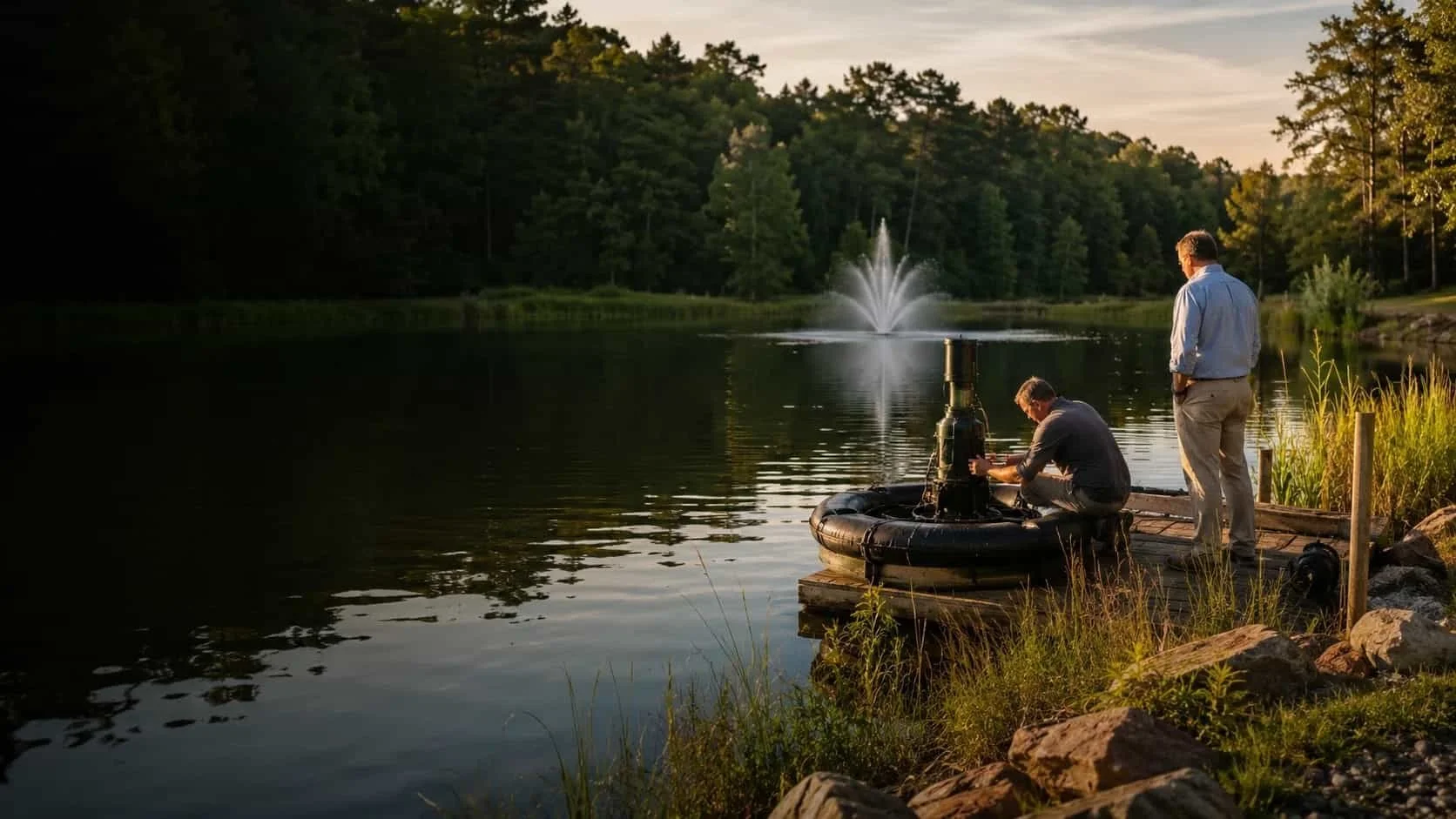
Pond & Lake Fountain Repair & Maintenance
Fountains Stop. We Get Them Going Again.
Pond Lake And Stormwater Management Services
We diagnose first, repair second. Most fountain failures trace back to predictable parts — pump seals, nozzle clogs, electrical, or winter freeze damage. Diagnosis is where good repair starts. Fountain repair, pump service, LED lighting repair, and seasonal maintenance for pond and lake fountains across the North Carolina Piedmont — most brands, most ages, most failure modes.
Fountains Fail in Predictable Ways. We Know All of Them.
Fountains fail predictably. Pump seals wear out and let water into the motor housing. Nozzles clog with biofilm and debris until the spray pattern collapses. Float intakes get blocked when twigs and leaves accumulate. LED light housings flood at the seal. GFI breakers trip when moisture finds the wrong path. Submersible cables develop weak spots where animals chew or where the cable rubs against the float. Bearings seize on units that ran without their winter pull-out for too many seasons. None of it is mysterious. All of it is fixable — usually.
What separates fountains that look great in year ten from fountains that fail in year three is whether someone is paying attention to the predictable failure modes at predictable intervals. A submersible pump seal is a wear item; replacing it as part of scheduled service is cheap. Letting it fail catastrophically destroys the motor and costs ten times as much. Nozzle cleaning takes 20 minutes and restores spray pattern; ignoring it leads to pump strain and electrical stress as the unit tries to push water through restrictions it wasn't designed to push through.
On NC ponds specifically, the single largest determinant of fountain longevity is winterization. Most floating fountains are not designed to operate through extended freezing conditions in standing water — ice expansion damages float housings, internal pump components, and electrical seals. Pulling the fountain in late fall, cleaning it, inspecting it, and storing it through the cold months extends fountain life dramatically. Spring deployment, inspection, and commissioning gets it back in service for the year. We service fountains we installed and fountains we didn't — most major brands, most ages, most failure modes.
Most fountain failures start at the pump seal. Water gets in, the motor stops, and what could have been a $200 part replacement becomes a $1,500 replacement.
Clogged nozzles change the spray pattern. The fountain looks wrong before it sounds wrong. The pump strains before it fails.
Float intakes lock up with leaf litter, twigs, and debris faster than owners think. The fountain that ran fine last week didn't get a clogged intake yesterday.
LED light failures look like pump failures but aren't. Different seals, different power, different repair. The diagnosis starts with figuring out which one stopped working.
GFI breakers trip on moisture, not on bad outlets. A repeatedly tripping fountain GFI is the system telling you water has reached an electrical path.
Winterization saves fountains. Pulling the unit in fall, cleaning it, inspecting it, storing it indoors — that single practice extends fountain life dramatically.
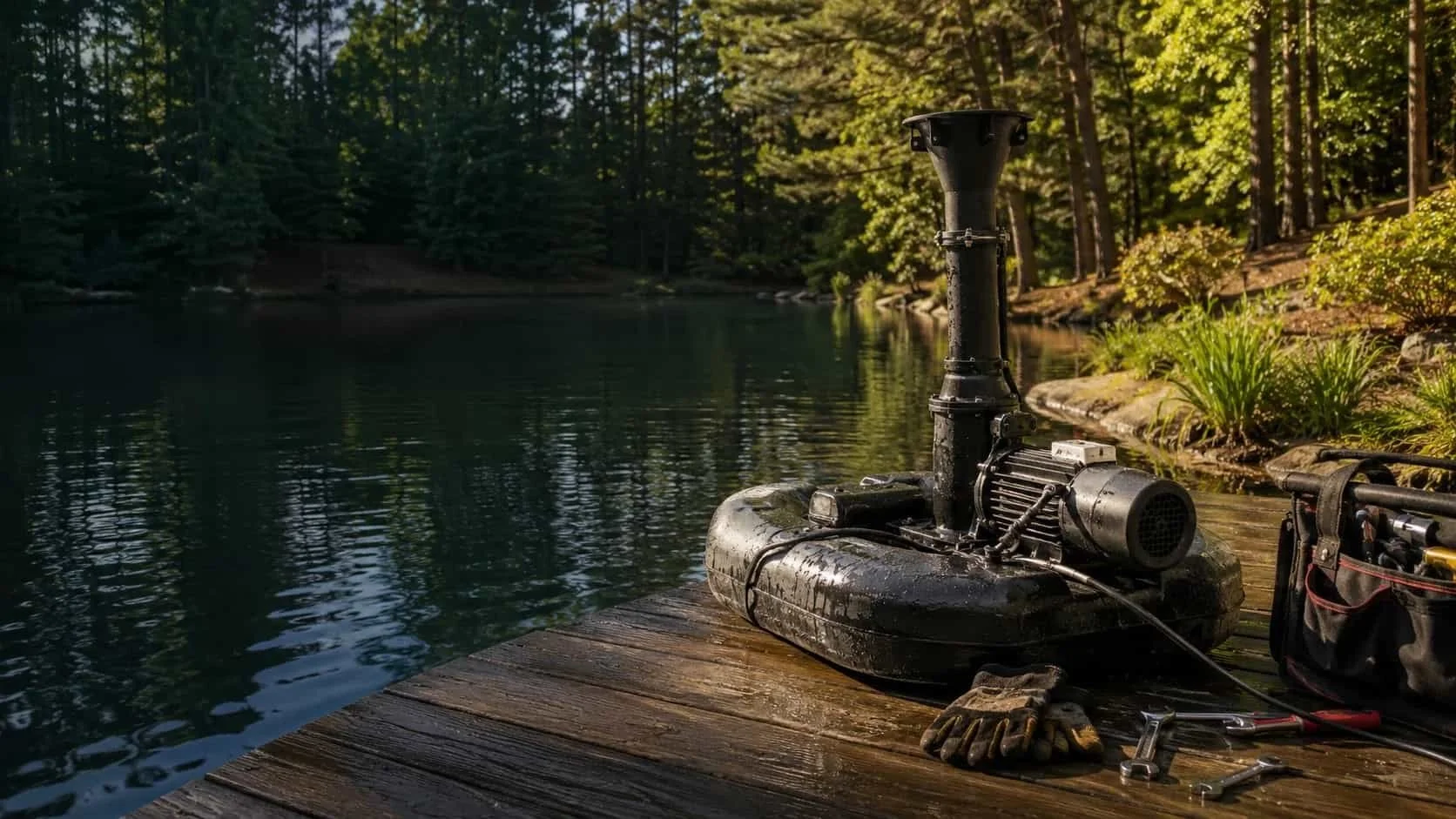
Pond & Lake Fountain Repair & Maintenance Services
Fountain service runs across the same geography as our installation work. We service fountains on HOA community ponds and lakes, commercial property water features, estate ponds, hospitality and multi-family properties, and the larger HOA and private water bodies throughout Iredell, Mecklenburg, Cabarrus, Rowan, Forsyth, Guilford, and Catawba counties. Both fountains we installed and fountains we didn't.
Annual service programs are most common in HOA portfolios, commercial property contexts, and hospitality settings where the fountain is a visible amenity that needs to look working at all times. Single-property residential and estate owners often start with a diagnostic visit when something stops working, then move to scheduled service after the first repair. Either path is fine. The goal is the same: keep the fountain running through its full service life, not just until the next failure.
Pump Repair & Rebuild
Submersible pump diagnostic, seal replacement, impeller inspection, motor rebuild or replacement, and post-repair commissioning. The pump is the single most common failure point on any fountain, and the most expensive to replace if seals fail catastrophically.
- Pump diagnostic and bench testing
- Mechanical seal replacement
- Impeller inspection and replacement
- Motor housing and stator inspection
- Submersible cable termination check
- Post-repair commissioning
Nozzle & Spray Pattern Service
Nozzles clog with biofilm, debris, and mineral deposits. The result is a misshapen spray pattern and a strained pump. Cleaning is routine. Replacement is sometimes necessary when nozzle parts are corroded beyond cleaning.
- Nozzle inspection and cleaning
- Biofilm and mineral deposit removal
- Nozzle component replacement
- Spray pattern adjustment
- Multi-pattern nozzle reconfiguration
- Pattern optimization for current conditions
LED & Lighting Repair
Submersible LED light housings flood, lenses cloud over, electrical connections corrode, and controllers fail. Lighting repair is its own specialty — different seals, different power systems, different failure modes than the pump.
- LED light diagnostic
- Lens replacement and cleaning
- Light housing seal replacement
- RGB controller and driver repair
- Underwater electrical connection service
- Lighting upgrade and retrofit
Electrical, Cable & Float Repair
Submersible cables develop weak spots from animal damage, mechanical wear, or aging. Floats accumulate UV damage, develop leaks, or get knocked off-station by storms. GFI tripping issues trace back to one of these places.
- Submersible cable inspection and replacement
- GFI and electrical diagnostics
- Float housing repair and replacement
- Mooring and anchor system service
- Cable rodent-damage protection
- Shore equipment and disconnect repair
Seasonal Service & Winterization
Pulling the fountain in fall, cleaning, inspecting, storing, and re-deploying in spring is the single most impactful maintenance practice for fountain longevity in NC. We do the full cycle — and we coordinate around HOA, commercial, and property-specific schedules.
- Fall pull-out and storage prep
- Complete unit cleaning and inspection
- Off-season parts replacement
- Spring re-deployment and commissioning
- Spray pattern re-adjustment
- Annual service documentation

Ponds We Know by Name.
We plan service around Piedmont realities — Carolina clay, spring runoff, summer algae pressure, nutrient loading from managed landscapes, and stormwater obligations tied to local municipalities — across every property in the portfolio. Proudly serving Charlotte, Concord, Mooresville, Statesville, Hickory, Salisbury, Winston-Salem, High Point, Greensboro, Lake Norman, the Piedmont Triad, and Catawba Valley.

Pond & Lake Fountain Repair Services FAQ
How do I know if my fountain pump is failing?
Common signs include reduced spray height, an asymmetric or collapsing spray pattern, the pump cycling on and off unexpectedly, GFI breaker tripping, unusual noises (grinding, humming, vibration), the spray pattern looking right but the water flow weak, or the fountain not starting at all. If you notice any of these, it's worth a diagnostic visit before the issue cascades. Catching a failing seal early is the difference between a $200 repair and a $1,500 replacement.
Should I pull my fountain for winter?
On most NC ponds, yes. Floating fountains are not designed to operate through extended freezing conditions in standing water. Ice expansion damages float housings, internal pump components, and electrical seals. Pulling in late fall, cleaning, inspecting, and storing through cold months extends fountain life significantly. Some operators choose to run year-round on ponds where ice cap rarely forms (mostly Lake Norman properties and warmer microclimates), but even on those installations a fall service visit is recommended.
How long do fountain pumps last?
Properly maintained submersible fountain pumps typically run 7–15 years before requiring major rebuild or replacement. The wide range reflects significant variation in usage hours, water conditions, seasonal pull-outs, and brand quality. Higher-end commercial-grade pumps (Otterbine, Vertex/Aquamaster premium lines) run on the longer end of that range; budget retail-grade pumps often fail much sooner. Annual service and proper winterization are the largest determinants of how long a given pump lasts.
Can you fix any brand of fountain?
Most major brands, yes. Vertex/Aquamaster, Otterbine, Kasco, Airmax, Scott Aerator, Easy Pro, and the components used by most regional fountain manufacturers — we service all of these regularly. For older or very obscure systems, we may need to source parts, in which case we'll quote based on availability. Bench rebuilds, seal replacements, impeller swaps, and electrical work are largely brand-agnostic at the component level.
Why isn't my fountain spraying as high as it used to?
The most common causes are: clogged nozzle (debris, biofilm, mineral deposits restricting flow), worn pump impeller (reduced water-moving capacity), failing pump seal (water in motor reducing performance), partially blocked float intake (reduced water supply), or in some cases, voltage drop in a long submersible cable run. A diagnostic visit traces the actual cause quickly — guessing wrong wastes parts and labor.
How much does fountain repair cost?
Annual service for a typical pond fountain runs $200–$500 depending on size and complexity, with nozzle cleaning, inspection, and minor adjustments included. Pump rebuild and seal replacement runs $300–$900 in parts, plus labor. Complete pump replacement varies by model — typically $800–$3,000+. LED lighting repair varies widely depending on the lighting system. Emergency visits carry a slightly higher rate than scheduled service. We quote based on diagnosis, not on assumption.
Are LED fountain lights worth replacing when they fail?
Almost always, yes. LED lighting is what makes the fountain function as an evening feature — for HOA properties and commercial sites, that visibility window is half the amenity value. Single-light failures often trace to housing seal issues or driver problems and are repairable. Full lighting system failure is sometimes more cost-effective to replace with newer-generation LED systems, particularly on installations that pre-date current RGB technology.
Why does the GFI keep tripping on my fountain?
Almost always moisture finding an unintended electrical path. Possibilities include water in the float compartment, deteriorated submersible cable, a compromised pump seal allowing water into the motor housing, corroded electrical connections, damaged shore-side junctions, or moisture wicking into the receptacle. A persistently tripping GFI is a safety signal worth diagnosing immediately — and the GFI is protecting equipment and people from electrical hazards while you address the underlying issue.
Do you do emergency fountain repair?
Yes, especially during the summer season when fountains are most visible from property amenities. We prioritize emergency calls and aim for same-week response on most issues. Properties on annual service programs receive priority scheduling during peak season. If your fountain is down and you have an event, gathering, or visibility window coming up, call as soon as possible.
Can you repair fountains we didn't install?
Yes — most of our fountain repair work is on equipment we didn't install originally. Estate properties that changed hands, HOAs that inherited fountains from a developer, commercial properties whose original installer is no longer in business — all common scenarios. Brand-agnostic repair capability matters here. We diagnose the actual unit you have, source the right parts, and get it running again.
-
NCDA&CS Pesticide Applicator License — Category N (Aquatic Pest Control)
Trained in NCSU SCM Inspection & Maintenance protocols
EPA-registered aquatic herbicide and algaecide application
NC DEQ Stormwater Control Measure (SCM) maintenance compliance
-
NC DEQ Stormwater Design Manual: https://www.deq.nc.gov/
NC DEQ SCM O&M: https://www.deq.nc.gov/
EPA NPDES: https://www.epa.gov/npdes
NC State Extension Pond Guide: https://content.ces.ncsu.edu/pond-management-guide
NC Wildlife Resources Commission: https://www.ncwildlife.org
NALMS (North American Lake Management Society): https://www.nalms.org
Duke Energy Lake Norman drawdown schedule: https://lakes.duke-energy.com/