

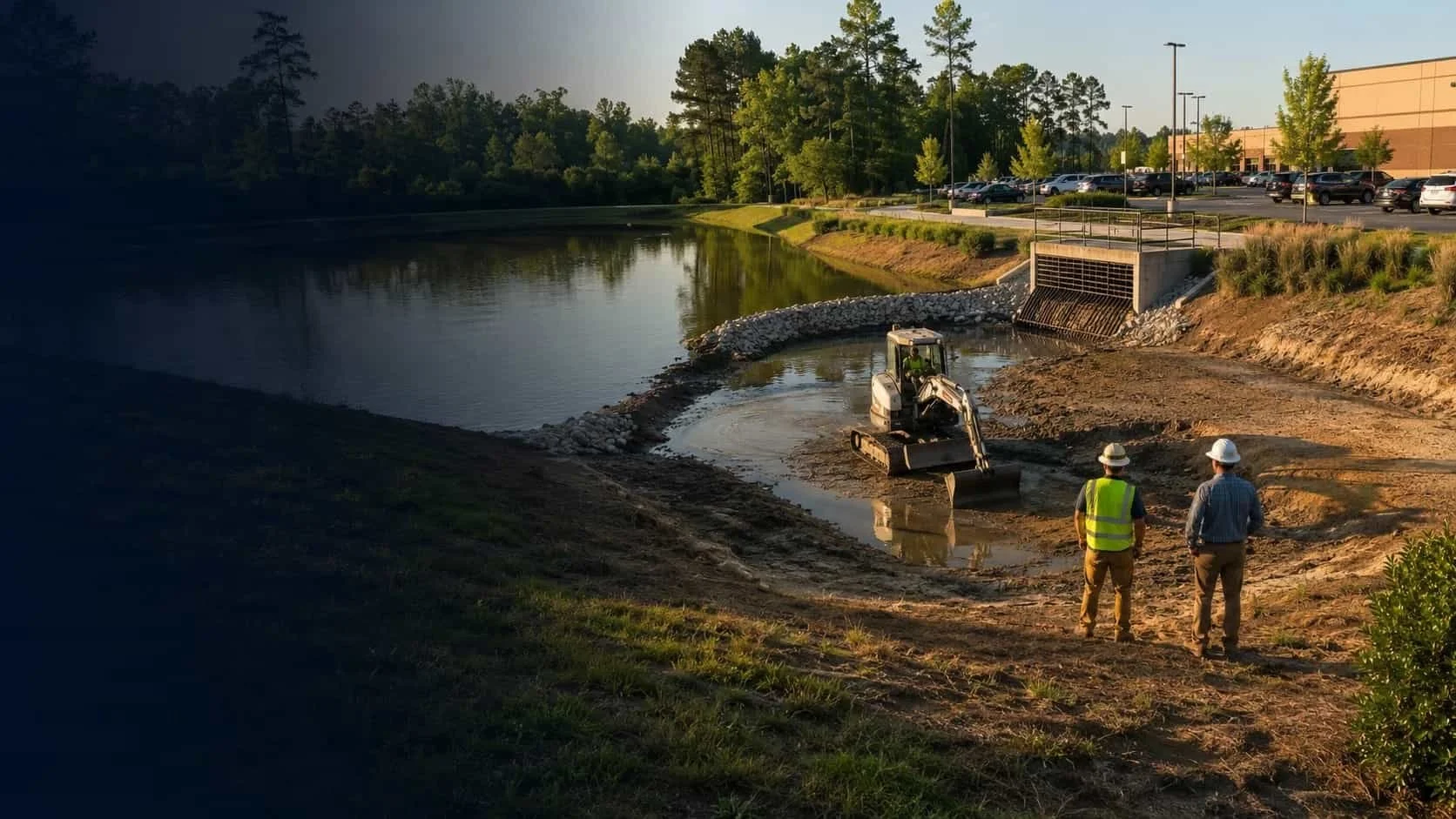
Stormwater BMP Maintenance Services
Maintenance Is What Keeps a BMP Working.
Inspection Just Tells You It Isn't.
Pond Lake And Stormwater Management Services
Stormwater BMP maintenance and physical repair across the NC Piedmont — forebay sediment removal, outlet structure repair, embankment work, vegetation restoration, and bioretention rehabilitation for HOA, commercial, and industrial sites. We do the physical work that keeps your stormwater control measures functioning as designed — and as required. Engineered BMPs work until they don't. Maintenance is what keeps the don't from happening.
An Unmaintained BMP Is a Compliance Liability and a Function Loss.
Forebays, Embankments, Outlet Structures — All Need Hands-On Work.
Stormwater BMPs are engineered systems with predictable maintenance needs. Forebays fill with sediment on a schedule determined by the upstream watershed. Outlet structures clog with debris on a schedule determined by trash and organic input. Embankments require vegetation management to prevent woody growth that would compromise structural integrity. Bioretention soil media compacts and loses infiltration capacity over years. Concrete weirs, risers, and trash racks weather, crack, or erode at the base. None of this is unusual or unexpected. All of it is part of the original engineering design — including the maintenance schedule that the permit's O&M plan specifies.
What separates a BMP that performs as designed from a BMP that fails inspection is whether someone is doing the physical work at the appropriate intervals. Forebay cleanout when sediment reaches the design threshold — typically every 5–10 years for most Piedmont sites, sometimes faster on construction-active or agricultural watersheds. Outlet structure clearing twice a year minimum. Embankment mowing and woody-vegetation removal annually. Trash and debris removal at every visit. The work is straightforward. The cost is predictable. The alternative — letting maintenance backlog accumulate until inspection or a heavy rainfall event forces emergency action — is significantly more expensive.
We work across the full range of NCDEQ-permitted Stormwater Control Measures: wet detention ponds, dry detention basins, bioretention cells, sand filters, level spreaders, infiltration systems, and constructed stormwater wetlands. Most of our maintenance work is on commercial property portfolios, HOA community SCMs, and industrial sites where the property owner or manager has a regulatory obligation and a finite budget — and benefits from a maintenance program scoped to address findings before they cascade into NOV territory.
Forebay cleanout is the #1 most-skipped BMP maintenance task. Most retention ponds in the Piedmont are past due. Most owners don't know it.
Outlet structures clog faster than people think. Twice-yearly clearing keeps water moving through the structure as designed.
Embankment and slope work has a window — late summer through fall, when soil moisture is low and equipment access is feasible. Plan ahead.
Bioretention soil media compacts and loses infiltration capacity over years. Cores, replacement, or rehabilitation is part of long-term BMP maintenance.
Concrete weirs, risers, and trash racks weather and crack over time. Structural repair has a real timeline — not something to defer.
Multi-BMP programs cost less than one-off emergency work. Same crew, same scheduling, same documentation — same math you saw on every other page, because it works.
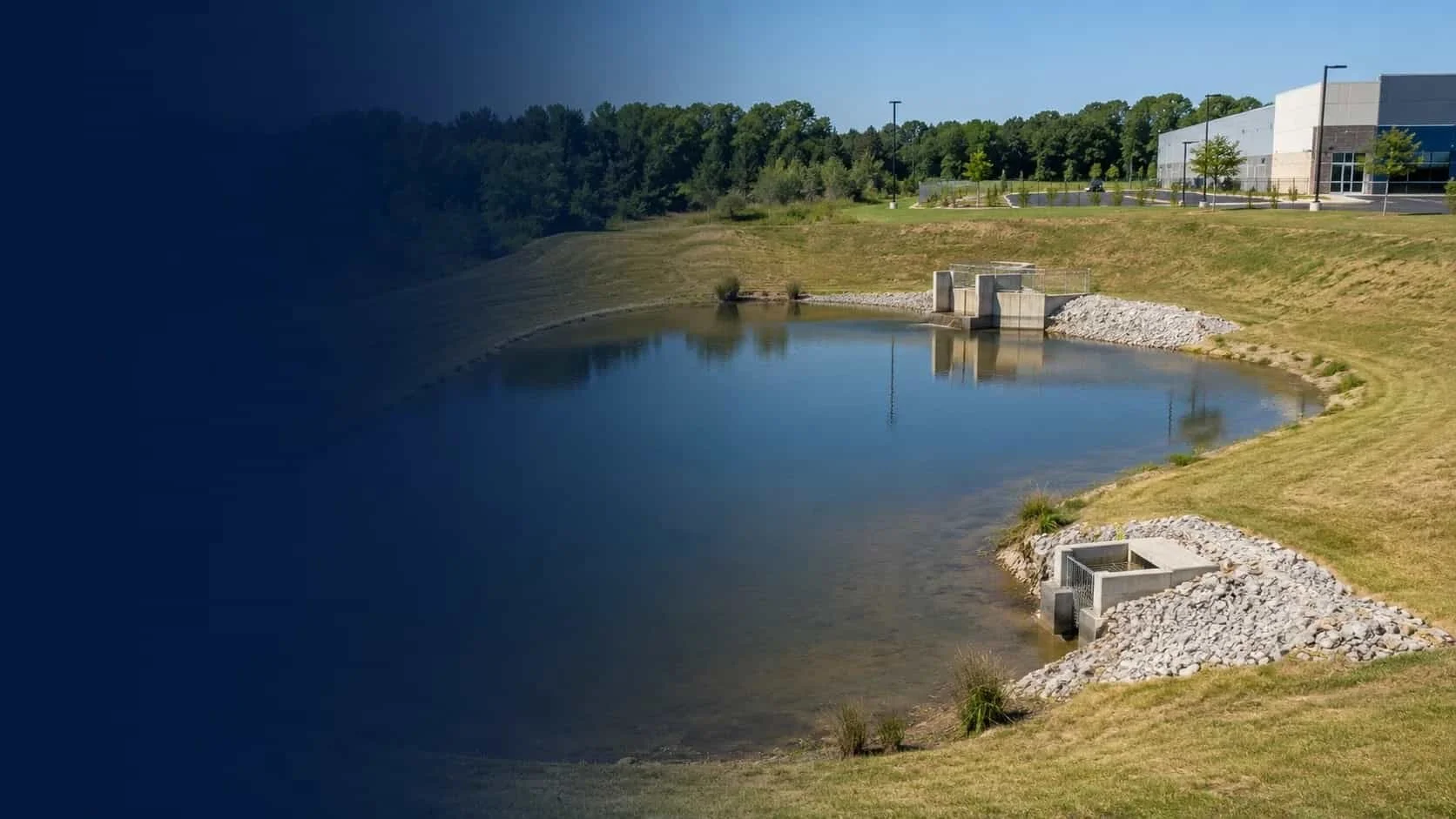
BMP Maintenance Services
BMP maintenance work runs across the full geography of the NC Piedmont. We do forebay cleanouts, structural repair, embankment work, and bioretention maintenance across Iredell, Mecklenburg, Cabarrus, Rowan, Forsyth, Guilford, Catawba, and surrounding counties. The Charlotte-Mecklenburg, Mooresville, Cornelius, Davidson, Huntersville, Concord, Statesville, Kannapolis, Salisbury, Winston-Salem, Greensboro, High Point, and Hickory MS4 programs all govern maintenance expectations differently — we work within each jurisdiction's requirements.
Multi-property portfolio maintenance is where the work consolidates most cost-effectively. Commercial property managers with retention ponds and bioretention cells across multiple developments. HOA boards with multiple community SCMs. Industrial property owners with on-site stormwater BMPs. Engineering firms supporting compliance for institutional clients. Same crew, same documentation standards, same regulatory tracking across the entire portfolio.
Forebay & Sediment Removal
The most-skipped maintenance task on most retention ponds — and the one that defines whether the BMP is actually capturing sediment as designed. Cleanout returns the forebay to design depth and re-establishes the engineered capture function.
- Forebay sediment depth survey
- Sediment removal to design specification
- Sediment characterization and disposal coordination
- Forebay liner inspection and repair
- Post-cleanout commissioning and verification
- Documentation of work for compliance records
Outlet Structure Repair & Clearing
Risers, weirs, trash racks, anti-vortex plates, and the engineered structures that control flow through the BMP. Concrete weathers, debris accumulates, and orifice plates clog. Repair and clearing both fall under this scope.
- Outlet structure inspection and clearing
- Trash rack repair and replacement
- Concrete weir and riser repair
- Orifice plate clearing and replacement
- Anti-vortex device inspection
- Underdrain inspection and clearing
Embankment, Slope & Spillway Repair
Embankment slopes, principal and emergency spillways, and the structural soil that holds water during storm events. Erosion repair, woody vegetation removal, regrading, and slope stabilization.
- Embankment slope inspection and repair
- Woody vegetation removal
- Erosion repair and stabilization
- Principal spillway maintenance
- Emergency spillway clearing
- Slope mowing and vegetative cover establishment
Vegetation Restoration & Management
Vegetation in and around BMPs is part of the engineered design — and most BMPs have vegetative requirements specified in the permit. Restoration, invasive removal, and management to the regulatory standard.
- Native vegetation restoration
- Invasive species removal
- Buffer establishment and maintenance
- Cattail and emergent reduction to allowable coverage
- Pre-inspection vegetation cleanup
- Multi-year vegetation establishment monitoring
Bioretention & Non-Pond BMP Rehabilitation
Bioretention cells, sand filters, infiltration systems, level spreaders, and constructed stormwater wetlands all have type-specific maintenance needs. Media replacement, infiltration restoration, and structural repair across non-pond BMP types.
- Bioretention media core sampling and replacement
- Sand filter rehabilitation
- Infiltration system restoration
- Level spreader repair and re-grading
- Constructed wetland vegetation management
- Underdrain cleaning and replacement

Ponds We Know by Name.
We plan service around Piedmont realities — Carolina clay, spring runoff, summer algae pressure, nutrient loading from managed landscapes, and stormwater obligations tied to local municipalities — across every property in the portfolio. Proudly serving Charlotte, Concord, Mooresville, Statesville, Hickory, Salisbury, Winston-Salem, High Point, Greensboro, Lake Norman, the Piedmont Triad, and Catawba Valley.

Stormwater BMP Maintenance Services FAQ
What does BMP maintenance include?
Physical maintenance work on Stormwater Control Measures — forebay sediment removal, outlet structure clearing and repair, embankment work, vegetation management to the regulatory standard, bioretention media replacement, structural concrete repair, and the activities that keep an engineered BMP functioning as designed. It's distinct from inspection (evaluation) — maintenance is the work that resolves what inspection identifies.
How often should a BMP be maintained?
Major maintenance tasks have specific schedules. Forebay cleanout typically every 5–10 years depending on watershed conditions. Outlet structure clearing twice yearly minimum. Embankment mowing and woody vegetation removal annually. Bioretention media replacement every 10–15 years. Minor maintenance (trash removal, vegetation cleanup, light erosion repair) is most cost-effective on a scheduled program with 2–4 visits per year. Specific cadence depends on the BMP type and site conditions.
How often does the forebay need to be cleaned out?
NCDEQ design standards typically require forebay cleanout when sediment accumulation reaches a specific depth — often half the design depth. For most Piedmont sites, that's a 5–10 year interval. Sites with construction-active watersheds, agricultural drainage, or unstabilized upstream conditions may need cleanout more frequently. Sites with stable mature watersheds may run longer. Sediment depth measurement during inspection is what triggers the cleanout schedule.
Do you maintain bioretention cells and non-pond BMPs?
Yes. Bioretention cells, sand filters, infiltration systems, level spreaders, and constructed stormwater wetlands all have type-specific maintenance needs that we work. Media replacement, infiltration restoration, vegetation management, underdrain clearing, and structural repair across non-pond BMP types. Many properties have a mix of pond and non-pond BMPs — consolidating maintenance to one provider simplifies scheduling and documentation.
Can you do concrete and structural repair?
Yes. Weirs, risers, trash racks, anti-vortex plates, and other concrete and metal stormwater structures all weather, crack, or erode over time. Structural repair scopes vary widely — minor concrete patching to full outlet structure rebuild. Major structural work is project-based and may require engineering review depending on scope. We coordinate with civil engineers when structural design changes are involved.
How much does BMP maintenance cost?
Highly variable by scope. Annual maintenance for a typical HOA-scale retention pond runs $1,500–$4,000 per year. Forebay cleanout is project-based — typically $5,000–$25,000+ depending on sediment volume, access, and disposal requirements. Outlet structure clearing usually $400–$1,200 per visit. Embankment vegetation work ranges $800–$3,000 per cycle. Major structural repair varies widely. Every quote is built around the specific BMP and condition.
Do I need a permit for BMP maintenance work?
Most routine maintenance doesn't require additional permits — the maintenance is performed under the existing stormwater permit's O&M plan. Sediment removal that involves disposal of more than a certain volume may have disposal-side regulatory requirements. Structural modifications or design changes typically require engineering review and may need permit amendments. Work in regulated waters (depending on connection to other water bodies) may require additional review. We flag permit considerations at the initial scope, not after work begins.
What's the difference between routine maintenance and emergency response?
Routine maintenance is scheduled work on a predictable cadence — annual programs, scheduled cleanouts at design intervals, regular vegetation management. Emergency response is unscheduled work driven by a triggering event — NOV issuance, sudden structural failure, major storm damage, fish kill in an HOA pond, or other time-pressured circumstance. Emergency work carries higher rates and tighter timelines. Annual programs are designed specifically to prevent the conditions that trigger emergencies.
Do you handle multi-BMP maintenance programs across multiple properties?
Yes — that's much of the work. Property management portfolios with multiple sites, HOA boards with several community SCMs, commercial owners with portfolio-scale stormwater obligations. Multi-property maintenance programs benefit from consistent scheduling, consolidated documentation, and pricing efficiency from coordinated routing. Cross-jurisdiction tracking is built into the portfolio approach so different MS4 program requirements are handled correctly.
What documentation do you provide after maintenance work?
Written work records with photo documentation (before/during/after), itemized scope of work completed, materials and quantities (sediment removed, vegetation removed, structural parts replaced), disposal coordination records where applicable, and a maintenance summary formatted for compliance file inclusion. The documentation maps to the O&M plan compliance requirements and supports MS4 annual reporting.
-
NCDA&CS Pesticide Applicator License — Category N (Aquatic Pest Control)
Trained in NCSU SCM Inspection & Maintenance protocols
EPA-registered aquatic herbicide and algaecide application
NC DEQ Stormwater Control Measure (SCM) maintenance compliance
-
NC DEQ Stormwater Design Manual: https://www.deq.nc.gov/
NC DEQ SCM O&M: https://www.deq.nc.gov/
EPA NPDES: https://www.epa.gov/npdes
NC State Extension Pond Guide: https://content.ces.ncsu.edu/pond-management-guide
NC Wildlife Resources Commission: https://www.ncwildlife.org
NALMS (North American Lake Management Society): https://www.nalms.org
Duke Energy Lake Norman drawdown schedule: https://lakes.duke-energy.com/