

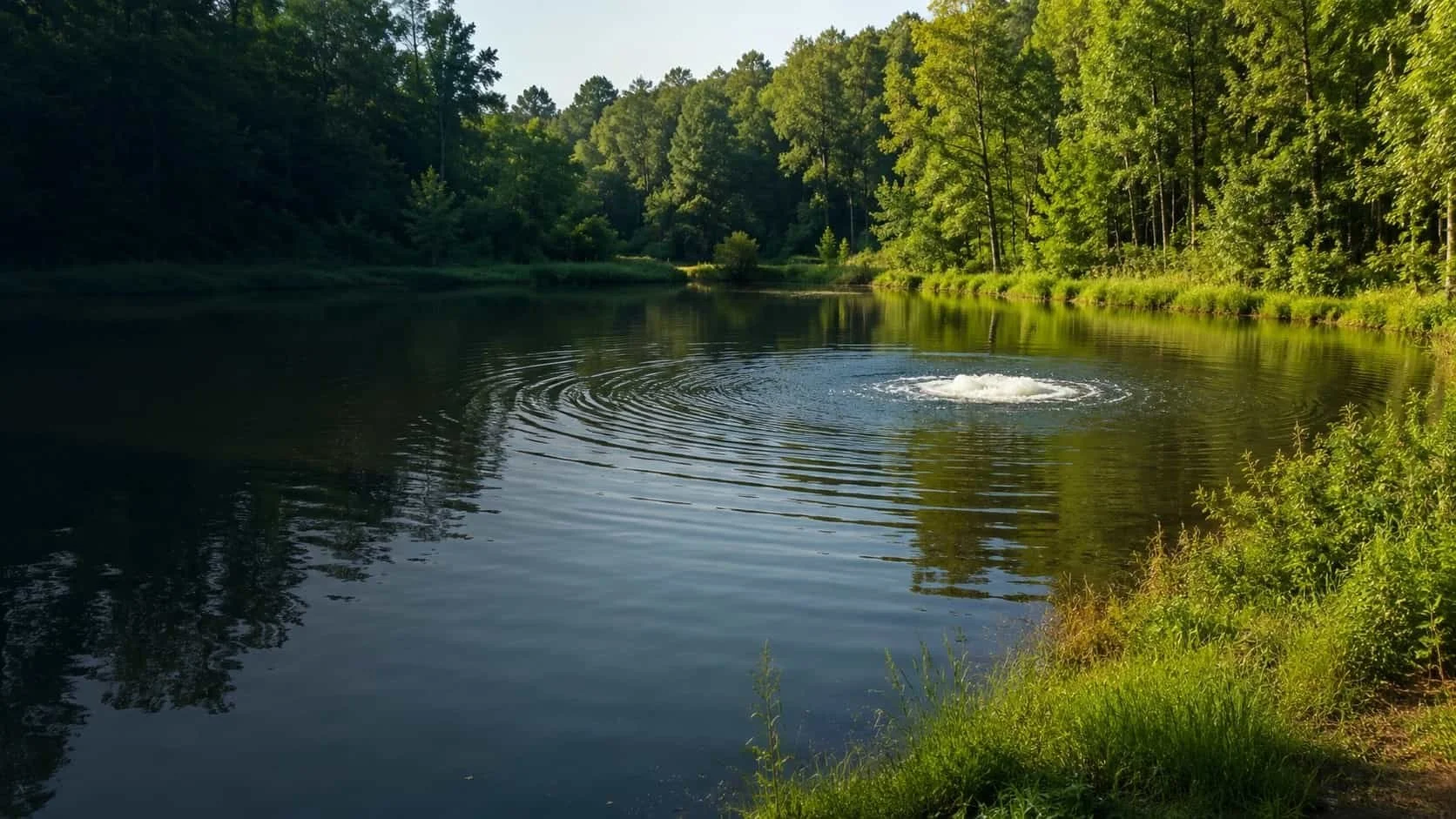
Pond Algae Control Services
That Green Is Not the Pond's Color.
If You Can Smell the Pond Before You See It, We Need to Talk.
Pond Lake And Stormwater Management Services
Pond algae identification and licensed treatment across the NC Piedmont — filamentous mats, planktonic blooms, blue-green algae, and the underlying nutrient conditions that keep feeding them. We identify what's actually growing in your pond before we treat it — because small ponds have less margin, and the wrong algaecide on the wrong species can kill the fish you were trying to save.
By the Time the Surface Goes Green, the Damage Is Already Working.
A pond algae bloom is the water telling you what's been happening underneath it for six to eight weeks. The conditions that produce a visible bloom — elevated phosphorus and nitrogen, warm shallow water, low circulation, abundant sunlight — were building since April. The bloom in July is just the deadline. On a pond specifically, that deadline arrives faster than on a lake. Less water volume means less dilution. Less surface area means less oxygen exchange. Once a pond bloom establishes, you have a narrow window before secondary problems start stacking up — first oxygen drops, then fish stress, then fish kills if the bloom crashes the wrong way.
Across the Piedmont, the species responsible vary. Filamentous algae forms the stringy green mats along banks and around aerators that pond owners colloquially call "pond scum." Planktonic algae suspends in the water column and turns the pond the pea-soup green that most owners associate with neglect. Blue-green algae — actually cyanobacteria, not true algae — is the most serious because some species produce toxins harmful to people, pets, livestock, and fish. Backyard ponds with dogs drinking from them, agricultural ponds with cattle, and HOA ponds adjacent to walking paths all carry real risk when blue-green is present.
We start with identification. What species, what growth stage, what's driving the bloom, and what the downstream effects of each treatment option look like for your specific pond. Aquatic algaecide application in NC requires a licensed pesticide applicator with the appropriate aquatic credential. We hold that license. Treatment selection, application timing, and dosing all matter — especially on small ponds where dose math and oxygen impact margins are tight.
Pond algae moves fast. Small water volume means visible bloom to fish kill is sometimes a week, not a month.
Surface algae in a pond isn't harmless. Blue-green species can poison pets, livestock, and people on contact.
Algae dying off consumes oxygen. In a small pond, a poorly-timed treatment can crash dissolved oxygen and kill the fish you were trying to protect.
Spring is the cheapest treatment window. Catch the bloom forming and you skip the entire summer fight.
Aerated ponds bloom less. They still bloom — just less. Aeration is prevention math, not algae elimination.
Pond shape matters. Shallow coves bloom first and longest. The deep center stays cleaner because it stratifies and circulates.
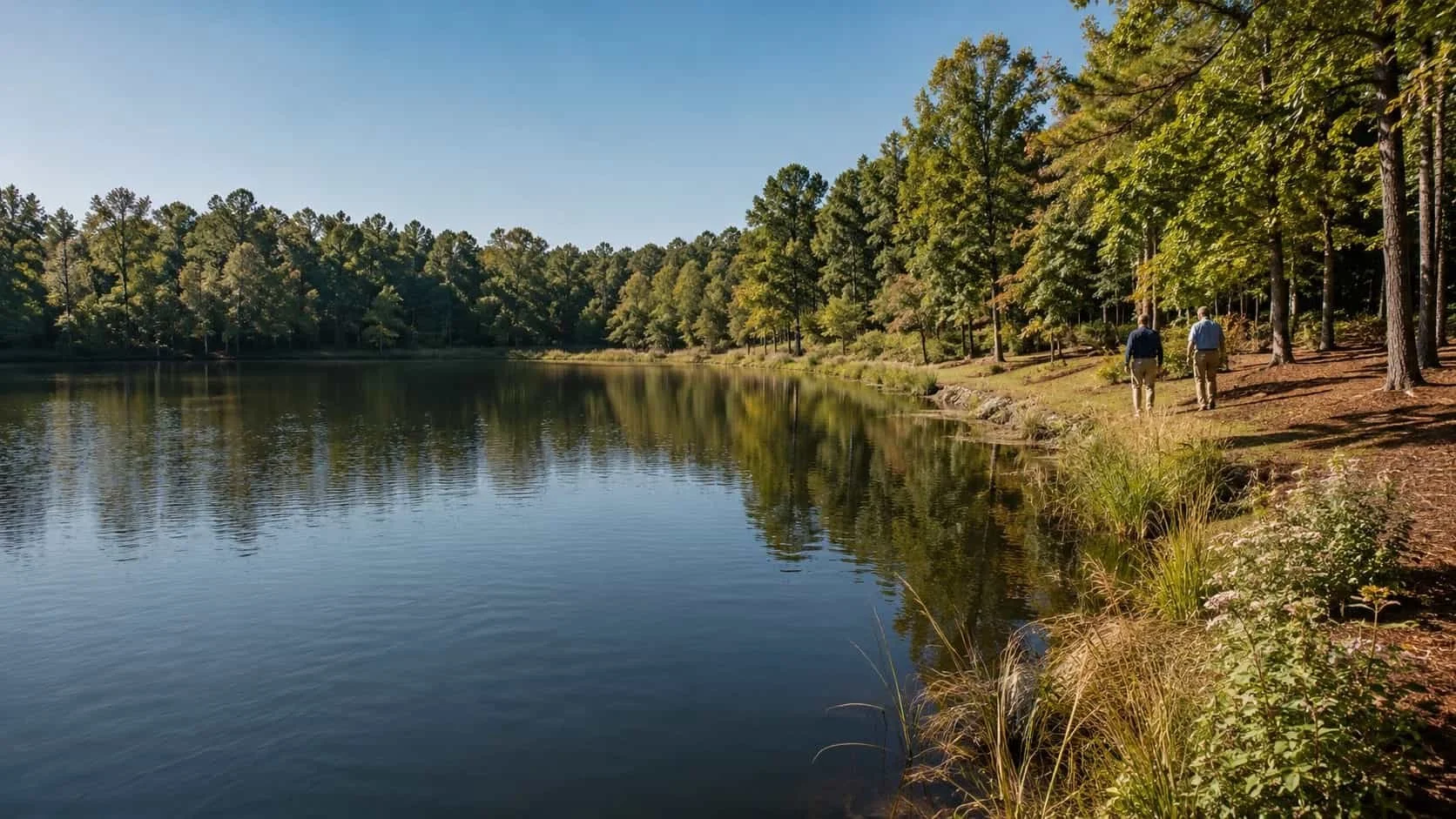
Pond Algae Control Services
Algae pressure on Piedmont ponds is predictable. Every spring brings the conditions, every summer brings the bloom, every August brings the calls. We work HOA community ponds, private residential ponds, agricultural and livestock ponds, golf course water features, and commercial property ponds throughout Iredell, Mecklenburg, Cabarrus, Rowan, Forsyth, Guilford, and Catawba counties.
Most of these ponds share common underlying conditions — heavy clay soils, nutrient loading from surrounding development or agriculture, summer heat, and watershed pressure from upland drainage. Every year, in roughly the same months, the same species show up. We know the pattern because we've been treating it across the region for years. Service area extends from the Charlotte metro through Statesville and out to Hickory, with consistent annual programs in the larger HOA developments and on the working farms across the Piedmont.
Filamentous Algae ("Pond Scum") Treatment
The stringy green mats along the bank and around aerators. The most common pond complaint we hear. Manageable with the right timing — the second treatment is almost always avoidable with better timing on the first.
- Filamentous mat identification and mapping
- Targeted algaecide application
- Spot treatment for bank accumulation
- Oxygen-conscious phased dosing
- Mechanical removal options for sensitive ponds
- Annual filamentous management programs
Planktonic Algae & Pea-Soup Water
Suspended in the water column, planktonic algae turns a pond pea-soup green and reduces visibility to inches. It's also the type that crashes hardest when treated wrong — taking dissolved oxygen with it and producing fish kills.
- Planktonic algae density assessment
- Phased treatment to protect dissolved oxygen
- Coordination with aeration if installed
- Water clarity monitoring
- Treatment timing around weather patterns
- Long-term nutrient reduction planning
Blue-Green Algae (Cyanobacteria)
The serious one. Cyanobacteria can produce toxins harmful to dogs, livestock, and people. Backyard ponds, livestock ponds, and HOA ponds adjacent to walking paths all need this taken seriously.
- Cyanobacteria identification and verification
- Toxin testing coordination with state labs
- Treatment protocols for pet/livestock-adjacent ponds
- HOA and resident communication support
- Post-treatment monitoring and re-treatment
- Risk reduction recommendations
Nutrient Reduction & Source Control
Algaecide kills the bloom you have. Nutrient reduction prevents the next one. On ponds especially, source control is half the battle — small water bodies can't absorb continuous nutrient loading from surrounding lawns and drainage.
- Nutrient source identification
- Phosphorus binding treatments (alum)
- Watershed-source recommendations
- Aeration-as-prevention evaluation
- Native vegetation buffer planting
- Annual nutrient management programs
Annual Prevention Programs
Reactive pond algae treatment is more expensive than preventive management — every year. Annual programs combine early-season treatment, aeration support, and monitoring to keep blooms from establishing in the first place.
- Spring pre-emergent treatment
- Scheduled monitoring through peak season
- Early-warning intervention
- Aeration integration and seasonal service
- HOA and owner reporting
- Documented treatment calendar

Ponds We Know by Name.
We plan service around Piedmont realities — Carolina clay, spring runoff, summer algae pressure, nutrient loading from managed landscapes, and stormwater obligations tied to local municipalities — across every property in the portfolio. Proudly serving Charlotte, Concord, Mooresville, Statesville, Hickory, Salisbury, Winston-Salem, High Point, Greensboro, Lake Norman, the Piedmont Triad, and Catawba Valley.

Pond Algae Control Management Services FAQ
Why does my pond turn green every summer?
Primarily nutrient loading — nitrogen and phosphorus from lawn fertilizers, stormwater runoff, organic matter, waterfowl, and decomposing vegetation. Summer heat accelerates the process. Ponds turn green faster than lakes because they have less water volume to dilute incoming nutrients. The pattern repeats every year because the underlying watershed and nutrient conditions don't change unless something addresses them.
Is the green stuff in my pond dangerous to pets or livestock?
It can be. Blue-green algae (actually cyanobacteria) can produce toxins harmful to dogs, cattle, horses, and humans on contact or ingestion. If you see thick paint-like surface mats, pea-soup green water, or smell a strong earthy/musty odor, keep pets and livestock away from the water until it's been assessed. Dogs are particularly at risk because they drink lake water and groom contaminated fur.
How quickly can you clear pond algae?
It depends on species and severity. Filamentous algae often shows visible results within a few days of targeted treatment. Planktonic algae takes one to three weeks depending on density. Blue-green blooms are more complex — treatment reduces the active bloom, but full clearing depends on follow-up weather conditions. We give realistic timelines at the assessment.
Will algaecide hurt my fish?
Properly applied algaecides don't directly harm fish populations. The risk is indirect — rapid algae decomposition after treatment consumes dissolved oxygen, and in small ponds with dense blooms that drop can stress or kill fish. We design pond treatments specifically around this risk, phasing dosing on dense blooms and coordinating with aeration to maintain oxygen during the dieback period.
Why does pond algae come back every year?
Because the conditions that produced it the first time are still there. Treatment controls the bloom you have. The nutrient loading, water temperature, sunlight, and watershed conditions haven't changed. Recurring algae is almost always a nutrient management issue, not a treatment quality issue. Annual programs that include source control and prevention are significantly more effective than emergency treatments.
Should I just rake out the algae mats?
It helps temporarily for filamentous mats. The downside: mechanical removal disturbs the bottom and shoreline, releasing nutrients back into the water column and often accelerating the next bloom. It also leaves the nutrient conditions completely unaddressed. Rake-and-leave is the most expensive long-term approach to pond algae management.
Can aeration prevent pond algae?
Aeration is one of the strongest preventive tools — particularly on ponds with stratification, which concentrates nutrients in the lower oxygen-poor layers where blue-green algae thrives. Increasing dissolved oxygen at depth shifts the chemistry that feeds cyanobacteria. Aeration alone won't fix a pond with heavy nutrient input, but combined with nutrient management it's significantly more effective than either approach alone.
How much does pond algae treatment cost?
Single-event treatment on a small HOA or private pond typically runs $200–$500 depending on pond size and bloom severity. Larger or denser ponds run higher. Annual prevention programs are scoped to the pond and usually run 30–50% less per year than reactive single-event treatments over the same period. Every quote follows a site assessment.
What if my pond is near a creek or drainage?
Treatment protocols change. Drift, downstream effects, and connection to natural waterways all factor into product selection and application method. Lakes and ponds connected to creeks or feeding drinking water sources require tighter scoping — and in some cases additional regulatory consultation. We flag these conditions at the initial assessment, not after the contract is signed.
Do you treat small backyard ponds?
Yes. Backyard ponds under a quarter-acre are some of our most frequent service calls. The math is the same as commercial ponds — identification, licensed treatment, oxygen consideration, follow-up — just at smaller scale. Pricing scales accordingly.
-
NCDA&CS Pesticide Applicator License — Category N (Aquatic Pest Control)
Trained in NCSU SCM Inspection & Maintenance protocols
EPA-registered aquatic herbicide and algaecide application
NC DEQ Stormwater Control Measure (SCM) maintenance compliance
-
NC DEQ Stormwater Design Manual: https://www.deq.nc.gov/
NC DEQ SCM O&M: https://www.deq.nc.gov/
EPA NPDES: https://www.epa.gov/npdes
NC State Extension Pond Guide: https://content.ces.ncsu.edu/pond-management-guide
NC Wildlife Resources Commission: https://www.ncwildlife.org
NALMS (North American Lake Management Society): https://www.nalms.org
Duke Energy Lake Norman drawdown schedule: https://lakes.duke-energy.com/