

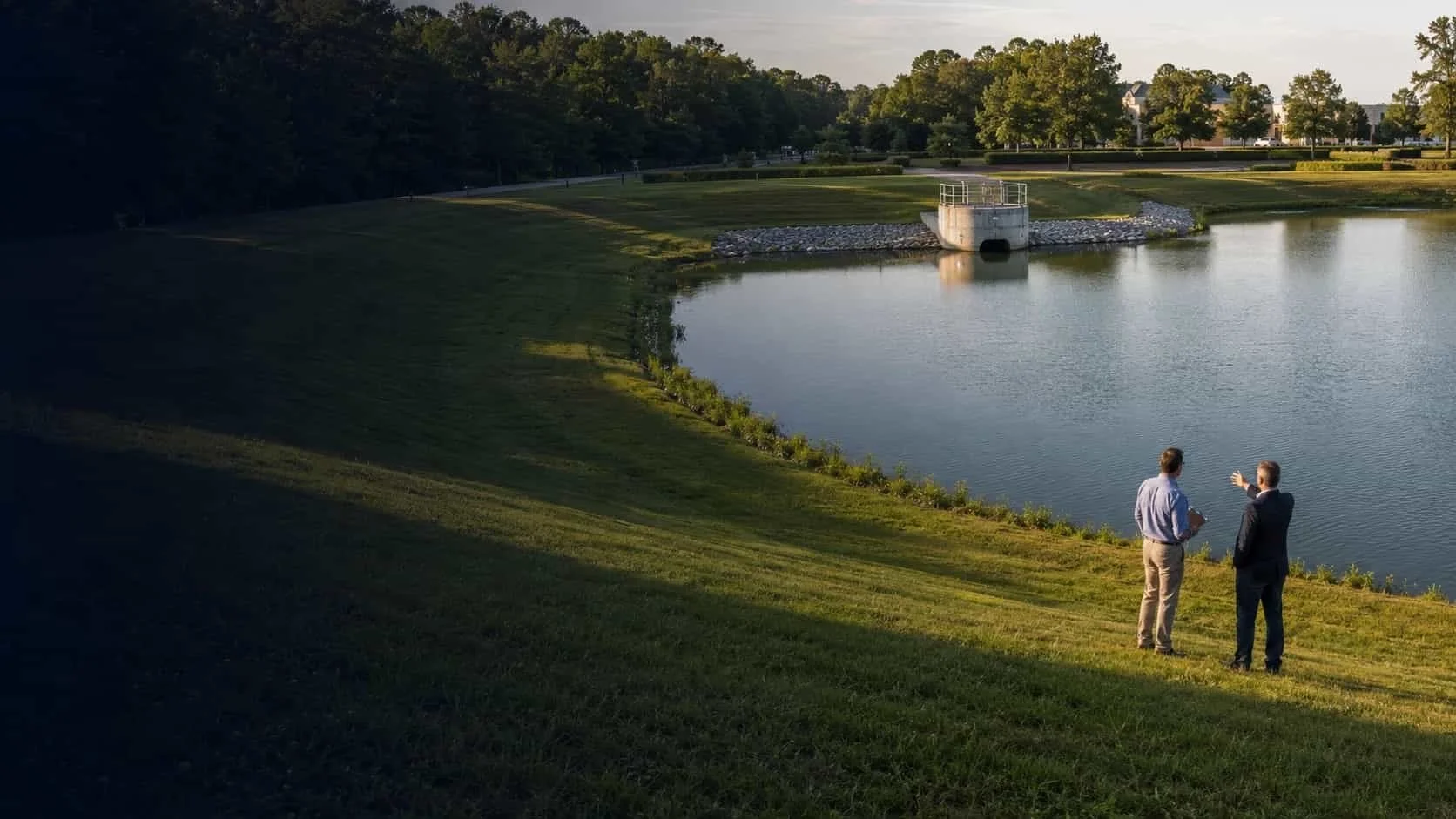
Retention Pond Management Services
Your Retention Pond Has a Permit.
Has Anyone Been Keeping Up With It?
Pond Lake And Stormwater Management Services
We inspect, maintain, document, and resolve — keeping HOA and commercial retention ponds in compliance with NCDEQ, the relevant MS4 jurisdiction, and the O&M plan that came with the pond's original permit… BMP maintenance, forebay cleanout, NOV response, and audit-ready documentation for HOA and commercial retention pond owners across the NC Piedmont.
A Retention Pond Isn't an Aesthetic. It's a Regulated Asset.
Every retention pond built since the early 2000s in North Carolina was installed under a stormwater permit that came with an O&M plan — a formal document specifying what maintenance the pond must receive, how often, and to what standard. Most HOA boards and commercial property managers don't know they have one. Many haven't seen it since the developer transferred control. NCDEQ, the relevant MS4 jurisdiction (Charlotte-Mecklenburg, Mooresville, Concord, Statesville, and others all run their own programs), and the original permit conditions all reference that document — and inspections measure against it.
The most common findings during retention pond inspections aren't dramatic. Sediment accumulation in the forebay past the design depth. Woody vegetation growing on the embankment. Outlet structure restricted by debris. Trash accumulation in the principal spillway. Erosion at the inflow point. Cattails or other emergent vegetation covering more than the allowable percentage of the pond surface. Each of these can trigger a Notice of Violation. Each carries corrective action requirements and, in many jurisdictions, daily fines until resolved.
We work with HOA boards, commercial property managers, industrial site managers, and developers on retention pond compliance across the NC Piedmont. SCM inspections following NCDEQ protocols and NC State Extension methodology. Forebay cleanout, outlet structure repair, vegetation management to the regulatory standard, and audit-ready documentation that your annual SCM report can be built around. When a NOV has already been issued, we work the corrective action plan with the owner and the issuing jurisdiction. The goal is always the same: get the pond into compliance, document the work, and prevent it from happening again.
NOV fines accumulate per day until corrective action is documented. Some MS4 jurisdictions charge $250–$1,000 per day until resolved.
SCM inspections aren't optional. NCDEQ requires them. Your MS4 jurisdiction requires them. Documented O&M is part of the deal.
The forebay is engineered to capture 80% of incoming sediment. If it hasn't been cleaned out in five years, it isn't capturing anything.
Woody vegetation on the embankment is a violation in most jurisdictions. Tree roots compromise structural integrity over time.
Most retention ponds in the Piedmont are technically out of compliance. Most owners haven't read their O&M plan to know it.
Annual maintenance costs a fraction of NOV resolution. Always. The math has never come out the other way.
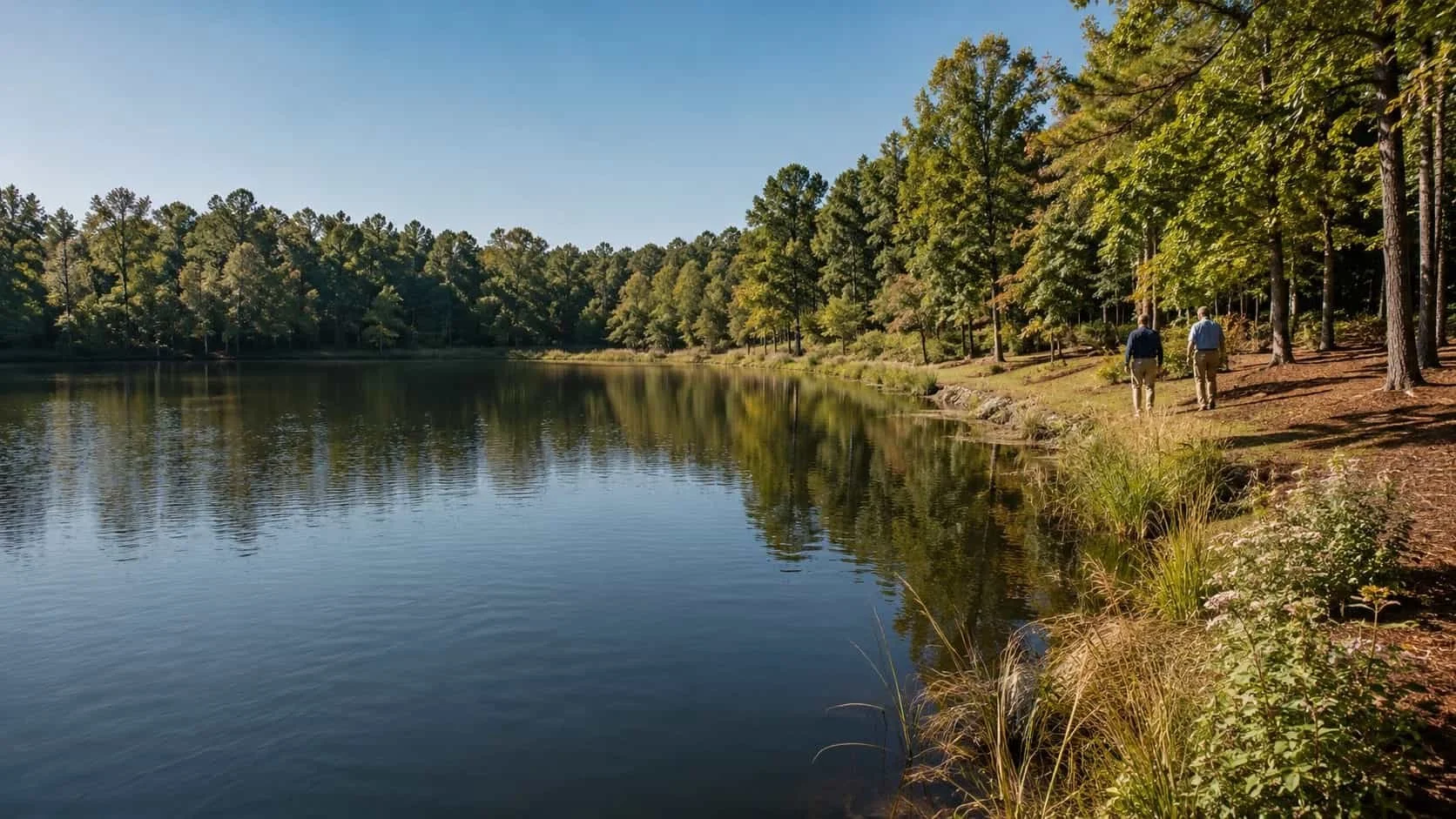
Retention Pond Services
Retention pond compliance work varies by MS4 jurisdiction. Charlotte-Mecklenburg runs one of the more active stormwater programs in the state. Mooresville, Cornelius, Davidson, Huntersville, and Concord each operate their own NPDES Phase II MS4 programs with locally-specific O&M expectations. Statesville, Kannapolis, Salisbury, Winston-Salem, Greensboro, High Point, and Hickory all have stormwater management programs that govern retention ponds within their jurisdictions. Every program enforces against the NCDEQ baseline; many add local conditions. We track them.
Our retention pond work runs across HOA communities, commercial property portfolios, industrial sites, and mixed-use developments throughout Iredell, Mecklenburg, Cabarrus, Rowan, Forsyth, Guilford, Catawba, and surrounding counties. Annual SCM programs for property management companies overseeing multi-property portfolios are a significant portion of the work — single property managers responsible for a dozen or more retention ponds across different jurisdictions benefit from consistent inspection methodology and documentation standards across the entire portfolio.
NCDEQ-Compliant SCM Inspections
Stormwater Control Measure inspections following NCDEQ protocols and NC State Extension SCM Inspection & Maintenance methodology. We document conditions, flag deficiencies, and produce inspection reports formatted for your annual SCM report.
- Annual or semi-annual SCM inspection visits
- NCDEQ-compliant inspection forms
- Photo documentation of all components
- Deficiency identification and prioritization
- Recommended corrective action with timelines
- Reports formatted for HOA boards and MS4 reporting
BMP Component Maintenance
Forebay sediment removal, outlet structure clearing, principal spillway debris removal, embankment repair, and the physical maintenance work that keeps a stormwater control measure functioning as designed.
- Forebay sediment cleanout to design depth
- Outlet structure inspection and clearing
- Principal spillway maintenance
- Embankment slope repair and stabilization
- Inflow channel erosion repair
- Trash and debris removal
Compliance Vegetation Management
Most NOVs involving vegetation come down to woody growth on the embankment or invasive emergent coverage past the allowable percentage. We manage both — to the regulatory standard, not the aesthetic one.
- Embankment woody vegetation removal
- Cattail and emergent reduction to allowable coverage
- Invasive species treatment
- Slope mowing to required height intervals
- Native vegetation establishment where required
- Pre-inspection vegetation cleanup
NOV Emergency Response
When a Notice of Violation has already been issued, the timeline tightens significantly. We work directly with the property owner and the issuing jurisdiction (NCDEQ, Charlotte-Mecklenburg, Mooresville, Concord, others) on the corrective action plan and documented resolution.
- Same-week site assessment
- Corrective action plan development
- Jurisdiction coordination and communication
- Expedited cleanup and repair work
- Documentation of corrective action completion
- Post-resolution preventive program
Compliance Documentation & Records
Audit-ready records, formatted for HOA board reporting, commercial property management files, or MS4 annual report submission. The paper trail matters as much as the work itself.
- Annual SCM inspection reports
- Maintenance activity logs with timestamps
- Before/after photo documentation
- O&M plan compliance tracking
- Board-ready compliance summaries
- Multi-year condition trending

Ponds We Know by Name.
We plan service around Piedmont realities — Carolina clay, spring runoff, summer algae pressure, nutrient loading from managed landscapes, and stormwater obligations tied to local municipalities — across every property in the portfolio. Proudly serving Charlotte, Concord, Mooresville, Statesville, Hickory, Salisbury, Winston-Salem, High Point, Greensboro, Lake Norman, the Piedmont Triad, and Catawba Valley.

Retention Pond Management Services FAQ
What is the difference between a retention pond and a detention pond?
Retention ponds hold water permanently — they have a permanent wet pool and a designed surface elevation. Detention ponds are dry between rain events; they fill during storms and slowly drain afterward. Both are types of Stormwater Control Measures (SCMs) and both have NCDEQ maintenance requirements, but the specific O&M obligations differ. Wet retention ponds typically have additional requirements around water quality treatment volume, forebay maintenance, and aquatic vegetation management.
Who is responsible for retention pond maintenance — HOA, developer, or commercial owner?
Once the developer has transferred control of the common area (which typically happens after a development reaches a certain occupancy or homeowner-vote threshold), the HOA assumes maintenance responsibility for community retention ponds. For commercial properties, the property owner or designated property management company is responsible. For mixed-use or industrial sites, responsibility is defined in the original stormwater permit and deed restrictions. Almost universally, the responsible party is whoever currently owns the underlying parcel — even if they didn't build the pond.
What does NCDEQ require for SCM maintenance?
NCDEQ requires that every permitted Stormwater Control Measure receive maintenance consistent with the O&M plan that was approved at permit issuance. The specifics vary by SCM type, but the consistent elements are: annual inspection by a qualified party, documented maintenance activities, forebay sediment removal when accumulation exceeds threshold, vegetation management to prevent woody growth on embankments, outlet structure functionality, and recordkeeping that can support an audit. MS4 jurisdictions like Charlotte-Mecklenburg often add their own requirements on top.
What is a forebay and why does it need cleaning?
A forebay is a smaller pool at the inflow point of a retention pond, designed to capture sediment and pollutants before they enter the main pond body. Engineered correctly, forebays capture roughly 80% of incoming sediment. As they fill, capture efficiency drops dramatically — and the sediment that should have been trapped in the forebay starts accumulating in the main pond instead. NCDEQ design standards typically require forebay cleanout when sediment reaches a specific depth (often half the design depth). For most ponds, this is a 5–10 year interval depending on watershed conditions.
What happens if I get a Notice of Violation?
An NOV initiates a regulatory enforcement process. You'll receive a written notice identifying the specific deficiencies, a required corrective action timeline (often 30–60 days for routine findings, shorter for serious issues), and any associated fines. Some MS4 jurisdictions charge daily fines that accumulate until corrective action is documented as complete. Failure to respond can escalate to additional enforcement, mandatory compliance orders, and in extreme cases, civil penalties. NOVs are resolvable — but the clock starts the day they're issued.
How often must a retention pond be inspected?
NCDEQ requires at minimum annual inspection by a qualified party for permitted SCMs. Many MS4 jurisdictions require semi-annual inspection for higher-priority sites — commercial properties, industrial facilities, and ponds with prior compliance issues. The O&M plan attached to your original permit specifies the required frequency for your specific pond. If you don't know what it requires, that's usually the first thing we look at.
Why are there cattails growing on my retention pond and is that a problem?
Cattails establish naturally in retention ponds because the conditions favor them — nutrient-rich water, shallow edges, and minimal flow. In moderate coverage they provide some water quality benefit. Past the threshold defined in your O&M plan (often 50% coverage or stated linear footage along the edge), they become a compliance issue. They also restrict flow, accumulate organic matter, and can shelter mosquito populations. Most jurisdictions consider extensive cattail coverage a maintenance finding during inspection.
Can woody vegetation grow on the embankment?
Almost universally no. Trees and large shrubs on the embankment create two problems: their root systems penetrate the embankment and create preferential flow paths that compromise structural integrity, and large trees can topple in storms — taking embankment material with them and creating breach risk. NCDEQ and virtually every MS4 jurisdiction specifically prohibit woody vegetation on retention pond embankments. This is one of the most common inspection findings and one of the most straightforward to correct early.
How much does retention pond maintenance cost?
Annual SCM inspection and routine maintenance for an HOA-scale retention pond typically runs $1,500–$4,000 per year depending on pond size, complexity, and condition. Major work like forebay cleanout is project-based, typically $5,000–$25,000+ depending on sediment volume and access. NOV resolution work runs whatever the specific corrective action requires — often significantly more than annual maintenance over the same period, plus fines. Every quote is built around the specific pond and its current condition.
Do you provide compliance documentation for HOA boards and MS4 reporting?
Yes — and that's much of the value. Inspection reports formatted for HOA board meetings, maintenance activity logs with timestamps and photo documentation, year-over-year condition trending, and compliance summaries that map to your MS4 jurisdiction's annual reporting requirements. When an inspector or auditor asks for records, they should be able to receive a comprehensive file the same day.
-
NCDA&CS Pesticide Applicator License — Category N (Aquatic Pest Control)
Trained in NCSU SCM Inspection & Maintenance protocols
EPA-registered aquatic herbicide and algaecide application
NC DEQ Stormwater Control Measure (SCM) maintenance compliance
-
NC DEQ Stormwater Design Manual: https://www.deq.nc.gov/
NC DEQ SCM O&M: https://www.deq.nc.gov/
EPA NPDES: https://www.epa.gov/npdes
NC State Extension Pond Guide: https://content.ces.ncsu.edu/pond-management-guide
NC Wildlife Resources Commission: https://www.ncwildlife.org
NALMS (North American Lake Management Society): https://www.nalms.org
Duke Energy Lake Norman drawdown schedule: https://lakes.duke-energy.com/