How to Find a Reliable Pond Management Company for Your HOA
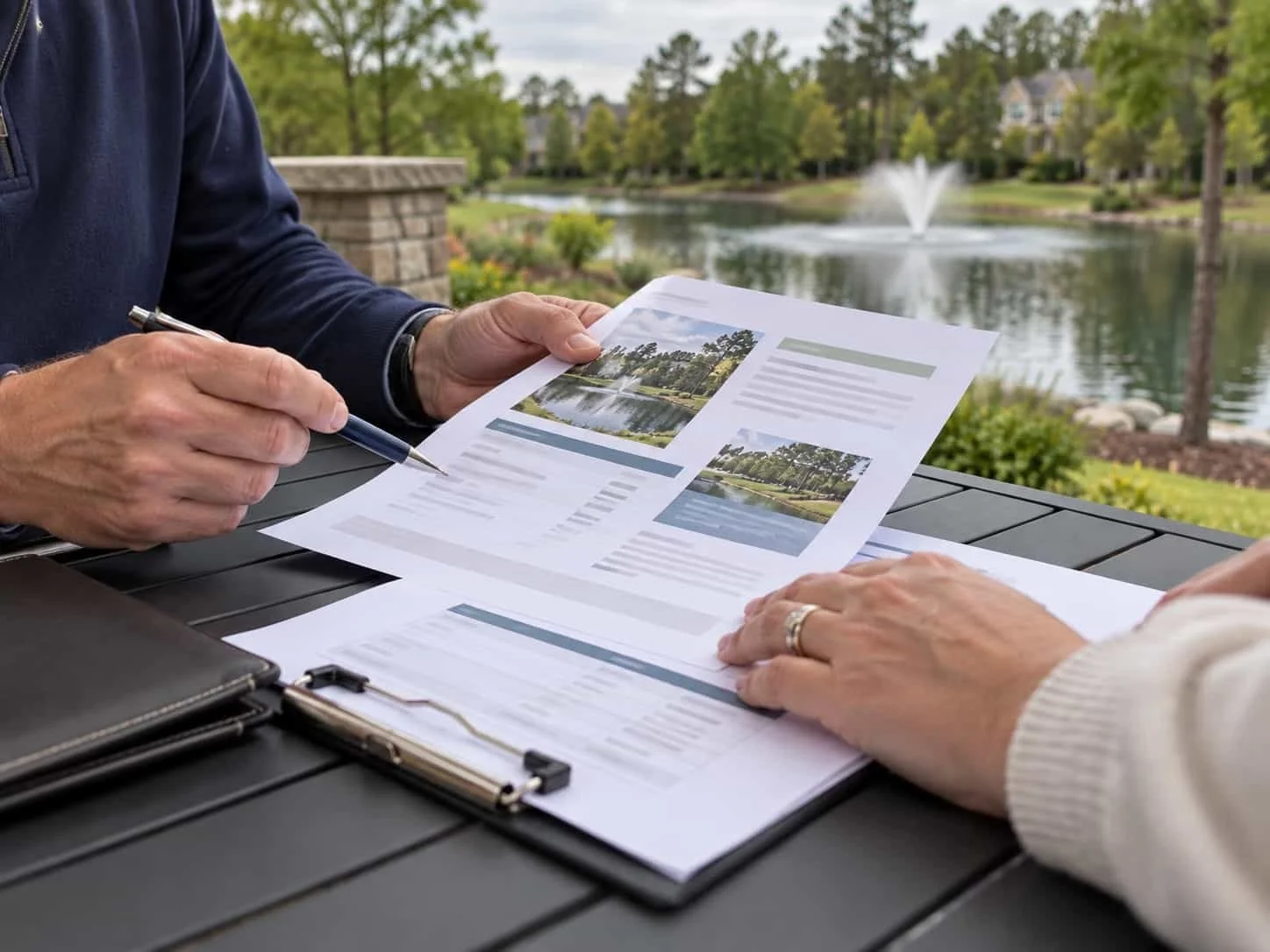
Picture this. Your HOA retention pond has turned the color of pea soup, two residents have already emailed the board about algae, the fountain has been dead since March, and the only proposal on your desk is a one-page quote from a landscaping company with no references. If you are asking how to find a reliable pond management company for your HOA, you are already ahead of most boards, because the wrong answer to that question creates compliance exposure, unexpected repair bills, and resident frustration that lands back on the board.
The right vendor keeps your community pond healthy, your stormwater infrastructure compliant, and your maintenance budget predictable season after season. The wrong vendor just claims to handle "full-service" lake and pond care without being able to back that up on paper. Clearwater Lake, Pond and Stormwater Management Services is built specifically for HOA communities across the North Carolina Piedmont, providing a single-vendor model that covers everything from routine pond inspections to fountain repair and stormwater SCM compliance.
Before signing any contract, apply these five filters in order: credentials, service scope, contract terms, pricing transparency, and reference verification. Each one is explained below.
| Filter | What to verify | Red flag |
|---|---|---|
| 1. Credentials | NC aquatic applicator license (Category A), general liability, workers comp, commercial auto, contractors pollution liability | Can only produce a lawn-care or turf license, or stalls when asked for policy numbers |
| 2. Service scope | Written list of what is performed in-house versus subcontracted, across all core services | "Full-service" claim with no written scope exhibit |
| 3. Contract terms | Named scope exhibit, visit schedule, approval threshold, response-time SLA, termination rights | Vague "regular maintenance" language with no attached schedule |
| 4. Pricing transparency | Base fee defined in writing, add-on scenarios listed with estimated ranges | One-page quote with a single number and no add-on schedule |
| 5. References | Three current HOA or commercial references, dated before-and-after documentation | References limited to the vendor most prestigious or oldest account |
Credentials and insurance to verify before anything else
Credentials are a pass or fail filter, not a negotiation. Any vendor who cannot produce the documents below during your initial screening call should be removed from consideration immediately. A brief license-and-insurance check, often under 15 minutes, screens out unqualified vendors before you invest time in a full evaluation.
State aquatic applicator license and business registration
In North Carolina, any company applying algae treatments or aquatic herbicides to a pond must hold a valid commercial applicator license issued by the NCDA&CS, specifically the Aquatic Pest Control (Category A) credential, which requires passing both the Core exam and the Aquatic category exam.1 This is not the same license as general lawn-care or turf work. Ask every vendor for their license number and verify it directly through the NCDA&CS credential search tool. Do not accept a copy of a certificate as verification. Look it up yourself.
Insurance documents that actually protect your community
Four insurance documents belong on your required list: general liability, workers compensation, commercial auto, and contractors pollution liability (CPL). Most boards ask for general liability and stop there. That gap creates real exposure, because standard GL policies typically carry what is known as the absolute pollution exclusion, which removes coverage for most pollution events arising from an insured business operations.
CPL coverage is built specifically to fill that gap - third-party bodily injury, property damage, cleanup costs, and legal defense tied to a pollution incident during pond treatment work. The HOA should also be listed as an additional insured on the GL certificate. If a vendor cannot produce all four documents, move on.
Stormwater and compliance credentials for regulated ponds
If your community pond is a retention or detention basin functioning as a stormwater control measure, your vendor needs to understand those obligations, not just the pond. Most North Carolina Piedmont municipalities that administer a post-construction stormwater program require the facility owner or HOA to maintain the SCM under a recorded operation and maintenance agreement, with an annual inspection performed by a qualified professional, records kept, and a report submitted by a set deadline.2 A vendor with documented experience performing SCM inspections and compliance reporting is meaningfully different from one who just treats algae. Ask specifically whether they have handled inspection and reporting for other HOA-owned stormwater facilities.
Evaluating service scope
Clearing the credentials filter does not mean a vendor can handle everything your pond actually needs. Many HOA boards discover mid-contract that their "full-service" vendor treats algae in-house but subcontracts fountain repair, outsources aeration work, and will not touch shoreline erosion. Those gaps create coordination problems and a frustrating accountability void when something goes wrong.
Core services versus what gets handled by a subcontractor
A complete HOA pond and lake management scope includes routine water quality monitoring, algae and aquatic vegetation control, aeration system maintenance and repair, fountain service, stormwater SCM inspection and compliance reporting, shoreline stabilization, sediment management, and debris removal. Ask each vendor to confirm in writing which of these are performed in-house and which are subcontracted.
Subcontracting introduces real accountability risk. If a subcontractor damages equipment or misses a scheduled treatment, your HOA can end up caught between two companies, each pointing at the other. Look for contract language that makes the prime contractor fully responsible for any subcontractor performance, including insurance and indemnification.
Why a single-vendor model reduces risk for HOA communities
Clearwater Lake, Pond and Stormwater Management Services was built around a single-vendor model specifically because HOA communities across the North Carolina Piedmont kept describing that exact accountability problem. Serving communities from Lake Norman to the Charlotte Metro, the Catawba Valley, and the Piedmont Triad, Clearwater handles routine pond and lake management, aquatic weed and algae control, aeration and fountain service, shoreline erosion repair, and stormwater SCM compliance under one contract for HOA and community associations. One point of contact. One invoice. One company accountable when something needs attention - instead of juggling a landscaper, an aquatic treatment sub, and a separate fountain repair vendor with no one coordinating between them.
What a realistic HOA maintenance schedule looks like
For most HOA ponds in the Piedmont, monthly service visits during the active growing season - roughly April through October - handle routine water quality checks, algae and vegetation treatments, equipment inspections, and debris removal. Cooler months usually shift to quarterly or monthly monitoring depending on the pond history and your compliance obligations, with an annual review anchoring long-term planning and budget forecasting.
Any proposal you receive should include a written visit schedule attached to the contract, not a vague reference to "regular maintenance." If a vendor cannot define exactly when they will be on-site and what they will do each visit, that ambiguity will create problems throughout the contract term.
Contract terms and communication standards that protect your HOA
A clear contract is a reliable signal of an accountable vendor. Problematic vendors present vague language, resist defining what is included, and push back when you ask for specifics. Treat contract clarity as a proxy for how they will actually operate once they are on-site.
Scope exhibit, reporting requirements, and approval thresholds
The contract should attach a detailed scope of work as a named exhibit, listing specific tasks, locations, and exclusions.6 Written service reports, inspection logs, treatment records, and dated photos should be required after each visit, not available only on request. Equally important: set a dollar threshold above which the vendor must get board approval before performing additional work. Without that guardrail, "emergency" algae cleanup or equipment repairs become surprise invoices with no prior authorization.
Response-time guarantees and termination rights in writing
Workable service-level benchmarks are same-day or within-four-hours response for true emergencies - a major algae bloom, a blocked outlet structure, a failed fountain in a high-visibility location - next-business-day acknowledgment for non-urgent issues, and a named after-hours contact for weekend callouts. The contract should also give the HOA clear termination rights: for cause, with immediate effect, covering insurance lapse, repeated missed visits, or failure to respond within the agreed SLA, and for convenience with a defined notice period. If a vendor resists including these terms, that resistance tells you something.
Comparing bids and understanding what you are actually buying
Price is not the deciding factor, but understanding the pricing structure is essential to reading bids accurately. Boards that compare proposals only on the total annual number consistently misread what each vendor is actually offering.
Common pricing models for HOA pond contracts
National cost-guide data puts routine per-visit pricing at roughly $250 to $450 per visit, with annual maintenance contracts for a detention or retention pond running about $450 to $1,500 per year for a single pond. Larger or multi-pond communities run higher, and in North Carolina, HOA pond contracts carrying active stormwater compliance obligations - rather than serving as a purely decorative feature - tend toward the higher end of that range, since inspection and reporting work adds to the scope. Treat any figure as a starting reference, not a quote: your actual cost depends on pond size, condition, and service frequency, and the base contract should define precisely what falls within the recurring fee versus what triggers an additional charge.
Add-on costs boards frequently overlook
Emergency algae treatments, fountain or aeration equipment repairs, and major capital work like dredging are typically billed separately from the base maintenance contract. Dredging in particular varies enormously by method and access - national cost-guide figures put typical dredging projects in the $2,500 to $40,000 range, averaging around $15,000, with mechanical and hydraulic methods running higher than manual removal on a small pond, and separate costs for sediment disposal and site mobilization.5 Those figures are general and not North Carolina-specific; a site-specific quote accounting for access, disposal, and any permitting is the only reliable number for your pond.
Ask every vendor to list likely add-on scenarios in writing, with estimated pricing, before you sign anything. A well-structured bid separates the base maintenance fee from a clearly labeled schedule of additional services with transparent pricing ranges. Vendors who cannot or will not do this are not vendors you want managing your community infrastructure.
Verifying a vendor track record before you commit
A vendor proposal tells you what they claim they can do. References and documented past work tell you what they actually do once they are on-site and accountable to a real community. This step matters more than most boards give it credit for.
What to request from every finalist vendor
Ask for a minimum of three references from HOA communities or commercial properties with a similar pond type and service scope. Contact information should be for current or recent clients, not the vendor oldest or most prestigious account. Beyond references, ask for before-and-after photos tied to specific treatment cycles with date stamps, written service reports from active accounts, and any project documentation showing the problem, the approach, the timeline, and a measurable outcome. Vague praise does not tell you anything useful. Documented results do.
Questions to ask during the reference call
The most revealing questions are not about satisfaction, they are about operational behavior under pressure. Did the scope of work stay within what was quoted? Were crews on-site when scheduled, and did they communicate proactively when they were not? How did the vendor handle an unexpected problem - an algae surge after heavy rain, a fountain failure, a compliance notice from the county? Were the results visible and lasting, or did the same problems return within a season? Would you renew the contract with the same company? These questions surface the gap between a vendor pitch and how they actually perform when things do not go as planned.
Choosing the right pond management partner for your HOA… The answer to how you find a reliable pond management company for your HOA comes down to five verifiable factors: documented credentials, a full in-house service scope, a transparent contract with clear SLAs, honest pricing structures, and references you have actually called. Price matters, but accountability matters more. A vendor who is slightly more expensive and fully accountable will cost your HOA less over a three-year contract than a cheaper vendor who creates compliance headaches and reactive repair bills.
For HOA boards across the North Carolina Piedmont evaluating their options, Clearwater Lake, Pond and Stormwater Management Services is structured to meet the standard this guide describes - licensed aquatic applicators, full insurance coverage including pollution liability, and a single-vendor scope covering pond and stormwater services across the region. Whether your HOA manages a small retention pond in a newer subdivision or a multi-acre community lake, applying this framework protects your community water quality, your maintenance budget, and your residents confidence in the board decisions. Send us a photo of your pond and a few details about your HOA, and we will walk you through what a properly scoped management plan looks like for your community. Request a pond assessment. Or call (704) 450-1598 and tell us what your board is dealing with.
What license does a pond management company need in North Carolina?
What insurance should an HOA require from a pond vendor?
How much does HOA pond management cost?
Does our HOA pond need to be inspected for stormwater compliance?
Should our HOA hire one vendor or separate specialists for algae, aeration, and fountains?
How many references should we check before signing a contract?
What should be in the contract besides price?
Sources
- North Carolina Department of Agriculture and Consumer Services, Structural Pest Control and Pesticides Division, "Pesticides Licenses," accessed September 25, 2026.
- Town of Mooresville, North Carolina, Stormwater Department, "Post-Construction BMP Forms," accessed September 25, 2026.
- International Risk Management Institute, "Absolute Pollution Exclusion," IRMI Insurance Definitions, accessed September 25, 2026.
- Angi, "How Much Does Pond Maintenance Cost? [2026 Data]," accessed September 25, 2026.
- Angi, "What Does Pond Dredging Cost? [2026 Data]," accessed September 25, 2026.
- L.S. Carlson Law, "HOA Vendor Contracts: What You Are Entitled to See," accessed September 25, 2026.