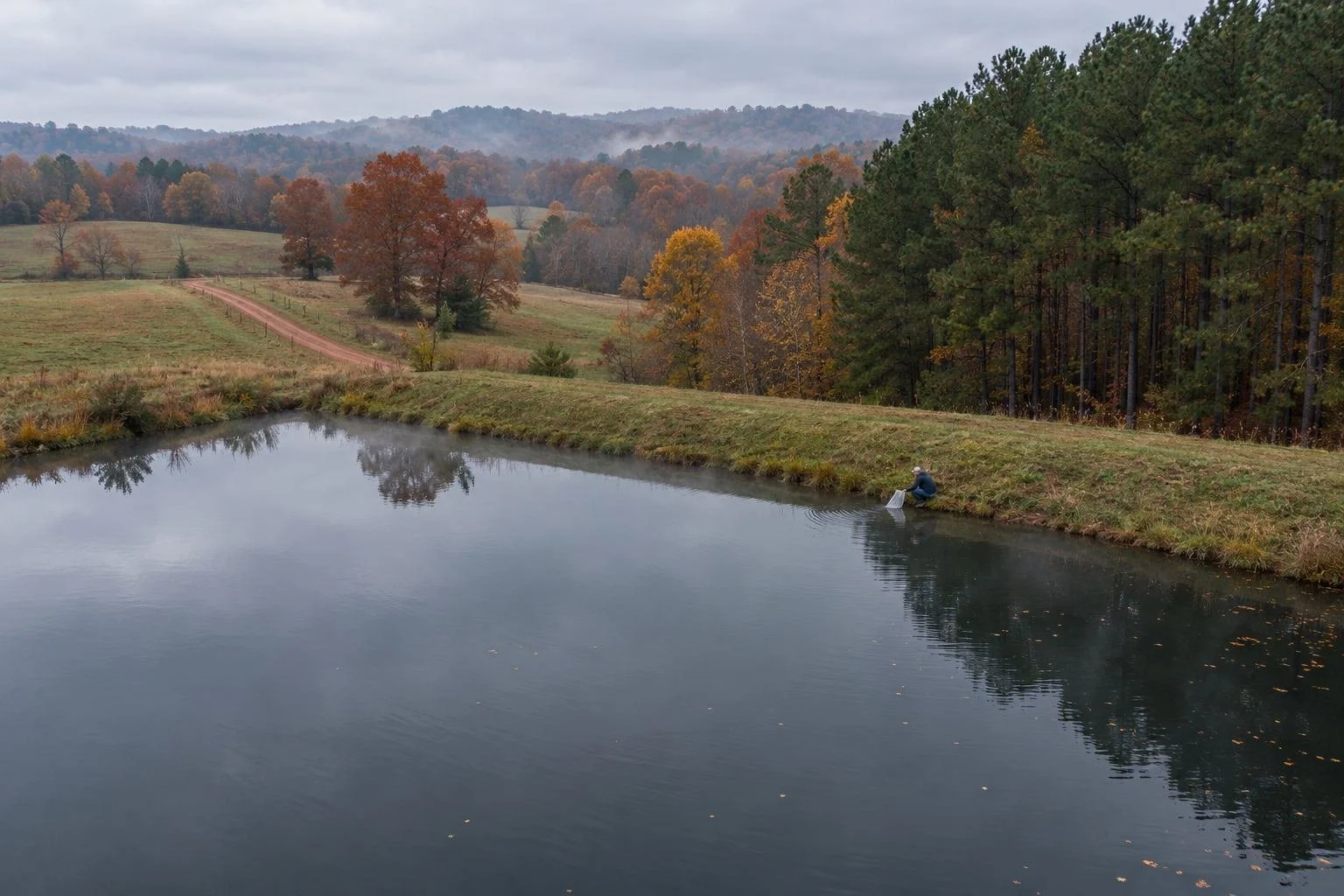
Stock bluegill and redear sunfish fingerlings in October or November, then add largemouth bass fingerlings the following June. North Carolina State University Extension sets that order so the sunfish grow big enough to escape the young bass and become their food supply. Channel catfish can go in with the sunfish. If the pond already holds fish, check the population before buying more.¹
When is the best time to stock fish in a North Carolina pond?
For a new pond, the best time is right now. North Carolina State University Extension's Pond Management Guide calls for sunfish fingerlings in the fall, usually October or November, and largemouth bass fingerlings the following June.¹ Aim to have the sunfish delivered by the end of November to stay on that schedule. Clemson Extension allows bream in fall or winter, but the sequence never changes: sunfish first, bass months later.²
Cool weather also helps the fish survive the trip. Fish are typically transported during cool weather to reduce handling stress, according to Kentucky State University's extension aquaculture specialist.³ Mississippi State University Extension advises against hauling fish at all when it is 85 degrees or hotter outside.⁴ By late October the Piedmont has turned that corner; Statesville's average first fall frost is October 19.⁵
This guide from Clearwater Lake, Pond and Stormwater Management Services covers stocking order, per-acre numbers and existing ponds, from Lake Norman farm ponds to Triad HOA ponds. New ponds should be full by September or early October.¹
Why do bluegill and redear go in before the bass?
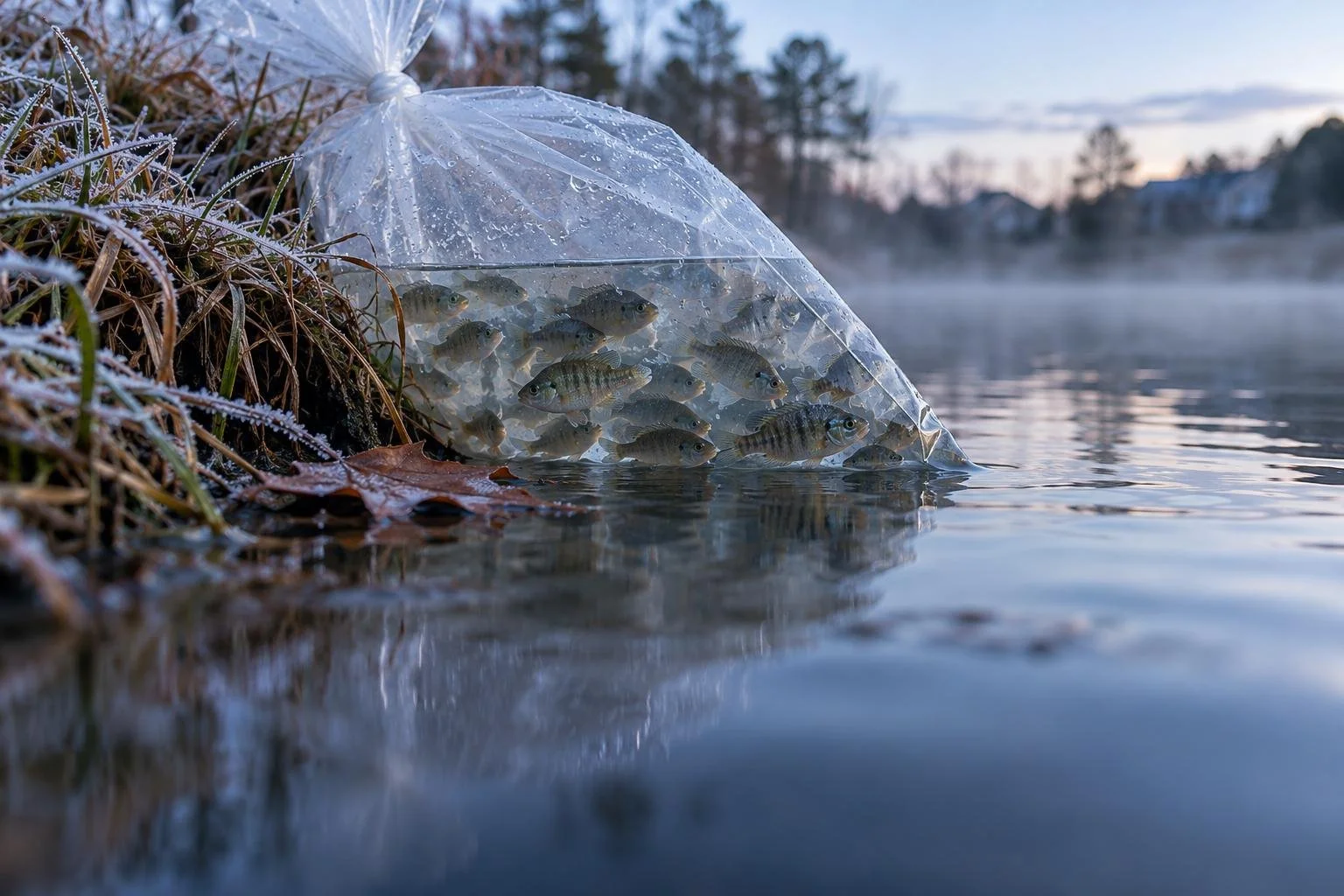
Because the bass need something to eat, and the sunfish need a head start. North Carolina State's guide stocks sunfish first so they can grow large enough to avoid being eaten, and because bluegill are the primary food source for largemouth bass.¹ Fall fingerlings mature and spawn before the bass go in. Bluegill spawn from late spring, starting at about 70 degrees, into early fall, so June bass arrive to a pond already producing the small fish they eat.⁶
Redear sunfish, also called shellcrackers, round out the forage and help with snail control.⁶ Clemson's fact sheet uses about three bluegill for every redear and roughly ten sunfish for every bass, and it stocks bass in spring so they reach spawning size by the following spring.²
The goal is balance. Mississippi State University Extension defines a balanced pond as one where predator and prey are both reproducing and growing at a desirable rate. Too many bass and they run short of bream to eat, so bass growth is poor. Too few bass and the bream overpopulate and stay small.⁷
How many bluegill and bass per acre should you stock?
For a new pond of 10 acres or less, North Carolina State recommends 350 bluegill, 150 redear sunfish and 50 largemouth bass per acre if the pond is not fertilized, and double those numbers if it is.¹ Channel catfish are optional at 50 per acre unfertilized or 100 fertilized. Sunfish go in at 1 to 2 inches; bass and catfish at 2 to 4 inches.
New pond stocking guide for North Carolina (ponds of 10 acres or less)
| Species | Fish per acre, unfertilized | Fish per acre, fertilized | Fingerling size | When to stock |
|---|---|---|---|---|
| Bluegill | 350 | 700 | 1 to 2 inches | October to November |
| Redear sunfish | 150 | 300 | 1 to 2 inches | October to November |
| Channel catfish (optional) | 50 | 100 | 2 to 4 inches | October to November |
| Largemouth bass | 50 | 100 | 2 to 4 inches | The following June, after the sunfish |
Rates from North Carolina State University Extension's Pond Management Guide, Option 1 (fingerlings, one bass for every ten sunfish).¹ For ponds well under 1 acre, the guide suggests 100 channel catfish (2 to 4 inches) and 300 hybrid sunfish (1 to 2 inches) per acre in June or July instead. Ponds over 10 acres and ponds that already hold fish need a site-specific plan.
Use the unfertilized column unless you are certain you will fertilize every year. Clemson's guidance is to use the unfertilized rate if you are unsure.² North Carolina State adds that fertilization, once started, should continue every year, and should be skipped in weedy ponds or ponds with extensive shallows.¹
Small ponds are different. For ponds well under 1 acre, North Carolina State's best option skips the bass and bluegill plan: 100 channel catfish and 300 hybrid sunfish per acre, stocked in June or July, fed a commercial diet and restocked periodically.¹ Clemson notes that ponds under half an acre cannot reliably produce quality bass and bream over the long term.² Keep hybrid sunfish out of any pond managed for bass and bluegill; they can interbreed with bluegill and reduce forage for the bass.¹
Should you add fish to a pond that already has fish?
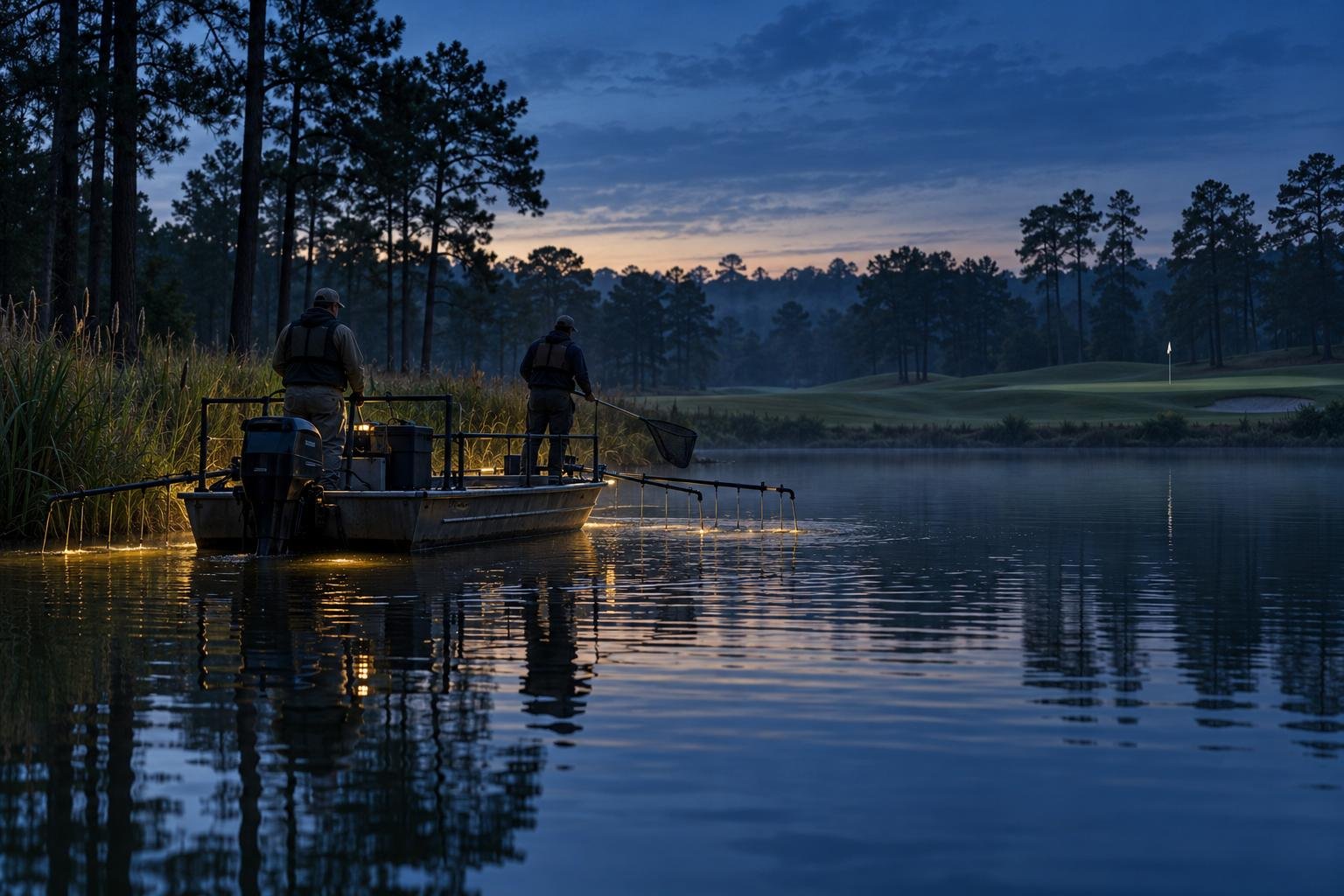
Usually not, until you know what is already swimming there. North Carolina State's guide says stocking a pond that already contains fish is normally not recommended, with supplemental channel catfish or hybrid sunfish as the exceptions.¹ In an established pond, the fix for imbalance usually starts with removing fish, not adding them.⁷ Three ways to read the population:
Angler catch records. Log the number, length and weight of fish harvested. In a balanced pond, bluegill run 6 inches and larger and bass average 1 to 2 pounds. A catch of mostly 3 to 5 inch bluegill, with few bass and those few over 2 pounds, points to overcrowded bluegill. Bluegill averaging more than a third of a pound alongside skinny bass under a pound points to too many bass.¹
Seine check. North Carolina State uses a 20 by 4 foot minnow seine with quarter-inch mesh, pulled at four or five shoreline spots in July or August in ponds at least two years old, then compares the catch of young bass and bluegill to a reference table.¹
Electrofishing survey. A fisheries consultant samples shoreline fish such as bass, bluegill and redear with electrofishing gear, ideally at night when bass move toward shore, then scores size structure. For a balanced bass population, proportional stock density should fall between 40 and 60 percent.⁸
That homework now falls on the owner. Wildlife Resources Commission district fish biologists noted in a 2023 Extension-hosted presentation that the agency no longer makes site visits for private waters.⁹
Fixes depend on the problem. For overcrowded bass, North Carolina State says to harvest about 20 bass per acre and reassess. For overcrowded bluegill with few bass present, the guide allows stocking 50 advanced 6 to 8 inch bass fingerlings or 20 adult bass over 10 inches per acre.¹ Mississippi State's bluegill fix starts with controlling aquatic weeds first.⁷
Can you stock channel catfish, and what are the rules?
Yes. Channel catfish are the one optional species North Carolina State builds into the standard plan, at 50 to 100 per acre, 2 to 4 inches long, stocked with the sunfish in the fall.¹ They come with conditions:
Plan to restock. Channel catfish may spawn in a bass pond, but predation limits survival of the young.¹ Mississippi State says they usually do not reproduce well with largemouth bass and must be restocked periodically.⁴
Restock with big fish. Supplemental catfish should be 8 to 10 inches long,¹ large enough that the bass will not eat them.⁴
Feed them. Catfish are one of the species North Carolina State recommends feeding. They can be harvested freely, though heavy early harvest means restocking sooner.¹
Ask about health. Ask the supplier to guarantee catfish fingerlings free of exposure to channel catfish virus.¹⁰
Channel cats only. Blue catfish and flathead catfish are on the undesirable list from state district fish biologists.⁹
Which fish should you keep out of a small pond?
Crappie top the list. North Carolina State says crappie are not suitable for most ponds because they tend to overpopulate, leaving stunted crappie, bluegill and bass; the guide reserves them for ponds over 30 acres, and only after consulting a biologist. It also does not recommend gizzard shad, bullheads or common carp.¹ Gizzard shad can grow too large for most predators to eat.⁶ District fish biologists add green sunfish, warmouth and white perch to the undesirable list.⁹
Never move fish from a creek, a lake or a neighbor's pond. Mississippi State warns that it risks disease, misidentified species and numbers that throw off balance.⁴ Triploid grass carp are the one non-sport fish many owners add on purpose, for weed control. They carry their own permit and stocking-rate rules, covered in our guide to getting rid of pond weeds.
What water quality does a pond need before you stock fish?
Fish need a pH between 6.5 and 9.0, total alkalinity above 20 ppm, and dissolved oxygen that stays above about 3 mg/L. North Carolina State notes fishing is usually poor below pH 6.0 and that ponds under 20 ppm alkalinity need lime before fertilizer will work.¹ Clemson Extension puts ideal alkalinity near 100 ppm and says oxygen below 3 mg/L stresses fish and makes them more susceptible to disease.¹¹
Test first. Use kits that read in 5 ppm steps, or send a sample to the North Carolina Department of Agriculture and Consumer Services.¹
Lime in the same window. North Carolina State calls for a soil test to set the lime rate (six samples per acre in an existing pond), pulverized agricultural lime in late fall or early winter, and a repeat every three to four years. Never use hydrated or builder's lime, which can kill fish.¹
Watch oxygen. Oxygen depletion is the most common cause of fish kills, especially after overfertilization, herbicide use, or cloudy, hot weather.¹ The summer fish kill guide covers the warning signs.
Where do you buy fish, and do you need a permit?
Buy from a licensed hatchery or fish supplier, and check whether your pond counts as public water. The North Carolina Department of Agriculture and Consumer Services licenses hatcheries and production facilities for bluegill, redear sunfish, channel catfish and northern-strain largemouth bass,¹² and North Carolina State's guide notes the department keeps a list of in-state suppliers.¹ The Extension office in Haywood County also posts a list of companies that sell fish for pond stocking.¹³
Questions for the supplier. Get a written warranty with replacement terms, because fish can die days after delivery from hauling stress, poor tempering or disease. Ask whether the supplier raises the fish or buys them from a third party.⁴ Compare several suppliers on price and delivery.¹
Permits. Under the North Carolina Wildlife Resources Commission's definition, a private pond sits on land held by one owner or group, lets no fish escape, and lets no legal-size fish in from public waters. Stocking that pond needs no permit, except for grass carp.¹⁴ A pond with a stream flowing in or out is not self-contained, and stocking it requires a fish stocking permit from the Commission.¹ The permit is free, starts with a call to your district fisheries biologist, and can take up to 60 days for a written response, so a creek-fed pond aiming for November should apply now.¹⁴
How should you feed newly stocked fish?
Feed sunfish and catfish only when the water is above 65 degrees, and only what they clean up in 10 to 15 minutes. North Carolina State caps feeding at 10 pounds per acre per day, recommends a floating commercial feed with 28 to 32 percent protein, and suggests mixing fingerling and grow-out pellets for bluegill. Stop above 90 degrees, and stop whenever fish quit eating, because uneaten feed decays and can trigger oxygen depletion and fish kills.¹
Largemouth bass usually ignore pellets unless trained.¹ For November fingerlings, the 65 degree rule means the feeder stays off until spring once the water cools, which matches the fall pond maintenance checklist.
How does stocking fit with aeration and weed control?
Fish, oxygen and weeds work as one system. North Carolina State notes aeration is most important at night, when oxygen becomes most depleted.¹ If the pond needs an aeration system, plan it alongside stocking; the aeration sizing guide walks through the math. Most diffused systems can be powered down from late November through early March, but year-round operation is the better choice for heavily stocked ponds.
Weeds hide bluegill. When vegetation is dense, bream often become overcrowded and stunted because the weeds keep bass from thinning them out. Treat no more than one-fourth to one-third of the pond with herbicide at a time and wait 5 to 7 days between treatments, since herbicide use is a known trigger for oxygen depletion.¹
What changes for HOA, golf course and farm ponds?
HOA stormwater ponds. Many community ponds are wet ponds built as stormwater control measures, and North Carolina rules tie those to a recorded operation and maintenance agreement that makes the owner responsible for maintaining the system.¹⁵ Before stocking or installing an automatic feeder, pull that agreement and the O and M plan and confirm fish and feeders fit it. HOA pond management works best when the fishery and the stormwater function are planned together.
Golf and community fishing ponds. Catch-and-release-only rules can backfire. Clemson notes that both underfishing and overfishing can produce small, stunted fish,² and North Carolina State's harvest guideline is about 10 to 20 bass per acre per year in the 10 to 12 inch range.¹ Golf course ponds that double as fishing amenities need a harvest rule.
Farm and private ponds. Rotenone, used to reclaim a pond full of unwanted fish, may only be applied by certified applicators, and treated water should not go to livestock for at least 10 days.¹ For farm and large-land ponds and private residential ponds, the fall order is the same: test the water, read the fish, then stock.
A fall pond and fishery assessment covers that order in one visit: water chemistry and lime needs, weed cover, aeration capacity and what catch records say about balance, before a single fish is ordered. It pairs naturally with ongoing pond management.
Stocking this fall? Get the pond and its fish checked before the truck arrives.
Call (704) 450-1598 or request service at clearwaterlpm.com.
Frequently Asked Questions
Can I stock fish in a new pond that is not full yet?
Usually, yes. Mississippi State University Extension says a new pond does not need to be full at fall stocking as long as it fills by the following spring, and it bases fish numbers on the full pond acreage rather than the surface area on stocking day.⁴ North Carolina State's guide aims for new ponds to be filled by September or early October, so a pond still filling in late fall is workable but not ideal.¹
How long after stocking can we start keeping fish?
Plan on patience. North Carolina State's guide says sunfish harvest should not begin until the second year after stocking, and largemouth bass not until the third year or until they reach 12 to 14 inches.¹ Catch-and-release can happen sooner. Keeping bass too early removes the predators that stop bluegill from overpopulating, which undoes the balance the stocking plan was built to create.
Can we stock adult fish instead of fingerlings to fish sooner?
Yes. North Carolina State offers an adult option in April: 70 bluegill and 30 redear sunfish at 3 to 5 inches, plus 20 largemouth bass at 8 to 14 inches, per acre. Catch-and-release can start right away, with modest sunfish harvest after one year and bass harvest after two years or once they reach 12 to 14 inches.¹ It is a spring plan, so it does not replace fall fingerling stocking.
What should we do when the fish delivery arrives?
Temper the fish before release. Float the unopened bags in the pond until the water inside matches, allowing at least 20 minutes for every 10 degrees of difference, and release quickly once a bag is opened because the oxygen escapes.¹⁰ Mississippi State suggests floating bags at least 30 minutes, out of direct sun.⁴ Healthy fish swim quickly to deeper water; fish that sink or swim weakly are stressed.¹⁰
Can I stock trout in a Piedmont pond?
Generally, no. North Carolina State's guide says suitable trout ponds are generally above 3,000 feet with good water flow, and it warns against ponds that exceed 70 degrees for more than a few hours.¹ Ponds around Charlotte, Statesville, Hickory and the Triad sit well below that elevation, so bluegill, redear sunfish, largemouth bass and channel catfish remain the practical warmwater choices for a Piedmont fishing pond.
Will fish help control mosquitoes in an HOA stormwater pond?
They can. North Carolina State Extension's stormwater guidance calls mosquitofish extremely effective at limiting mosquito population growth, and research it cites found fewer mosquitoes in ponds and wetlands where mosquitofish were present. They need at least 18 inches of permanent water to survive. The same publication notes they can reduce the diversity of a wet pond system, so treat them as a deliberate choice and check the pond's O and M plan first.¹⁶
Sources
1. Rice, J. A., J. M. Fisk II, and R. J. Richardson, eds. Pond Management Guide. AG-424. Raleigh: North Carolina State Extension, May 9, 2024. https://content.ces.ncsu.edu/pond-management-guide.
2. Whetstone, Jack M., Mac Watson, Lance Beecher, and W. Cory Heaton. "Stocking and Harvesting Recreational Fish Ponds." HGIC 1712. Clemson Cooperative Extension Home and Garden Information Center, revised May 3, 2023. https://hgic.clemson.edu/factsheet/stocking-harvesting-recreational-fish-ponds/.
3. Wynne, Forrest. "Stocking Recreational Fish Ponds." University of Kentucky Martin-Gatton College of Agriculture, Food and Environment, April 15, 2021. https://exclusives.mgcafe.uky.edu/2021/anr/stocking-recreational-fish-ponds.
4. Neal, Wes. Sport Fish Suppliers and Stocking Guidelines for Stocking Mississippi Ponds. Publication 2525. Mississippi State: Mississippi State University Extension Service, 2025. https://extension.msstate.edu/publications/sport-fish-suppliers-and-stocking-guidelines-for-stocking-mississippi-ponds.
5. North Carolina State Extension. "Average First Fall Frost Dates for Selected North Carolina Locations." Raleigh: North Carolina State Extension. Accessed October 28, 2026. https://content.ces.ncsu.edu/average-first-fall-frost-dates-for-selected-north-carolina-locations.
6. Stone, Nathan. Forage Fish: Introduction and Species. SRAC Publication No. 140. Southern Regional Aquaculture Center, revised September 2008. https://srac.tamu.edu/fact-sheets/serve/12.
7. Mississippi State University Extension Service. "Manipulating Pond Balance." Accessed October 28, 2026. https://extension.msstate.edu/natural-resources/fisheries/pond-and-lake-management/fish-management/manipulating-pond-balance.
8. Higginbotham, Billy. "Fish Population Assessment and Interpretation for Private Waters." College Station: Texas Cooperative Extension. Accessed October 28, 2026. https://extension.rwfm.tamu.edu/wp-content/uploads/sites/9/2010/04/3_Fish_Popl_Assessment.pdf.
9. Guiot, Danci, and Seth Mycko. "Fish Management in Ponds." Presentation by District 5 fish biologists, August 28, 2023. Posted by North Carolina State Extension, Granville County Center. https://granville.ces.ncsu.edu/wp-content/uploads/2023/09/NC-Extenstion-Fish-Management-in-Ponds_DLG.pdf.
10. McGee, Michael, and Charles Cichra. "Fish Fingerlings: Purchasing, Transporting, and Stocking." FA013. Gainesville: University of Florida IFAS Extension, revised 2024. https://ask.ifas.ufl.edu/publication/FA013.
11. Jackson, Karen E., and C. Guinn Wallover. "Recreational Pond Chemistry." HGIC 1880. Clemson Cooperative Extension Home and Garden Information Center, May 8, 2020. https://hgic.clemson.edu/factsheet/recreational-pond-chemistry/.
12. North Carolina General Assembly. North Carolina General Statutes, Section 106-761. Accessed October 28, 2026. https://ncleg.gov/EnactedLegislation/Statutes/HTML/BySection/Chapter_106/GS_106-761.html.
13. North Carolina State Extension, Haywood County Center. "List of Companies That Sell Fish for Pond Stocking." Accessed October 28, 2026. https://haywood.ces.ncsu.edu/list-of-companies-that-sell-fish-for-pond-stocking.
14. North Carolina Wildlife Resources Commission. "Fish Stocking and Grass Carp Possession Permits." Accessed October 28, 2026. https://www.ncwildlife.gov/fishing/hatcheries-and-stocking/fish-stocking-and-grass-carp-possession-permits.
15. North Carolina Administrative Code. Title 15A, Chapter 02H, Section .1050. Raleigh: Office of Administrative Hearings. http://reports.oah.state.nc.us/ncac/title%2015a%20-%20environmental%20quality/chapter%2002%20-%20environmental%20management/subchapter%20h/15a%20ncac%2002h%20.1050.pdf.
16. North Carolina State Extension. "Mosquito Control for Stormwater Facilities." Raleigh: North Carolina State Extension, July 9, 2020. https://content.ces.ncsu.edu/mosquito-control-for-stormwater-facilities.