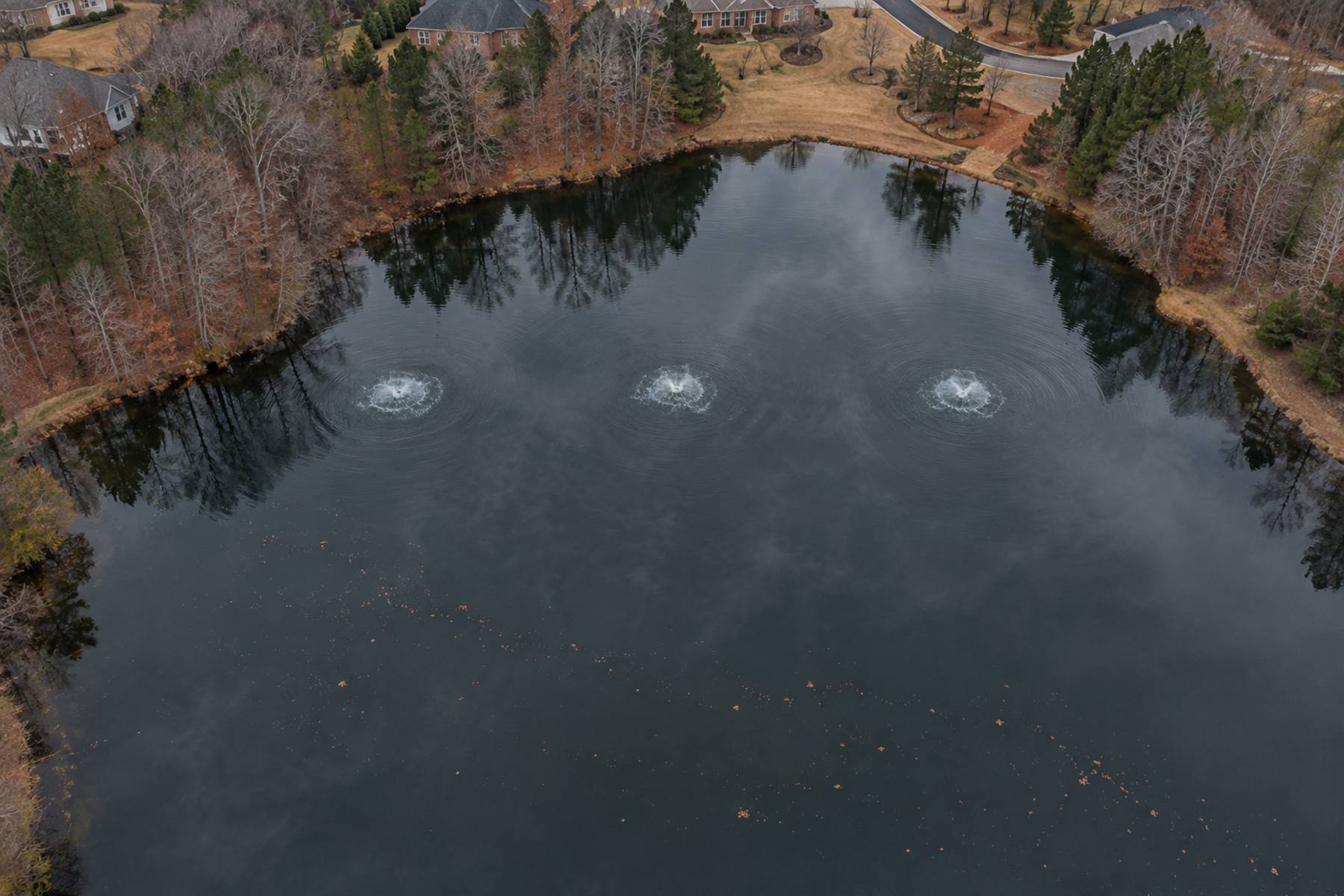
Size a pond aeration system by depth first, then by surface area and shape. Bottom diffusers lose coverage fast in shallow water: one manufacturer's chart shows the same small system covering a quarter acre at 6 to 9 feet deep and a full acre at 12 feet or deeper. North Carolina's wet pond standard calls for an average depth of 3 to 8 feet, so stormwater ponds usually need more diffusers than their acreage suggests.
What actually decides the size of a pond aeration system?
Five things decide it: depth, surface area, shape, how much the pond has to digest, and how far the pond sits from power. Horsepower is the last thing to choose, not the first. A compressor is only as useful as the diffusers it feeds and where those diffusers sit.
A common mistake across the North Carolina Piedmont, from Statesville farm ponds to Lake Norman neighborhood ponds, is a system bought by acreage alone and dropped into water shallower than the box assumed. The pond gets a strong boil in the middle and still grows algae in the corners. At Clearwater Lake, Pond and Stormwater Management Services, sizing starts with a depth map, not a catalog.
Clemson Cooperative Extension's rule of thumb is one diffuser unit per one to two acres, with more diffusers for shallow ponds and for ponds with odd shapes, bottlenecks or narrow arms.¹ That range is wide on purpose. Where your pond lands in it depends mostly on depth.
Why does depth matter more than acreage?
A diffuser works by lifting water. Air released near the bottom rises as a column of bubbles and drags bottom water up with it, which breaks up the summer layering that starves the bottom of oxygen. The deeper the release point, the longer each bubble stays in the water and the more water it moves. The Southern Regional Aquaculture Center notes that bubbles in shallow ponds rise too quickly to transfer much oxygen, while deeper release points work better because of the added water pressure and contact time.²
That is why aeration guidance often treats 8 feet as a dividing line. Kentucky State University's aquaculture program says diffused systems are generally used in ponds 8 feet or deeper, while surface aerators suit ponds 8 feet or shallower.³ University of Florida IFAS reaches the same split from the other side: fountains are not recommended for aeration in ponds deeper than about 8 feet, and bubblers do that mixing better.⁴
North Carolina's stormwater ponds sit right on that line. The North Carolina Department of Environmental Quality (NCDEQ) wet pond standard calls for a main pool with an average depth of three to eight feet.⁵ Clemson notes that most stormwater ponds are 6 feet deep or less.¹ So the typical HOA or office park pond in Charlotte, Mooresville or Concord sits in the depth band where every diffuser covers the least ground.
Manufacturer charts make the effect concrete. The table below uses one manufacturer's published coverage chart for a single product line. It is not a product recommendation; it shows how quickly coverage shrinks as the water gets shallower.
How depth changes what one aeration system covers
| System | 6 to 9 feet deep | 9 to 12 feet deep | 12 to 50 feet deep | Power draw |
|---|---|---|---|---|
| 1 diffuser, 1/4 hp | 1/4 acre | 1/2 acre | 1 acre | 184 watts |
| 2 diffusers, 1/2 hp | 1/2 acre | 1 acre | 2 acres | 472 watts |
| 4 diffusers, 3/4 hp | 2 acres | 3 acres | 4 acres | 495 watts |
| 6 diffusers, 1 hp | 3 acres | 6 acres | 6 acres | 725 watts |
Maximum surface area per system from one manufacturer's published PondSeries specifications, shown to illustrate the depth effect. Real sizing also weighs shape, nutrient load and fish.⁶
Read across any row and the pattern holds: in 6 to 9 feet of water, a system covers one quarter to one half of what it covers in 12 feet or more. Below 6 feet, the same manufacturer sells a separate shallow-water line rated for ponds up to 6 feet deep.⁷
How do I measure my pond for an aeration system?

You need three numbers: surface area, maximum depth and average depth. Penn State Extension's pond measurement guide lays out the methods.⁸
Surface area. For a rectangular pond, multiply length by width in feet and divide by 43,560 to get acres. For an irregular pond, trace the shoreline on Google Earth or walk it with a GPS unit. A GPS walk is accurate to about 1 percent when you mark every change in shape.
Maximum depth. Sound the pond from a boat with a weighted line or a marked pole, working in a grid. Winter, with plants died back and the water clearer, is the easiest time to do it.
Average depth. For a typical bowl-shaped pond, average depth runs about 0.4 times the maximum depth, so a pond 10 feet at its deepest averages about 4 feet. Readings taken along straight lines across the pond give a better number.
Volume. Multiply surface acres by average depth to get acre-feet. One acre-foot holds 325,851 gallons.
Worked through, a 1-acre pond that is 10 feet at its deepest averages about 4 feet and holds about 4 acre-feet, or roughly 1.3 million gallons. Volume matters because aeration is really a circulation job. One manufacturer's sizing guide for its diffused systems is built around turning the pond's full volume over every 48 hours or better.⁹
How many diffusers does my pond need?
Start with the depth band and the acreage, then add diffusers for shape. Clemson's guidance is direct: ponds with odd shapes, bottlenecks or narrow canals may need several diffusers so each section mixes.¹ A single boil in the middle of an L-shaped pond leaves the far leg stagnant, and that is usually where the algae starts.
Three examples from typical Piedmont ponds, using the coverage chart above as a starting point:
Half-acre HOA wet pond, 8 feet at the deepest. It sits in the 6 to 9 foot band, where a two-diffuser system covers about half an acre. Start with two diffusers in the deepest water, spaced apart, and confirm the pond's stormwater agreement allows the work.
One-acre office park pond, 10 feet deep, long and narrow. In the 9 to 12 foot band, a two-diffuser system covers about an acre, but the shape argues for a third diffuser at the narrow end.
Two-acre farm pond, 14 feet deep, roughly round. At 12 feet or more, a two-diffuser system covers about 2 acres, which lands right on Clemson's one-per-one-to-two-acres rule.
Then adjust for load. A pond that takes runoff from fertilized lawns, holds a heavy fish population or has a history of summer fish kills needs margin. Kentucky State's guidance puts recreational ponds at one half to 1 horsepower of aeration per surface acre and heavily stocked production ponds at 1 to 3 horsepower per acre.³ If your pond has turned green or smelled every summer, size toward the top of the range. Our guides to summer fish kills and summer pond odor explain why that history matters.
Is a fountain or a surface aerator a better fit for a shallow pond?
Sometimes, for oxygen near the surface. North Carolina State Extension notes that surface aerators drawing water from just below the surface suit shallow ponds but do not break up layering in deeper ponds, and that fountains spraying water high into the air are relatively inefficient aerators.¹⁰ Clemson ranks surface fountains as the least efficient option because they mostly recirculate water that already holds oxygen.¹
Regulated wet ponds add one more wrinkle. The NCDEQ wet pond standard treats fountains as optional, requires documentation that a fountain will not resuspend sediment or cause erosion, and recommends drawing its water from less than 2 feet below the permanent pool.⁵ A fountain built that way is a surface feature, not a bottom-to-top mixer. If the goal is oxygen at the bottom, a diffused system does that job and a fountain adds the look. Our comparison of aeration and fountains for commercial ponds covers the trade-off, and the fountain repair and winter care guide covers upkeep.
What does a pond aerator cost to run in North Carolina?
Less than most boards expect, because diffused systems run on small compressors. Using the power draws in the table and the U.S. Energy Information Administration's 2025 North Carolina average prices of 14.00 cents per kilowatt-hour for homes and 10.22 cents for commercial accounts, running around the clock works out to roughly:¹¹
A 184-watt, one-diffuser system: about $19 a month at the residential rate, or $14 at the commercial rate.
A 472-watt, two-diffuser system: about $48 a month residential, or $35 commercial.
A 725-watt, six-diffuser system: about $74 a month residential, or $54 commercial.
These are estimates at state average prices, and your utility rate and compressor will move them. Running continuously matters more than the bill. Clemson warns that switching a system on and off lets the pond restratify, and turning it back on can trigger the turnover you bought it to prevent.¹ North Carolina State Extension adds that aeration matters most at night, when oxygen runs lowest.¹⁰ That is also why solar-only systems struggle: Kentucky State notes they do not run reliably at night, on cloudy days or on calm summer days.³
Where should the compressor and diffusers go?
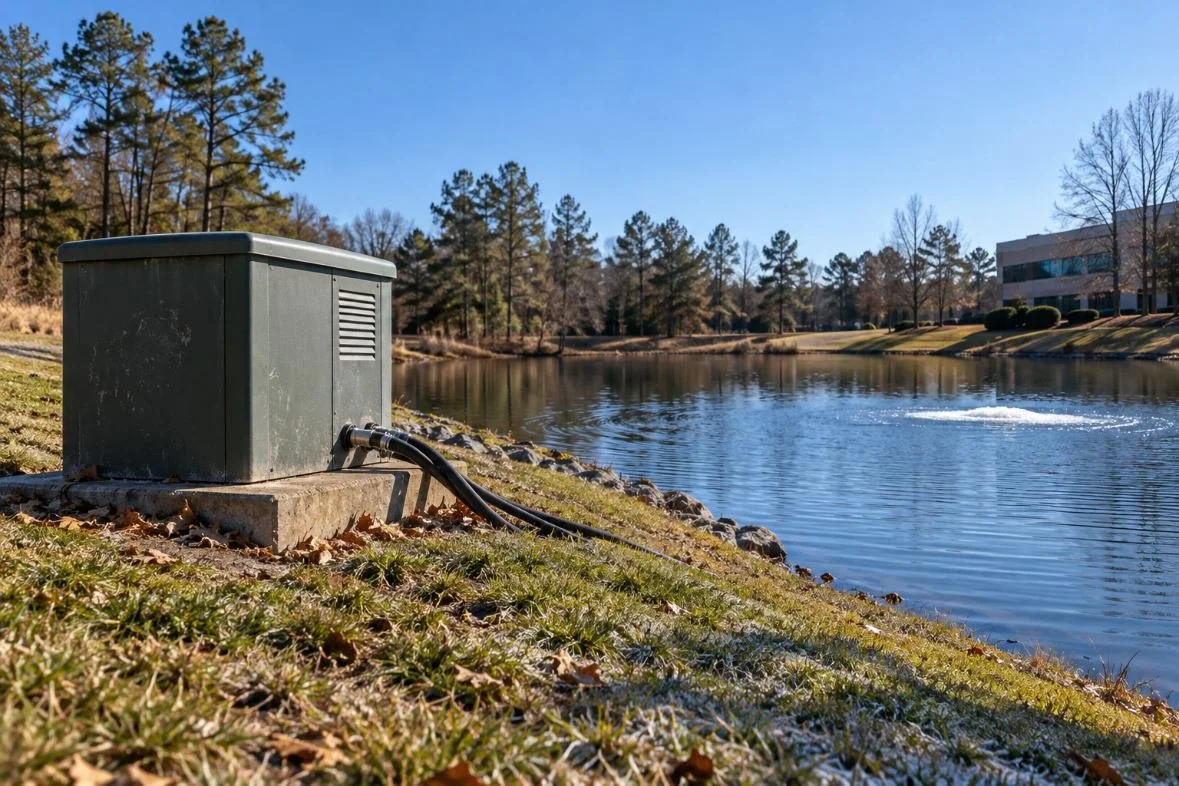
Diffusers go in the deepest water you have, spread so their circulation zones overlap, near the bottom but not buried in it. Kentucky State recommends setting diffusers on a plate or tray so mud, plants and debris do not block the bubbles.³ Keep them back from the banks. Clemson notes circulation can increase shoreline erosion, especially in small ponds without shoreline protection or with equipment placed too close to the bank.¹ Think twice before putting one in a stormwater pond's forebay, where stirring trapped sediment works against the pond's job.
The compressor needs power, ventilation and a short, sensible airline run. University of Florida IFAS lists electrical access as a selection factor in its own right.⁴ On HOA common areas, the nearest power is often at an entrance sign or a pump station, so plan the trench, the cabinet pad and the noise before choosing equipment. Our pond aeration systems page outlines how Clearwater designs and installs them.
When is the best time to install pond aeration in North Carolina?
Now through early spring. Clemson recommends installing before the pond stratifies, typically from late fall through April, because starting a new system in a layered summer pond can cause a man-made turnover.¹ The Piedmont's cold season is already underway: North Carolina State Extension puts the average first fall frost at Statesville on October 19.¹² Cool water lowers the start-up risk too. The Southern Regional Aquaculture Center notes low-oxygen problems are rare below 60 degrees Fahrenheit and common above 80.²
If a system has to go in after the pond has layered, start it slowly. Clemson's guidance is 10 minutes a day for the first two weeks,¹ and University of Florida IFAS suggests starting diffusers shallow and lowering them about a foot a week while watching dissolved oxygen.⁴ After start-up, run it continuously. Many Piedmont systems can rest from late November through early March, as our complete pond and lake aeration guide explains, but heavily stocked or nutrient-rich ponds do better running year-round.
Can you add aeration to an HOA stormwater pond?
Usually, but check the paperwork first. Many HOA ponds in Mecklenburg, Iredell and Cabarrus counties are stormwater control measures with a recorded operation and maintenance agreement. The NCDEQ wet pond chapter addresses fountains but does not mention aerators,⁵ so your agreement and your local stormwater program decide what needs approval. Tell whoever performs your annual inspection what you are adding and where the airline runs.
Then budget it like any other common-area utility. Our 2027 retention pond budget guide shows where power and equipment belong in the annual plan, and the HOA pond and stormwater management page covers the rest of the program.
How can you tell an aeration system is undersized?
The pond tells you. Watch for these signs:
Dead corners. Algae, scum or floating plants in coves and at the far ends of the pond while the middle looks fine.
Fish at the surface at dawn. North Carolina State Extension's warning sign for low oxygen is fish gulping at the surface early in the morning. If you see it, stop feeding and aerate immediately.¹⁰
Summer odor. A rotten-egg smell after hot, still weather means the bottom is going without oxygen.
A weak or uneven boil. Small, scattered bubbles instead of a strong rolling boil can point to a clogged diffuser or a compressor that is wearing out.
Any of these is worth a look before next summer. Weak boils and worn compressors are an aeration system repair job. Dead corners usually mean the pond needs more diffusers in the right places, not a bigger compressor.
Want your pond measured and sized before spring?
Call (704) 486-4141 or request service at clearwaterlpm.com.
Frequently Asked Questions
How many acres does one pond aerator diffuser cover?
It depends on depth more than anything. In one manufacturer's published chart, a single-diffuser system covers about a quarter acre in 6 to 9 feet of water and about 1 acre at 12 feet or deeper.⁶ Clemson Cooperative Extension's general rule is one diffuser per one to two acres, with more for shallow or irregular ponds.¹
Can a pond be too shallow for bottom aeration?
Bottom diffusers still help in shallow water, but each one covers far less ground because bubbles rise too quickly to transfer much oxygen.² Ponds under about 6 feet usually need more diffusers, a shallow-water system or a surface aerator. North Carolina State Extension notes that surface aerators suit shallow ponds.¹⁰
Should a pond aerator run 24 hours a day?
Yes, once it is running for the season. Clemson warns that running a system on and off lets the pond restratify, and restarting it can trigger a turnover and fish kill.¹ Many Piedmont systems can rest from late November through early March, but heavily stocked or nutrient-rich ponds benefit from running year-round.
Is solar pond aeration enough for a North Carolina pond?
Usually not on its own. Kentucky State University's aquaculture program notes that solar and wind aerators do not run reliably at night, on cloudy days or on calm summer days.³ Night is when pond oxygen runs lowest, so a solar-only system tends to fall short exactly when it is needed most. Where power is far away, it can still help a small pond as a supplement.
How much electricity does a pond aerator use?
Small diffused systems draw roughly 184 to 725 watts, based on one manufacturer's specifications.⁶ At North Carolina's 2025 average commercial rate of 10.22 cents per kilowatt-hour, that is about $14 to $54 a month running around the clock.¹¹ Clemson notes that pump-driven systems use more energy than air compressors.¹
Do I need permission to add aeration to an HOA stormwater pond?
Check before you install. Many HOA ponds are stormwater control measures with a recorded operation and maintenance agreement, and the NCDEQ wet pond standard addresses fountains but not aerators.⁵ Your agreement and local stormwater program decide what needs approval, so share the plan with your inspector before work starts.
Sources
1. Clemson Cooperative Extension, "Aeration, Circulation, and Fountains," Stormwater Ponds, Clemson University, accessed October 28, 2026, https://www.clemson.edu/extension/water/stormwater-ponds/problem-solving/aeration-circulation.html.
2. Craig Tucker, "Pond Aeration," SRAC Publication No. 3700 (Stoneville, MS: Southern Regional Aquaculture Center, September 2005), https://srac.msstate.edu/pdfs/Fact%20Sheets/3700%20Pond%20Aeration.pdf.
3. Forrest Wynne, "Use of Aeration and Water De-stratification Devices in Recreational Ponds," Kentucky State University Aquaculture Program, n.d., https://aquaculture.o2.boa.ca.uky.edu/sites/aquaculture.ca.uky.edu/files/use_of_aeration_and_water_de-stratification_devices_in_recreational_ponds_0.pdf.
4. S. T. Howley, S. P. Hohman, and A. J. Reisinger, "Stormwater Pond Management: What You Need to Know about Aeration," SS695 (Gainesville: University of Florida IFAS Extension, July 29, 2025), https://ask.ifas.ufl.edu/publication/SS695.
5. North Carolina Department of Environmental Quality, "C-3. Wet Pond," in NCDEQ Stormwater Design Manual (Raleigh: NCDEQ, revised November 23, 2020), https://deq.nc.gov/media/17537/download.
6. Airmax, "PondSeries Aeration System Technical Specifications," product listing, Pond Haven, accessed October 28, 2026, https://pondhaven.com/products/airmax-ps10-1-acre-pond-aerator.
7. Airmax, "Shallow Water Series Aeration Systems for Ponds up to 6 Feet Deep," product page, The Pond Guy, accessed October 28, 2026, https://www.thepondguy.com/product/airmax-shallow-water-series-aeration-systems/.
8. Bryan R. Swistock and Tom McCarty, "Pond Measurements: Area, Volume and Residence Time," Penn State Extension, updated May 19, 2025, https://extension.psu.edu/pond-measurements-area-volume-and-residence-time.
9. Kasco Marine, "Robust-Aire Sizing Guide," distributed by M.K. Rittenhouse and Sons, accessed October 28, 2026, https://www.mkrittenhouse.com/media/pdf/301_kasco-robust-aire-sizing-guide.pdf.
10. North Carolina State Extension, "Pond Management Guide," North Carolina State University, accessed October 28, 2026, https://content.ces.ncsu.edu/pond-management-guide.
11. U.S. Energy Information Administration, "Table 2.10. Average Price of Electricity to Ultimate Customers by End-Use Sector, by State, 2025 and 2024," Electric Power Annual 2025 (Washington, DC: EIA, October 2026), https://www.eia.gov/electricity/annual/html/epa_02_10.html.
12. North Carolina State Extension, "Average First Fall Frost Dates for Selected North Carolina Locations," North Carolina State University, accessed October 28, 2026, https://content.ces.ncsu.edu/average-first-fall-frost-dates-for-selected-north-carolina-locations.