That Summer Pond Smell? It’s Muck — Here’s How To Repair Your Pond
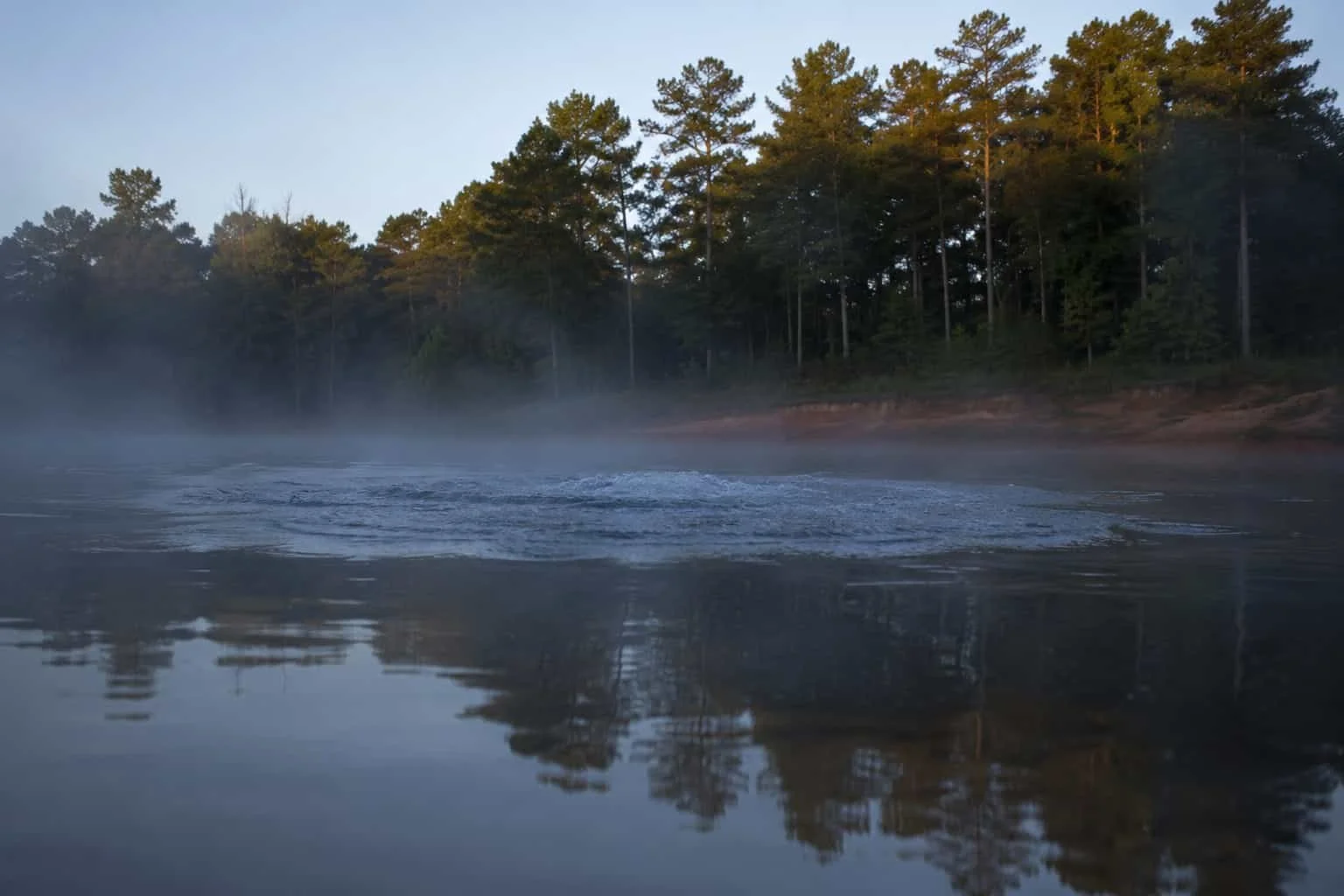
You walk down to the water on a hot afternoon and it hits you. Rotten eggs. Sulfur. Something turning over down there. Or you are on an HOA board and the third email this week says the pond behind the townhomes smells so bad nobody will sit on their patio. The usual response is that ponds just smell in the summer. They do not. That smell is a specific gas with a specific cause, and it is telling you something measurable about the bottom of your pond. Here is what it is, why it peaks in July and August across the North Carolina Piedmont, and the order the fixes have to happen in.
What that smell actually is
Hydrogen sulfide. Ponds stratify in summer. A warm surface layer sits on top of a cooler bottom layer, and the two stop mixing. North Carolina State Extension describes that bottom layer plainly: it is stagnant, low in dissolved oxygen, and it may contain high concentrations of toxic gases including carbon dioxide, hydrogen sulfide, and ammonia.¹ So the smell is not really a smell problem. It is a readout on oxygen. When you can smell sulfur at your own pond, the bottom of that pond has run out of oxygen and decomposition down there has switched to a process that produces gas instead of finishing the job.
What is decomposing is muck. Not clay, not the original pond bottom — muck is the accumulated organic layer sitting on top of it. Decades of leaf litter blowing in off the tree line, grass clippings from mowing to the edge, dead algae from every bloom the pond has ever had, goose and duck waste, uneaten fish feed, and fine sediment washed in by every Piedmont thunderstorm. Ponds that receive streamflow or stormwater runoff capture sediment over time. As it accumulates, water depth gets shallower, the ambient water temperature rises — especially during warmer months — and the nutrient-rich sediment becomes an internal source of nutrients feeding the next round of plant and algae growth.² Left alone long enough, most ponds fill in with sediment, become shallow wetlands, and eventually dry land.³
Your pond is not smelling because of one bad summer. It is smelling because of every summer that came before it.
Why it peaks in July and August here
Three things compound in a Piedmont summer. Stratification locks the bottom. From roughly June through September the water column stops turning over on its own. The bottom layer is sealed off from the atmosphere, and once its oxygen is spent, nothing replaces it.
Heat accelerates decomposition. Warmer water speeds up biological activity, which burns through the remaining oxygen faster. The shallower the pond has become, the warmer it runs and the faster this happens.⁴ Then a thunderstorm mixes it. This is the part people miss. High wind or cold rain can cause that stagnant bottom water to mix with the warmer water above it, and when it does, oxygen levels often drop low enough to kill fish.⁵ Oxygen depletion is the most common cause of fish kills, and it usually happens in summer.⁶ That is why the smell so often arrives all at once, the afternoon after a storm, across the entire pond instead of just along one bank. The storm did not create the problem. It unsealed it.
If your pond went from tolerable to unbearable overnight in August, treat that as a warning rather than a nuisance. The same event that released the odor is the event that kills fish. What your pond’s smell is telling you Not every pond odor means the same thing, and two of these are not pond problems at all. Use this before you spend money.
What your pond’s smell is telling you
Not every pond odor means the same thing, and two of these are not pond problems at all. Use this before you spend money.
| What you smell | Likely cause | What it means | What it needs |
|---|---|---|---|
| Rotten eggs or sulfur, strongest near the bank or after something stirs the bottom | Hydrogen sulfide escaping from anaerobic muck | The bottom of the pond has no oxygen | Sediment depth survey and an aeration assessment |
| Rotten eggs suddenly across the whole pond, usually a day after a storm | Turnover mixed the bottom layer to the surface | Active fish kill risk right now | Aerate immediately and call the same day |
| Musty, earthy, like wet dirt or fresh-cut grass | Algae, often a normal plankton population | Usually cosmetic rather than urgent | Monitor, and reduce nutrients from the surrounding land |
| Sharp sewage or septic odor, sometimes with gray water or suds | Possible sanitary sewer break or failing septic system | Not a pond problem | Contact your utility or a septic contractor first |
| Sharp ammonia smell | Ammonia accumulating under low-oxygen conditions | The system is stressed, same root cause as sulfur | Aeration assessment and water quality testing |
| No smell, but the pond is visibly shallower and the bottom feels soft underfoot | Muck accumulation without acute oxygen collapse yet | The problem is depth loss, not odor | Depth survey now, before it becomes the row above |
How much muck do you actually have?
This is the question that decides everything downstream, and you can get a usable first answer yourself in an afternoon. Take a long pole or a length of rebar out in a boat and push it straight down in the same spot twice. The first resistance is the top of the muck. Keep pushing and you will hit the firm original bottom. The difference between those two points is your muck depth at that location. Do it at eight or ten points spread across the pond, not just off the dock, because muck is never even.
For a rough volume estimate, compare the pond’s original design depth (or at least its original average depth) against the current average water depth. The difference gives you an approximate sediment depth, and several measurements at several locations are recommended for that estimate.⁷ Sediment volume is the principal factor in what removal costs, and hiring someone to measure it typically produces more accurate planning and cost numbers than a homeowner estimate will.⁸
Depth benchmarks worth knowing
Six to eight feet is the recommended average depth for a fishing pond of an acre or more. Below a six-foot average, the probability of aquatic vegetation taking hold rises sharply.⁹
Under 24 inches is where rooted weeds and bottom-forming algae reliably establish, because sunlight reaches the bottom.¹⁰
One foot is roughly the additional depth North Carolina wet pond design requires for sediment storage, on top of a minimum three-foot average pool depth.¹¹ If your community’s stormwater pond has more than about a foot of accumulated sediment, it is operating outside what it was drawn to do.
If your pole test says two feet of muck in a pond that was built at six, you do not have a smell problem. You have lost a third of your pond and the smell is the receipt.
The fix ladder, in order
Order matters more than product selection here. Doing these out of sequence is the most common way pond owners waste money on this specific problem.
Rung 1 — Stop adding to the pile
Nothing else works long term while the inputs continue. Stop mowing clippings toward the water. Keep a leaf line and stop blowing debris down the bank in fall. Let a vegetated buffer establish along the shoreline. Stop feeding waterfowl. If you feed fish, feed less — uneaten feed decomposes and depletes oxygen the same way everything else does.
Rung 2 — Aeration, done correctly
This is the rung that actually changes the chemistry. Increasing dissolved oxygen supports the aerobic bacteria that degrade organic debris and prevent buildup, and oxygenating the bottom sediments may slow the release of nutrients back into the water.¹² In plain terms: oxygen at the bottom turns muck from something that produces gas into something that gets consumed.
Type matters more than horsepower. The most effective systems create a circulation pattern that brings water from the bottom to the surface, which breaks down stratification and keeps the whole pond oxygenated — that is what a diffused system does. Surface aerators add oxygen efficiently to the upper layer but do not break stratification or oxygenate bottom water in deeper ponds. Fountains that spray water high into the air are relatively inefficient as aerators.¹³ If you installed a decorative fountain and the smell did not go away, that is why.
Aeration also matters most at night, because that is when oxygen is most depleted.¹⁴
One caution that is worth saying out loud: switching a large system on all at once in a pond that has been stratified all summer does mechanically what a thunderstorm does — it mixes oxygen-poor bottom water into the layer where your fish are living.¹⁵ That is a reason to have the startup sequenced rather than improvised, particularly in August.
Rung 3 — Beneficial bacteria, honestly
Bacterial products are sold hard for exactly this problem, and they are not useless. But the organisms that break muck down efficiently are aerobic — they need oxygen to work.¹⁶ Adding them to a pond with an anoxic bottom is buying an engine and no fuel. They belong after aeration, not instead of it. Barley straw, marketed for the adjacent algae problem, has tested poorly enough in field trials in the United States that Extension does not recommend it.¹⁷
Rung 4 — Sediment removal
At some point the organic layer is simply too thick for biology to catch up, and the pond needs the material physically taken out. There are two main methods. Mechanical dredging uses an excavator to scoop sediment from the bottom and place it outside the pond. Hydraulic dredging pumps sediment through a temporary pipeline to an upland location, where it can be dewatered using a sediment basin or geotextile tubes.¹⁸
Cost hinges on water. Wet sediment is more difficult and expensive to remove than dry sediment, and the ideal scenario is draining the basin and letting it dry enough for equipment to operate on the bottom.¹⁹ North Carolina State Extension puts it the same way: draining the pond and letting the bottom dry before removal is the most economical method, and the techniques that work without draining are much more expensive.²⁰
That is also why timing this in the wrong season, or waiting until an HOA has a crisis in July, costs more than planning it.
Where this stops being a do-it-yourself project
The volume estimate drives the entire budget. A pole test tells you whether you have a problem. It does not produce the number a contractor bids from, and being wrong on volume is being wrong on price. Removed sediment cannot go back in the water. Once sediment is taken out, it may not be returned to any waterbody unless a permit authorizes it or an exemption applies.²¹ It has to be placed and stabilized on upland ground, with erosion controls so it does not wash straight back down.
Some ponds require federal and state permits. In North Carolina, work that places fill in or affects jurisdictional waters requires a 404 permit from the United States Army Corps of Engineers, Wilmington District, and a 401 certification from the North Carolina Department of Environmental Quality Division of Water Resources.²² Whether that applies to your pond depends on how it connects to streams and wetlands, which is a determination rather than a guess. Community stormwater ponds run on a schedule. Stormwater control measures should be inspected quarterly at a minimum, and after storms exceeding an inch in twenty-four hours.²³ Sediment removal frequency is site specific and can range from every couple of years to longer than fifteen or twenty-five years depending on the system.²⁴ A board that has never budgeted for it is usually a board that is about to find out the hard way.
What a real fix looks like
A pond that stops smelling and stays that way is usually running four things in sequence, not one product.
A measured sediment survey so decisions are based on depth data instead of impressions
Aeration sized and placed for that specific basin with a startup plan appropriate to the season
Input reduction on the surrounding land so the layer stops rebuilding
A sediment removal plan with a timeline and a budget rather than an emergency in the middle of a July board meeting
Clearwater Lake, Pond and Stormwater Management Services works this way for residential ponds, HOA and community lakes, commercial and industrial basins, golf course water features, and municipal waterbodies across Charlotte Metro, Lake Norman, the Catawba Valley, the Piedmont Triad, and the surrounding North Carolina Piedmont. Our team carries credentials through the North Carolina Department of Agriculture, the Clemson Master Pond Manager program, and North Carolina State stormwater inspection and maintenance training.
When to call now rather than wait for fall
The smell arrived suddenly across the whole pond after a storm
Fish are at the surface gulping at sunrise, or you have found dead fish
A pole pushes two feet or more into soft bottom before it hits firm ground
The pond is visibly shallower than you remember it, or a mud shelf is forming at the inlet
Residents, tenants, or diners are complaining and the board needs an answer
You already installed aeration and the smell is still there
It is a community stormwater pond and nobody can tell you when it was last cleaned out
A sulfur smell is a measurement, not an inconvenience. It tells you the bottom of your pond has gone anaerobic, and it tells you roughly how long that has been building. Both of those are things we can put a number on.
Request a sediment and aeration assessment. Call (704) 450-1598 or request service at clearwaterlpm.com.
Why does my pond only smell in the summer?
Because summer is when the pond stops mixing. A warm surface layer seals off a cooler bottom layer, that bottom layer runs out of oxygen, and decomposition there starts producing hydrogen sulfide instead of finishing cleanly. In spring and fall the water column turns over regularly and the gas never gets a chance to build.
Is the smell dangerous?
North Carolina State Extension documents these as toxic gases within the pond, and the associated oxygen crash is the most common cause of summer fish kills. For people around an open amenity pond, the practical issue is odor and property impact rather than an acute exposure risk. If a strong odor persists in an enclosed or low-lying area, contact your county health department.
Will beneficial bacteria alone fix it?
Not by themselves. The bacteria that break muck down efficiently are aerobic, so they need oxygen at the bottom of the pond to do anything. In an anoxic pond they are money in the water. They work as a supplement after aeration is running, not as a substitute for it.
How much muck is too much?
It depends on the pond's design depth, but useful benchmarks exist. A fishing pond of an acre or more should average six to eight feet. Rooted weeds establish readily under 24 inches. North Carolina wet pond design allows roughly a foot of sediment storage over a minimum three-foot average pool, so a community pond with more than about a foot of accumulation is already outside its design.
Do I have to drain the pond to remove the sediment?
No, but it is usually cheaper. Wet sediment is harder and more expensive to remove than dry, so draining the basin and letting the bottom dry enough to support equipment is the most economical approach where it is feasible. Hydraulic dredging pumps material out without draining and costs more.
How often should a community stormwater pond be cleaned out?
Inspection should happen quarterly at a minimum, plus after any storm over an inch in twenty-four hours. Sediment removal frequency is site specific and can range from every couple of years to fifteen or twenty-five years or more, depending on the watershed feeding it and whether the system has a forebay.
Do you serve my area?
Clearwater serves the North Carolina Piedmont, including Charlotte Metro, Lake Norman, the Catawba Valley, and the Piedmont Triad. Call (704) 450-1598 to confirm coverage for your address.
Sources
1. Jim Rice et al., Pond Management Guide, AG-424 (Raleigh: NC State Extension, 2024), https://content.ces.ncsu.edu/pond-management-guide.
2. Heather B. Nix, Eugene C. McCall Jr., and John E. Chastain, Pond Maintenance: Dredging, LGP 1153 (Clemson, SC: Clemson Cooperative Extension, Land-Grant Press, 2022), https://lgpress.clemson.edu/publication/pond-maintenance-dredging/.
3. Rice et al., Pond Management Guide.
4. Nix, McCall, and Chastain, Pond Maintenance: Dredging.
5. Rice et al., Pond Management Guide.
6. Rice et al., Pond Management Guide.
7. Nix, McCall, and Chastain, Pond Maintenance: Dredging.
8. Nix, McCall, and Chastain, Pond Maintenance: Dredging.
9. Rice et al., Pond Management Guide.
10. Rice et al., Pond Management Guide.
11. North Carolina Department of Environmental Quality, Stormwater Design Manual, Chapter 10: Wet Ponds, accessed July 24, 2026, https://files.nc.gov/ncdeq/Energy Mineral and Land Resources/Stormwater/BMP Manual/Ch10 - Wet Ponds 22Sept2016.pdf.
12. Heather B. Nix, Susan Lunt, and Rebecca H. Davis, Pond Weeds: Causes, Prevention, and Treatment Options, LGP 1126 (Clemson, SC: Clemson Cooperative Extension, Land-Grant Press, 2021), https://lgpress.clemson.edu/publication/pond-weeds-causes-prevention-and-treatment-options/.
13. Rice et al., Pond Management Guide.
14. Rice et al., Pond Management Guide.
15. Rice et al., Pond Management Guide.
16. Nix, Lunt, and Davis, Pond Weeds.
17. Rice et al., Pond Management Guide.
18. Nix, McCall, and Chastain, Pond Maintenance: Dredging.
19. North Carolina Department of Environmental Quality, Stormwater Design Manual, A-7: SCM Operation and Maintenance, accessed July 24, 2026, https://www.deq.nc.gov/energy-mineral-and-land-resources/stormwater/bmp-manual/7-operation-and-maintenance/download.
20. Rice et al., Pond Management Guide.
21. Nix, McCall, and Chastain, Pond Maintenance: Dredging.
22. Rice et al., Pond Management Guide.
23. North Carolina Department of Environmental Quality, “SCM Operation & Maintenance,” Division of Energy, Mineral and Land Resources, accessed July 24, 2026, https://www.deq.nc.gov/about/divisions/energy-mineral-and-land-resources/stormwater/stormwater-program/stormwater-design-manual/scm-operation-maintenance.
24. NCDEQ, Stormwater Design Manual, A-7.