Why Your Pond Turned Green This Summer (And How to Get It Clear Again)

In May it looked fine. By the third week of July it looks like somebody poured paint into it. If you own or manage a pond anywhere across the North Carolina Piedmont — Statesville, Mooresville, Concord, Charlotte, Winston-Salem, Greensboro, Hickory — you already know the pattern. Spring water is clear. Then the heat settles in, the afternoon thunderstorms roll through, and within a couple of weeks the surface has gone green. Here is what is actually happening in your water, how to tell which kind of green you are looking at, what you can safely do about it yourself, and the point where doing it yourself starts costing you fish.
First, the safety question: is green pond water dangerous?
Sometimes. And you cannot tell by looking. One type of freshwater algae increasingly seen in North Carolina is cyanobacteria, also called blue-green algae. Despite the name, it can appear bright green, blue-green, or even reddish-brown.¹ Some cyanobacteria produce toxins that have been linked to adverse health effects in people, pets, and wildlife.² Confirming cyanobacteria requires microscopic analysis, which means appearance alone is never a diagnosis.³
The North Carolina Department of Health and Human Services recommends the following around any discolored or scummy water:⁴
Keep children and pets away from water that appears bright green, blue, discolored, or scummy
Do not handle or touch large accumulations of algae, sometimes called scums or mats
Do not use scummy water for cleaning or irrigation
Wash thoroughly if you come into contact with a bloom
Seek veterinary care immediately if a pet stumbles, staggers, or collapses after being in the water
Dogs are the highest-risk group at a residential or community pond. They wade the shallow edges where wind pushes bloom material and toxins concentrate, and they drink while they are standing in it.⁵ Suspected blooms can be reported to the North Carolina Division of Water Resources through its fish kill and algal bloom reporting survey.⁶ When in doubt, stay out.
What kind of green is it?
Not all green water is the same problem, and the wrong treatment on the wrong organism wastes money at best. Use this to narrow it down before anyone touches the pond.
| What you are seeing | What it probably is | Risk level | What it actually needs |
|---|---|---|---|
| Water the color of green paint or pea soup. A stick pulled out comes up clean, with no strands. | Planktonic algae bloom, possibly cyanobacteria | Treat as potentially toxic until ruled out | Keep people and pets out. Identification before any treatment. |
| Bright green scum, streaking, or foam collecting along the downwind bank. | Cyanobacteria bloom | Highest concern | No contact. Professional identification and a sequenced treatment plan. |
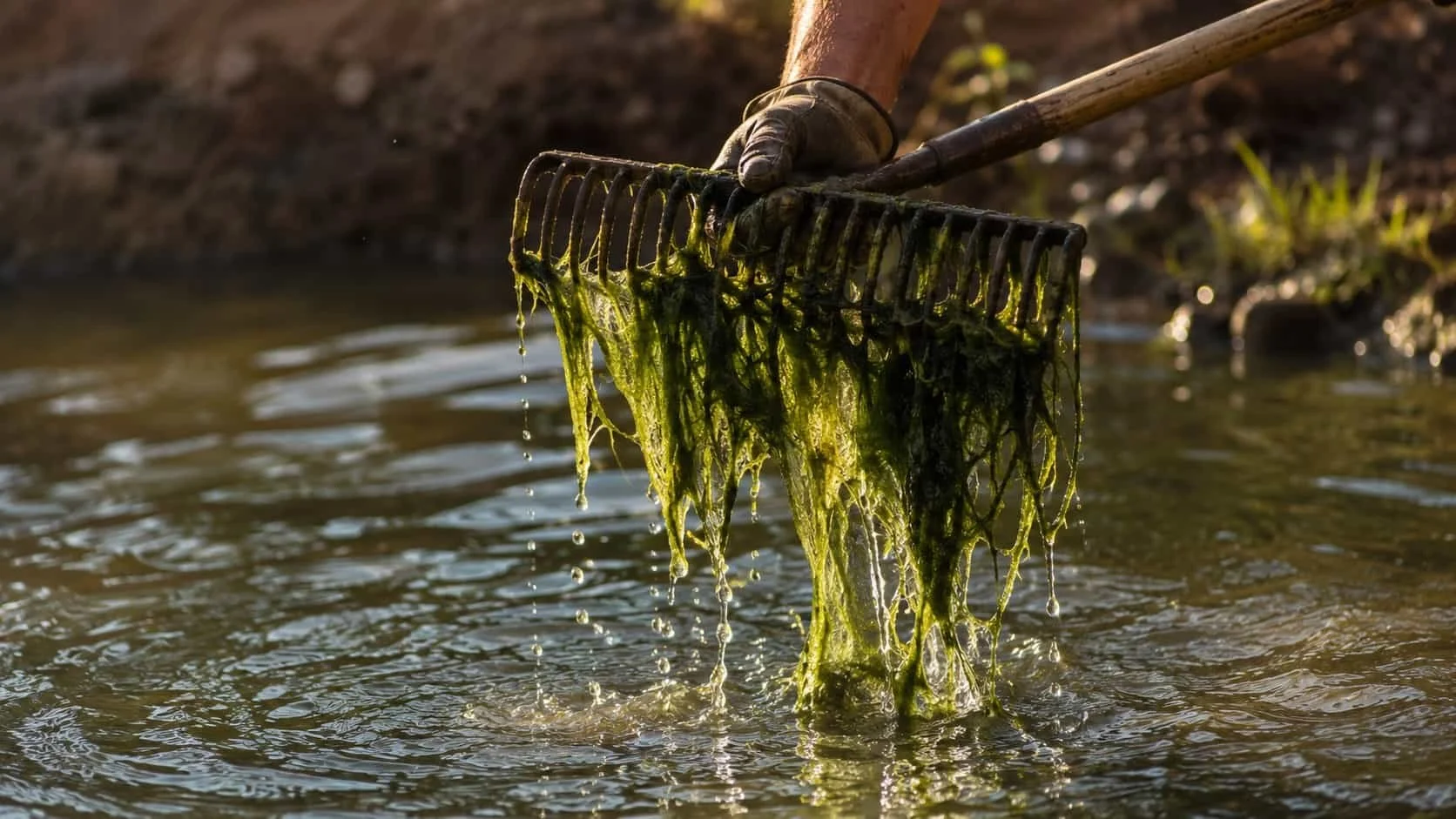
| Green hair, strands, or cottony mats you can lift out with a rake. | Filamentous algae, often called pond moss | Nuisance, not typically toxic | Physical removal plus nutrient and circulation correction. |
| A carpet of tiny green leaves, pinhead sized, blown into corners and coves. | Duckweed or watermeal | Nuisance. Blocks light and gas exchange. | Surface treatment plus nutrient source control. |
| Water is greenish but you can still see roughly 18 inches down. No scum. | Normal plankton bloom | Healthy in a fishing pond | Monitor. No treatment needed. |
| Green water plus fish at the surface gulping for air at sunrise. | Bloom with an oxygen crash underway | Emergency | Aerate immediately, stop feeding fish, and call for help today. |
Why Piedmont ponds turn green in July and August
Three conditions have to line up. In a central North Carolina summer, all three usually do.
Heat. Warm water holds less dissolved oxygen than cool water, and it accelerates algae reproduction. Increased sunlight and warmer temperatures are among the conditions that push algae into rapid growth.⁷
Nutrients. Nitrogen and phosphorus are the fuel.⁸ In the Piedmont they arrive from lawn fertilizer washing off during afternoon storms, grass clippings blown toward the bank, pet waste, failing septic systems, and street and parking lot runoff feeding neighborhood stormwater ponds. Resident geese and ducks are a major contributor at community and amenity ponds. They cause turbidity and algal problems, damage shoreline vegetation, and can push fecal bacteria to unsafe levels.⁹
Stagnation. Ponds stratify in summer. A warm surface layer sits on a cooler bottom layer that holds little or no dissolved oxygen.¹⁰ Nothing mixes. Nutrients release out of the sediment into that oxygen-poor bottom water and feed the bloom sitting above it.
Then it compounds. A bloom drives major changes in water chemistry, including high pH and dramatic swings in dissolved oxygen.¹¹ When the bloom dies, decomposition consumes the oxygen that is left. Oxygen depletion is the most common cause of fish kills, and it typically happens during summer in fertile ponds as a result of pond turnover or the die-off of an algal bloom.¹²
That is why the green itself is rarely the real emergency. What follows it is.
What you can do this week
These are legitimate, safe steps for a property owner or board member to take right now.
Cut the nutrient supply. This is the only item on this list that addresses cause instead of symptom. Stop fertilizing near the bank. Redirect downspouts and irrigation overspray away from the water. Let a buffer of taller vegetation grow along the shoreline instead of mowing to the edge. Stop feeding waterfowl, and get your neighbors to stop too.
Physically remove what you can reach. Filamentous algae mats and duckweed can be raked or skimmed. Haul the material well away from the bank so it does not decompose straight back into the pond. On small patches this genuinely works.
Run your aeration correctly, especially overnight. If you already have a system, verify it is actually moving water and that diffusers are not clogged. Aeration matters most at night, because that is when oxygen becomes most depleted.¹³ Worth knowing: fountains that spray water high into the air are relatively inefficient as aerators. The most effective systems create a circulation pattern that brings bottom water to the surface and breaks down stratification, which is what diffused aeration is designed to do.¹⁴
Watch the pond at sunrise. Through hot, cloudy stretches, check early for fish at the surface gulping for air. If you see it, stop feeding and aerate immediately. In an emergency, oxygen can be added by circulating water with a pump, picking up surface water and spraying it out horizontally to create as much surface movement as possible.¹⁵
Know what does not work. Barley straw is heavily marketed for algae control, but field testing in the United States has generally been negative or inconclusive and it is not recommended.¹⁶ Pond dye shades the bottom and can help prevent rooted growth from establishing, but it will not clear an existing planktonic bloom.¹⁷

Where do-it-yourself stops and starts getting expensive
This is the part most pond owners learn the hard way, usually in August.
You cannot treat what you have not identified. Accurate identification of the species is what determines the correct control measure.¹⁸ The wrong product on the wrong organism is wasted money, and on an active cyanobacteria bloom it can make a health situation worse rather than better.
Killing a large bloom in August can kill your fish. Oxygen depletion also occurs when dead algae decay in the pond after herbicides have been applied.¹⁹ North Carolina State Extension is blunt about the timing: do not treat aquatic weeds with herbicides during the summer months without consulting a weed control specialist, fisheries biologist, or Extension agent. If application is necessary, treat no more than one-fourth to one-third of the pond at a time and wait five to seven days between treatments to prevent oxygen depletion and a resulting fish kill.²⁰
Read that again. Treating a quarter of the pond, waiting a week, repeating, and monitoring oxygen the whole time is not a Saturday afternoon project.
Applying for hire in North Carolina requires licensing. Aquatic Pest Control is its own certification category with the North Carolina Department of Agriculture and Consumer Services, covering pesticide application to standing or running water such as ponds and lakes.²¹ If your HOA, management company, or business is hiring anyone to treat water, ask for the license number before work starts.
Treatment alone does not break the cycle. Herbicides treat the symptom and do very little to cure the problem. Growth returns soon after treatment unless something is done to reduce the nutrient source.²² A pond that turns green every July will turn green again next July unless something structural changes.
What actually gets it clear and keeps it clear
A pond that holds up through a Piedmont summer is usually running four things at once, not one.
Correct identification of what is growing, before anything is applied to the water
Targeted, properly sequenced treatment that respects oxygen limits in hot weather instead of ignoring them
Circulation and aeration sized and placed for the actual depth, shape, and use of that specific waterbody
Nutrient source reduction on the land around the pond, which is the piece that keeps next summer from being a rerun of this one
Clearwater Lake, Pond and Stormwater Management Services builds that as a season-long program rather than a one-time spray, for residential ponds, HOA and community lakes, commercial and industrial basins, golf course water features, and municipal waterbodies across Charlotte Metro, Lake Norman, the Catawba Valley, the Piedmont Triad, and the surrounding North Carolina Piedmont.
Our team carries credentials through the North Carolina Department of Agriculture, the Clemson Master Pond Manager program, and North Carolina State stormwater inspection and maintenance training.
When to call now instead of waiting it out
Do not wait for September if any of these describe your pond:
Fish are at the surface gulping at sunrise, or you have found dead fish
There is scum, foam, or streaking collecting along the downwind bank
Children, pets, or livestock have access to the water
It serves an HOA or commercial property and residents or tenants are already complaining
It turned green last summer too
You already treated it once this year and it came right back
Green water is a symptom with a cause underneath it. We find the cause, treat what is there safely for the season we are actually in, and set the pond up so next July looks different.
Request a summer pond assessment. Call (704) 450-1598 or request service at clearwaterlpm.com.
How long does it take to clear a green pond?
Visible improvement on a filamentous algae mat can happen within days. A heavy planktonic bloom in mid-summer is treated in stages so the pond does not lose oxygen all at once, so plan on several weeks. Ponds with a heavy nutrient load take a full season to stabilize.
Will one treatment fix it?
Rarely. Treatment addresses what is growing today. If the nutrient source and the lack of circulation are unchanged, growth returns. That is why we build a program instead of selling a single application.
Is it safe for my dog to swim in a green pond?
Not until it has been identified. Dogs are the most common victims of cyanobacteria exposure because they wade the shallow edges where blooms concentrate and drink while they are in the water. Keep pets out of any water that looks bright green, discolored, or scummy, and seek veterinary care immediately if a dog stumbles, staggers, or collapses after contact.
Can we still fish the pond?
Ask before you eat anything out of it. Aquatic herbicide labels carry their own restrictions on fishing, swimming, irrigation, and livestock watering, and those restrictions vary by product. Any reputable applicator will tell you the specific waiting periods in writing.
Does an aerator by itself fix algae?
Aeration is one of the strongest tools available, but it is a prevention and stabilization tool rather than an instant clarifier. Properly sized diffused aeration breaks stratification, keeps the whole water column oxygenated, and makes blooms less likely and less severe. Decorative fountains are relatively inefficient by comparison.
Why does my pond turn green every single summer?
Because the cause is still there. Nutrients keep arriving from the surrounding land, summer stratification keeps the bottom water stagnant and nutrient-rich, and heat does the rest. Break that pattern and the pond stops being an annual problem.
Do you serve my area?
Clearwater serves the North Carolina Piedmont, including Charlotte Metro, Lake Norman, the Catawba Valley, and the Piedmont Triad. Call (704) 450-1598 to confirm coverage for your address.
Sources
1. North Carolina Department of Health and Human Services, Division of Public Health, “Algal Blooms,” Occupational and Environmental Epidemiology, accessed July 24, 2026, https://epi.dph.ncdhhs.gov/oee/a_z/algal_blooms.html.
2. North Carolina Department of Environmental Quality, Division of Water Resources, “Algal Blooms,” accessed July 24, 2026, https://www.deq.nc.gov/about/divisions/water-resources/water-sciences-section/algal-blooms.
3. North Carolina Department of Environmental Quality, Identifying Cyanobacterial (Bluegreen) Algal Blooms, accessed July 24, 2026, https://www.deq.nc.gov/water-quality/water-sciences/identifying-cyanobacterial-blooms/download.
4. NCDHHS, “Algal Blooms.”
5. NCDHHS, “Algal Blooms.”
6. North Carolina Department of Environmental Quality, “Frequently Asked Questions: Cyanobacterial (Blue-green algae) Blooms,” accessed July 24, 2026, https://www.deq.nc.gov/about/divisions/water-resources/water-sciences-section/algal-blooms/frequently-asked-questions-cyanobacterial-blue-green-algae-blooms.
7. NCDEQ, “Frequently Asked Questions.”
8. NCDEQ, “Frequently Asked Questions.”
9. Jim Rice et al., Pond Management Guide, AG-424 (Raleigh: NC State Extension, 2024), https://content.ces.ncsu.edu/pond-management-guide.
10. Rice et al., Pond Management Guide.
11. NCDEQ, “Algal Blooms.”
12. Rice et al., Pond Management Guide.
13. Rice et al., Pond Management Guide.
14. Rice et al., Pond Management Guide.
15. Rice et al., Pond Management Guide.
16. Rice et al., Pond Management Guide.
17. Rice et al., Pond Management Guide.
18. Rice et al., Pond Management Guide.
19. Rice et al., Pond Management Guide.
20. Rice et al., Pond Management Guide.
21. North Carolina Department of Agriculture and Consumer Services, “Pesticides Licenses,” Structural Pest Control and Pesticides Division, accessed July 24, 2026, https://www.ncagr.gov/divisions/structural-pest-control-and-pesticides/pesticide/licensing-and-certification/licenses.
22. Rice et al., Pond Management Guide.