How Do Commercial Properties Manage Stormwater Ponds? A North Carolina Field Guide
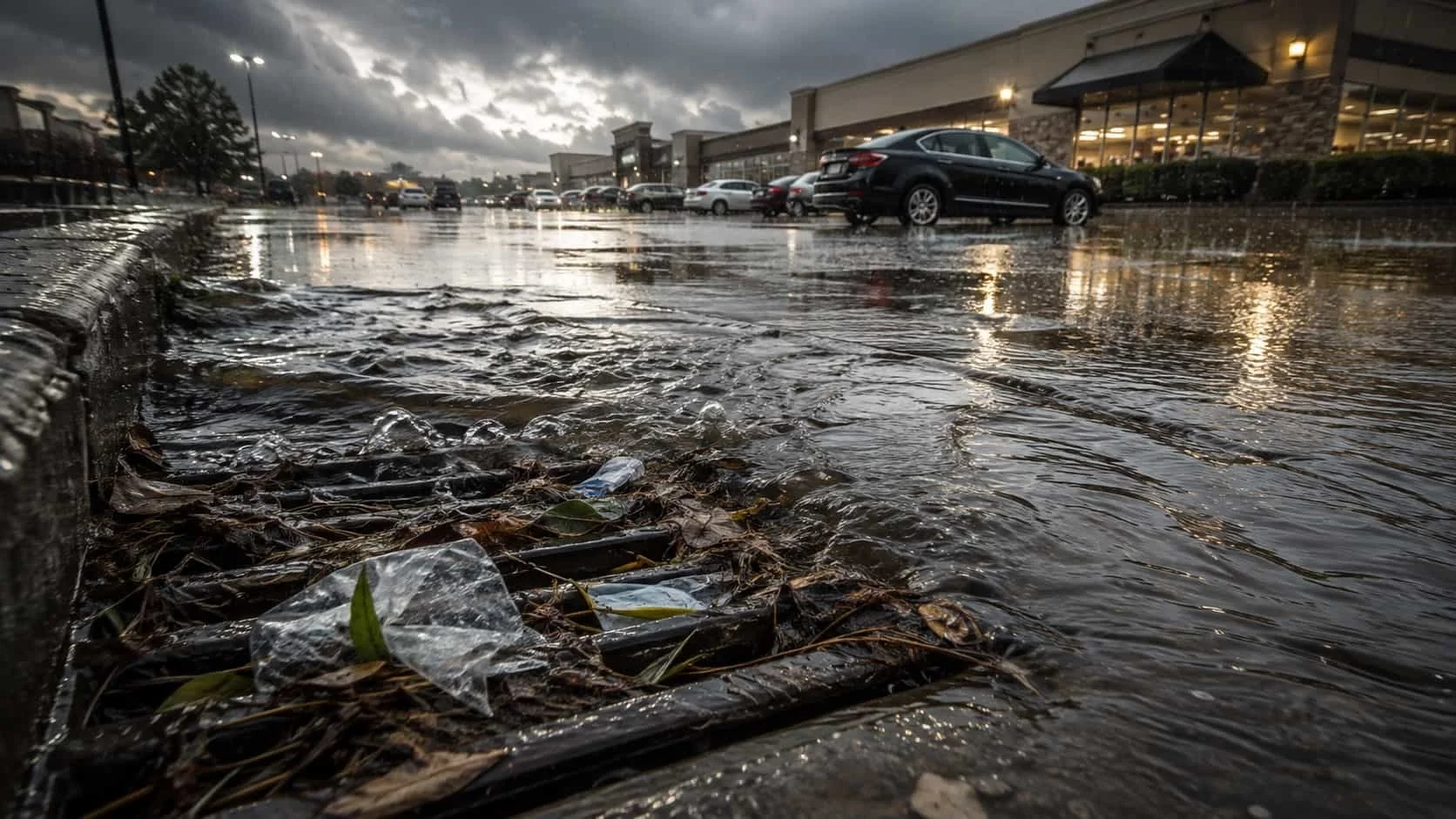
That pond behind your office park is not landscaping. It is a machine — a permitted piece of infrastructure with a job description, an owner’s manual, and a paper trail that follows the property through every sale and refinance. Facility managers inherit these ponds all the time without anyone explaining what they are, and the pond works quietly for years until the day it doesn’t.
So here is the working answer to a question we hear from new facility managers, property management portfolios, and owners who just closed on a site with water on it: how do commercial properties actually manage stormwater ponds? Not in theory. In practice, on a calendar, with names attached to tasks.
First, know which pond you have
Most commercial sites in North Carolina have one of two things. A wet pond holds water all the time — it uses a forebay to trap sediment near the inlet, a permanent pool to let pollutants settle between storms, and a temporary pool of extra depth that fills during a storm and drains down slowly over the following days.¹ A dry detention basin looks like a grassy bowl most of the year and only holds water briefly after rain. Both fall under the umbrella term you will see on your permit documents: stormwater control measure, or SCM.
The distinction matters because the maintenance differs. Wet ponds accumulate sediment and grow aquatic vegetation. Dry basins clog, rut, and grow woody brush in exactly the places brush should never grow — like on the embankment and around the outlet.
The maintenance rhythm that keeps a pond working
Well-run commercial properties treat the pond like an HVAC system: routine checks on a schedule, professional service at intervals, and a written record of both.
Walk it quarterly, minimum. North Carolina’s own guidance calls for physically inspecting SCMs at least quarterly, and after any storm that drops more than an inch of rain in 24 hours.² A walk-through takes twenty minutes: is the inlet clear, is the outlet structure unobstructed, is water sitting where it shouldn’t, is anything eroding.
Keep the outlet honest. Nearly every pond failure story runs through a clogged or damaged outlet. Trash, sediment, beaver activity, or a collapsed trash rack turns a functioning pond into a rising one.
Manage the vegetation deliberately. Mow embankments, keep trees and woody growth off the dam, and maintain the vegetated shelf around a wet pond — it is a pollutant filter, not decoration.
Watch the forebay. The forebay exists to collect sediment so the main pond doesn’t have to. When it fills, it stops working, and the sediment moves downstream into storage you cannot afford to lose.
Write it down. Every walk-through, every load of debris pulled off a grate. When anyone official ever asks how the pond is maintained, the answer is a folder, not a shrug.
Insert Code Block A — maintenance calendar table — here.
The annual professional inspection
Beyond the quarterly walk-throughs, SCMs generally need a formal annual inspection by a qualified professional — the state’s design manual points owners toward licensed professionals and inspectors certified through programs like NC State University’s SCM Inspection and Maintenance Certification.³ This is the documented evaluation against the operation and maintenance (O&M) plan that was recorded when the pond was permitted: sediment depth, structural condition, embankment integrity, outlet function, vegetative cover, the works.
If your property has an SCM, that O&M agreement almost certainly exists, runs with the land, and names the owner as the responsible party. Reading it is the single fastest way to learn what your specific pond requires.
Where compliance fits into all this
The reason the paperwork exists: North Carolina’s post-construction stormwater program requires developments to install and maintain permanent stormwater measures for the life of the property.⁴ Local MS4 jurisdictions then layer their own programs on top, and the details vary by town — some require annual inspection reports from a qualified North Carolina professional and grant a fixed window, such as 60 days, to complete repairs after a failed inspection.⁵ ⁶
The practical takeaway is not fear. It is that maintenance and compliance are the same activity, documented. A pond on a genuine maintenance program passes inspections as a side effect. We wrote more about how the inspection and documentation side works in our guide to SCM inspections and compliance in North Carolina.
The big-ticket items nobody budgets for
Routine maintenance is cheap. What gets expensive is the deferred version of it:
Sediment removal. Every pond fills in eventually — that is literally its job. Skipped forebay cleanouts accelerate it, and by the time storage capacity is visibly gone, you are pricing excavation, not raking. If your pond has also started producing a distinct summer smell, sediment is usually the culprit — we covered why ponds smell in summer and what that smell means.
Outlet and riser structure repairs. Concrete spalls, joints separate, trash racks rust off. Small now, structural later.
Shoreline and embankment erosion. Rills become gullies, gullies threaten the dam, and dam problems are a different universe of cost and liability. Repairs and restorations caught early stay in the maintenance budget instead of the capital budget.
Who should do what
A workable division of labor for most commercial sites: your facility team does the quarterly walk-throughs and clears trash. Your landscaper mows what they can reach safely. A water management specialist handles the annual inspection and documentation, aquatic vegetation and algae treatment, sediment monitoring, and structural repairs — the parts that require licenses, equipment, and someone whose name belongs on a report.
The failure mode we see most often is the middle ground: assuming the landscaper “handles the pond” because they mow near it. Mowing is not management, and “our landscaper looks at it” has never once satisfied an inspector.
Put your pond on a program
Clearwater Lake, Pond and Stormwater Management Services runs SCM maintenance and inspection programs for office parks, retail centers, industrial sites, HOAs, and property management portfolios across the North Carolina Piedmont — full-service stormwater maintenance, one vendor, one folder of documentation that is always current.
Request a stormwater pond assessment. Or call (704) 450-1598 and tell us what is sitting behind your building.
How often does a commercial stormwater pond need to be inspected in North Carolina?
State guidance calls for physical inspections at least quarterly, plus checks after storms exceeding one inch of rain in 24 hours. Most permitted SCMs also need a formal annual inspection by a qualified professional, and some local jurisdictions require an annual report on top of that.
What is the difference between a retention pond and a detention basin?
A retention pond (wet pond) holds a permanent pool of water year-round and treats runoff by letting pollutants settle. A detention basin is dry between storms and temporarily holds runoff to release it slowly. Both are stormwater control measures and both require maintenance.
Who is allowed to perform the annual SCM inspection?
Jurisdictions generally require a qualified professional — typically a licensed engineer or landscape architect, or an inspector certified through a recognized program such as NC State University's SCM Inspection and Maintenance Certification.
What happens if a stormwater pond fails inspection?
Typically the owner receives a repair list and a deadline — some North Carolina towns grant about 60 days to complete corrections. Failing to act can escalate to enforcement. A pond on a real maintenance program rarely gets to that point.
What drives the cost of stormwater pond maintenance?
Pond size and type, vegetation pressure, sediment load from the drainage area, and the condition of the structures. Routine programs are predictable; the expensive line items — sediment removal and structural repair — are almost always the result of deferral.
Sources
1. North Carolina Department of Environmental Quality, "SCM Operation and Maintenance," Stormwater Design Manual, deq.nc.gov — wet pond components: forebay, permanent pool, temporary pool.
2. North Carolina Department of Environmental Quality, "SCM Operation and Maintenance," deq.nc.gov — quarterly minimum inspection frequency and post-storm inspections after rainfall exceeding one inch in 24 hours.
3. North Carolina Department of Environmental Quality, Stormwater Design Manual, Section A-7: Operation and Maintenance, deq.nc.gov — qualified professional inspections, annual inspection and reporting, and the NC State University SCM Inspection and Maintenance Certification program.
4. North Carolina Department of Environmental Quality, "Stormwater Program," deq.nc.gov — post-construction program requirements to install and maintain permanent stormwater management measures.
5. Town of Apex, "Stormwater Control Measures (SCM)," apexnc.org — annual inspection by a qualified North Carolina professional and the 60-day repair period following a failed inspection.
6. Town of Carrboro, "SCM Maintenance and Inspection Program," townofcarrboro.org — annual professional inspection and annual reporting requirements as an example of local program layering.