Is It Worth Hiring a Pond Management Company? The Honest Answer
By the middle of August, most pond owners in the North Carolina Piedmont have a version of the same shelf in the garage. A jug of algaecide with a quarter left in it. A bag of barley straw. A bottle of blue dye. A fountain that looked great in the box.
And the pond is still green.
So the question changes. It stops being “what do I buy next” and becomes “is it worth paying somebody.” Here is the honest answer — including the parts you genuinely can do yourself, the parts that were never going to work, and the line where doing it yourself starts costing more than help ever would.
What you can genuinely do yourself, and should keep doing
Any honest answer starts here, because a professional program does not replace these things. It depends on them.
Cut the nutrient supply. This is the only item anywhere on this page that addresses cause instead of symptom, and you are the only one who can do it. Stop fertilizing near the bank. Redirect downspouts. Let a buffer of taller vegetation grow along the shoreline instead of mowing to the water. Stop feeding the geese, and get the neighbors to stop. No company can do this part for you.
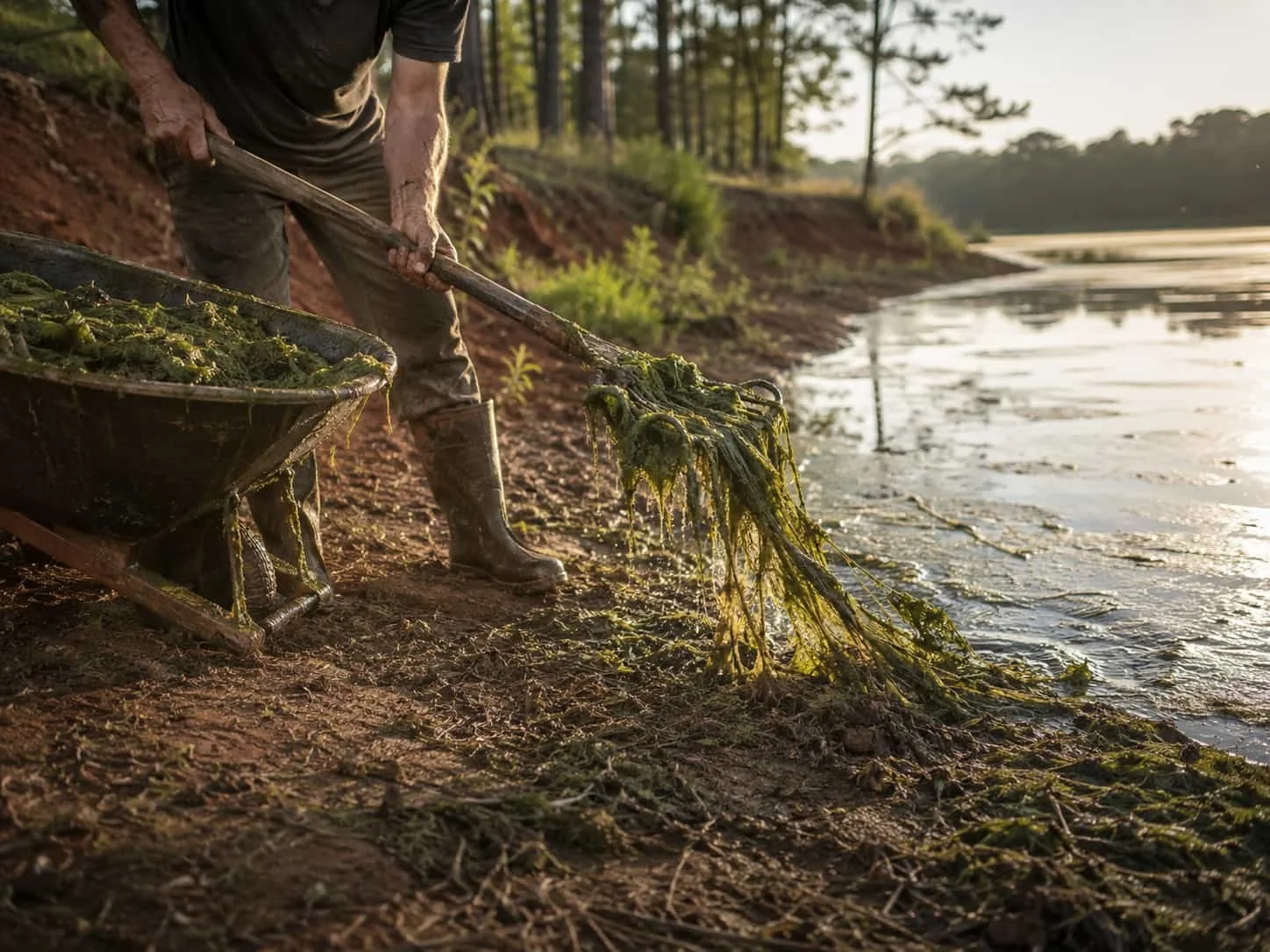
Physically remove what you can reach. Filamentous mats and duckweed can be raked and skimmed. Haul the material well away from the bank so it does not decompose straight back into the water. On small areas this genuinely works.
Run the aeration you already own correctly. Check that diffusers are not clogged and that water is actually moving. Run it through the night, because that is when oxygen becomes most depleted.¹
Measure your muck. A pole pushed to soft bottom, then firm bottom, at eight or ten spots tells you whether sediment is the real story. It costs nothing and it changes the conversation.
Watch the pond at sunrise in hot stretches. Fish at the surface gulping air is the warning that matters. If you see it, stop feeding and aerate immediately.
If your pond is small, lightly affected, and nobody swims in it, that list may honestly be all you need. Plenty of ponds never need a company. Keep reading anyway, because the next two sections are about money you may have already spent.
The products that were never going to work
Barley straw. Heavily marketed for algae control, but field testing in the United States has generally been negative or inconclusive, and North Carolina State Extension does not recommend it.²
The decorative fountain. Fountains that spray water high into the air are relatively inefficient as aerators. The systems that actually change a pond create a circulation pattern that brings bottom water to the surface and breaks down summer stratification, which is what diffused aeration is built to do.³ If the fountain did not fix the algae or the smell, nothing was wrong with your fountain. It was doing exactly what fountains do.
Pond dye, asked to do the wrong job. Dye shades the bottom and can help keep rooted growth from establishing. It will not clear a bloom that already exists.⁴
Notice the pattern. These sell because they are easy to buy and easy to apply. The things that work are less satisfying to purchase: fewer clippings in the water, more circulation, less fertilizer, a rake.
The misdiagnosis tax
Here is where do-it-yourself quietly gets expensive: treating before identifying.
Accurate identification of the species is what determines the correct control measure.⁵ The wrong product on the wrong organism is the whole jug wasted, and a repeat purchase three weeks later. Most of the money lost to DIY pond care is lost right here, before anything even touches the water.
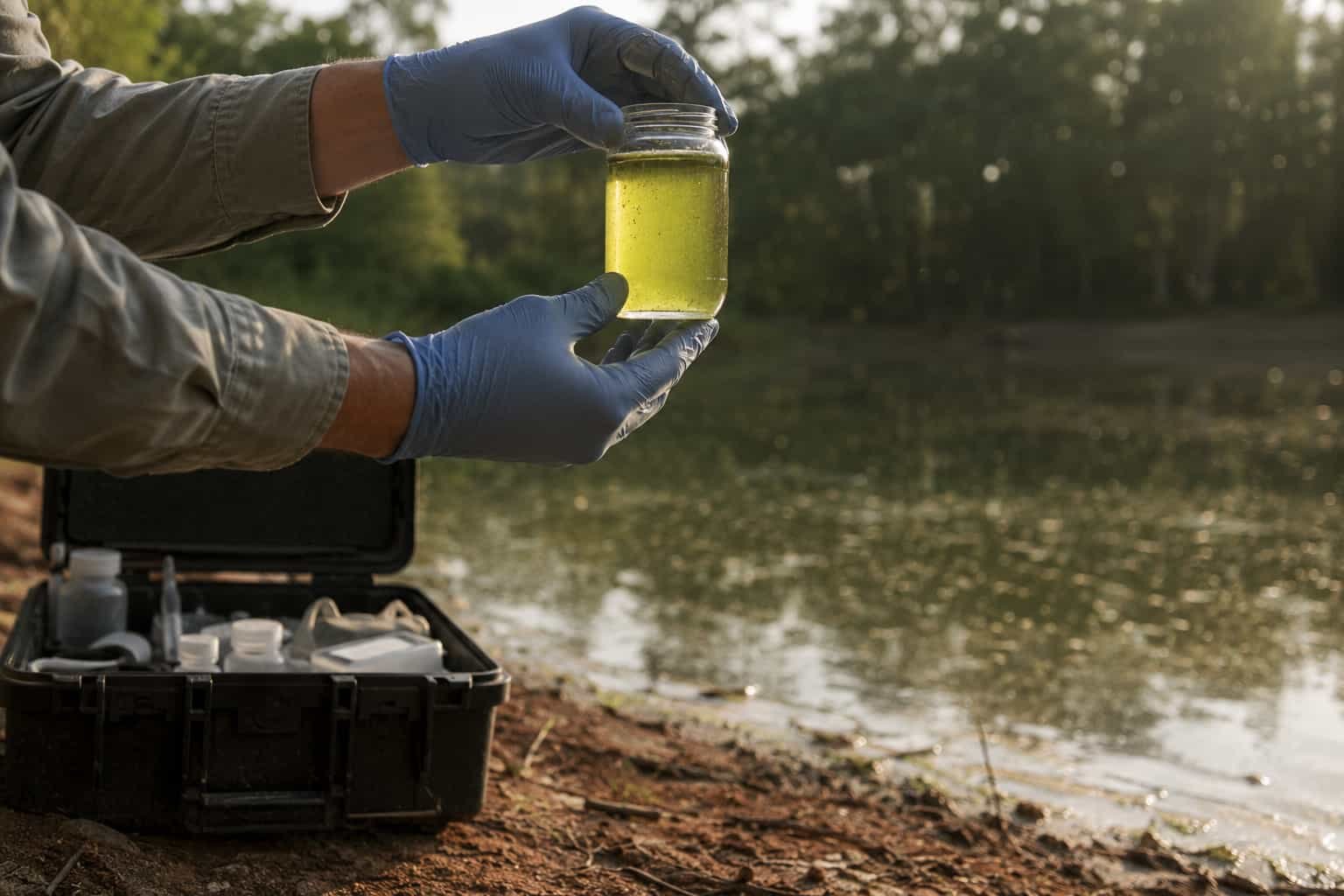
And there is one identification you cannot make from the bank at all: whether a green bloom is cyanobacteria. It can look bright green, blue-green, or even reddish-brown,⁶ some of it produces toxins linked to adverse health effects in people, pets, and wildlife,⁷ and confirming it requires microscopic analysis.⁸ If children, pets, or livestock touch that water, guessing stops being a money mistake. Dogs are the highest-risk group at any pond — they wade the shallow edges where blooms concentrate and drink while they are standing in it.⁹
The mistake that kills the fish
The most expensive do-it-yourself error in an August pond is the most common one: killing a large bloom all at once.
When the treatment works, everything it killed starts decomposing, and decomposition consumes oxygen. Oxygen depletion is the most common cause of fish kills, it typically happens in summer, and it also occurs when dead algae decay after herbicides have been applied.¹⁰
North Carolina State Extension is explicit about the season we are in right now: do not treat aquatic weeds with herbicides during the summer months without consulting a specialist. If treatment is necessary, treat no more than one-fourth to one-third of the pond at a time and wait five to seven days between treatments, specifically to prevent oxygen depletion and a fish kill.¹¹
Read that as a scheduling problem. Three or four visits, spaced a week apart, with the pond watched in between. That is not a Saturday. That is a program — which is why the one-jug Saturday version so often ends with fish on the bank, and a pond that is now worse than green.
The licensing line
There is also a legal line here, and it is brighter than most owners realize.
In North Carolina, applying pesticides to water for compensation requires certification in the Aquatic Pest Control category through the North Carolina Department of Agriculture and Consumer Services — the category covering pesticides purposefully applied to standing or running water such as ponds, lakes, and streams.¹² Two practical consequences follow.
Anyone you pay must hold it. Ask for the license number before work starts, every time, no matter who you hire.
The strongest tools are not on the shelf. Restricted-use pesticides are only available to certified applicators,¹³ which is why the products next to the pond dye at the store are the general-use ones. You can apply those to your own pond — and the label is the law, so follow it exactly — but the gap between what a homeowner can buy and what a licensed applicator can deploy is real.
One more thing worth knowing exists, without dwelling on it: where a pond discharges downstream, permitting can come into play for treatments. That is one more thing a licensed professional is accountable for knowing so you do not have to be.
So where is the line? The honest decision table
Job by job, here is where doing it yourself genuinely holds up and where it does not.
| The job | Do it yourself? | The catch |
|---|---|---|
| Cutting nutrient inputs — mowing habits, buffers, downspouts, waterfowl | Yes, and only you can | It means changing habits, not buying products |
| Raking algae mats and skimming duckweed | Yes, genuinely | Works on small areas; haul the material well away from the bank |
| Testing muck depth with a pole | Yes | Tells you whether there is a problem, not the volume a contractor bids from |
| Running and cleaning aeration you already own | Yes | Only helps if the system was sized and placed correctly to begin with |
| Identifying what is growing, including whether a bloom is toxic | No | Cyanobacteria confirmation requires microscopic analysis, not a good eye |
| Chemical treatment during summer heat | Not without help | Partial treatments a week apart, with oxygen watched, or you lose the fish |
| Choosing and sizing an aeration system | Risky | Fountains are inefficient aerators; wrong sizing is the most common wasted spend |
| Sediment removal and dredging | No | Volume drives the cost, disposal is regulated, and permits can apply |
What you are actually buying when you hire
Not a person with a jug. If that is what shows up, you hired wrong. A real pond management program is four things running together:
Identification before anything goes in the water — because the species determines the treatment, not the other way around
Licensed, sequenced treatment that respects summer oxygen limits instead of ignoring them
Aeration matched to the actual pond — depth, shape, and use — because equipment bought on guesswork is the single most expensive category of DIY loss
Work on the causes — because herbicides treat the symptom, and growth returns unless the nutrient source is reduced¹⁴
For sediment problems, the professional version starts with measurement rather than a quote, because sediment volume is the principal factor in what removal costs, and a measured survey produces more accurate planning and pricing than an estimate from the bank.¹⁵
And an honest company will tell you when you do not need them. If a pond needs a rake and a buffer strip, that should be the advice you get.
Five questions to ask before hiring anyone
Whoever you call — including us — these five questions sort the professionals from the jug-and-invoice operations in about two minutes.
1. What is your Aquatic Pest Control license number? Non-negotiable in North Carolina.¹⁶ No number, no work.
2. Will you identify what is growing before treating it? If the answer is anything but yes, the treatment is a guess with your money.
3. How do you treat in summer? Listen for partial treatments, spacing between applications, and oxygen. If nobody mentions the fish, mention them yourself and see what happens.
4. Is this a treatment or a program? A one-time spray is cheaper this month and more expensive by October, because the cause is still there.
5. What can I keep doing myself? The honesty test. A good answer includes things that cost you nothing and them a little revenue.
The honest bottom line
Keep doing it yourself if the pond is small, the problem is mild, no one and nothing you love touches the water, and this is its first bad summer. Rake, cut the nutrients, run the aeration, watch it at sunrise. That is real pond management and it is free.
It is worth hiring help when any of these are true:
The pond turns green or weedy every single summer, no matter what you buy
There are fish in it that you care about, and treatment season is now
There is scum, streaking, or foam on the water and children or pets have access
It belongs to an HOA or a business, and residents, tenants, or a board are asking questions
You are about to spend real money on aeration and do not want to size it by guesswork
A pole test finds two feet or more of soft bottom
You have already given this pond two summers of Saturdays
Clearwater Lake, Pond and Stormwater Management Services runs season-long programs — identification first, licensed treatment sequenced for the season, aeration sized to the pond, and the cause-side work that keeps next August from being a rerun — for residential ponds, HOA and community lakes, commercial properties, golf courses, and municipal waterbodies across Charlotte Metro, Lake Norman, the Catawba Valley, the Piedmont Triad, and the surrounding North Carolina Piedmont. Our team carries credentials through the North Carolina Department of Agriculture, the Clemson Master Pond Manager program, and North Carolina State stormwater inspection and maintenance training.
Request an honest assessment of your pond.
Call (704) 450-1598 or request service at clearwaterlpm.com.
How much does professional pond management cost?
It depends on four things: the size of the waterbody, what is actually growing in it, how accessible it is, and whether you are buying a one-time treatment or a season program. A one-time spray is cheaper up front and tends to repeat, because it treats the symptom while the cause keeps working. The big-ticket item in pond care is sediment removal, and its price is driven by measured volume — which is why a real quote starts with a survey, not a glance from the bank. Any company should be able to explain exactly what drives your number.
Can I legally treat my own pond in North Carolina?
Generally yes, with general-use products applied to your own pond, following the label exactly — the label is the law. Restricted-use pesticides are only available to certified applicators. And anyone you pay to treat water must hold the Aquatic Pest Control certification through the North Carolina Department of Agriculture and Consumer Services, so always ask for the license number. Where a pond discharges downstream, permitting can also come into play for treatments.
Is it worth hiring a company for a small backyard pond?
Often not, honestly. If the pond is small, the problem is mild, there is no fish investment, and no children or pets contact the water, the free work — nutrient control, raking, running your aeration properly — may be all it needs. Hiring earns its money when the problem recurs every summer, when fish or safety are at stake, or when you are about to buy equipment and do not want to size it by guesswork.
What should an HOA look for in a pond management company?
Five things: a current Aquatic Pest Control license number, identification before treatment as standard practice, a summer protocol that treats in stages to protect oxygen and fish, a program structure rather than a one-time spray, and documentation the board can file — what was applied, when, and why. A vendor who cannot produce the first and last of those quickly is not a vendor.
Will one professional treatment fix my pond?
Rarely, and be suspicious of anyone who promises it will. Treatment addresses what is growing today. Herbicides treat the symptom, and growth returns unless the nutrient source feeding it is reduced. That is why the durable version is a program: treatment, aeration, and cause-side work running together across the season.
Do you serve my area?
Clearwater serves the North Carolina Piedmont, including Charlotte Metro, Lake Norman, the Catawba Valley, and the Piedmont Triad. Call (704) 450-1598 to confirm coverage for your address.
Sources
1. Jim Rice et al., Pond Management Guide, AG-424 (Raleigh: NC State Extension, 2024), https://content.ces.ncsu.edu/pond-management-guide.
2. Rice et al., Pond Management Guide.
3. Rice et al., Pond Management Guide.
4. Rice et al., Pond Management Guide.
5. Rice et al., Pond Management Guide.
6. North Carolina Department of Health and Human Services, Division of Public Health, “Algal Blooms,” Occupational and Environmental Epidemiology, accessed July 24, 2026, https://epi.dph.ncdhhs.gov/oee/a_z/algal_blooms.html.
7. North Carolina Department of Environmental Quality, Division of Water Resources, “Algal Blooms,” accessed July 24, 2026, https://www.deq.nc.gov/about/divisions/water-resources/water-sciences-section/algal-blooms.
8. North Carolina Department of Environmental Quality, Identifying Cyanobacterial (Bluegreen) Algal Blooms, accessed July 24, 2026, https://www.deq.nc.gov/water-quality/water-sciences/identifying-cyanobacterial-blooms/download.
9. NCDHHS, “Algal Blooms.”
10. Rice et al., Pond Management Guide.
11. Rice et al., Pond Management Guide.
12. North Carolina Department of Agriculture and Consumer Services, “Pesticides Licenses,” Structural Pest Control and Pesticides Division, accessed August 14, 2026, https://www.ncagr.gov/divisions/structural-pest-control-and-pesticides/pesticide/licensing-and-certification/licenses.
13. NCDA&CS, “Pesticides Licenses.”
14. Rice et al., Pond Management Guide.
15. Heather B. Nix, Eugene C. McCall Jr., and John E. Chastain, Pond Maintenance: Dredging, LGP 1153 (Clemson, SC: Clemson Cooperative Extension, Land-Grant Press, 2022), accessed July 24, 2026, https://lgpress.clemson.edu/publication/pond-maintenance-dredging/.
16. NCDA&CS, “Pesticides Licenses.”