Pond Bank Erosion: Why Fall Is the Right Time to Fix It
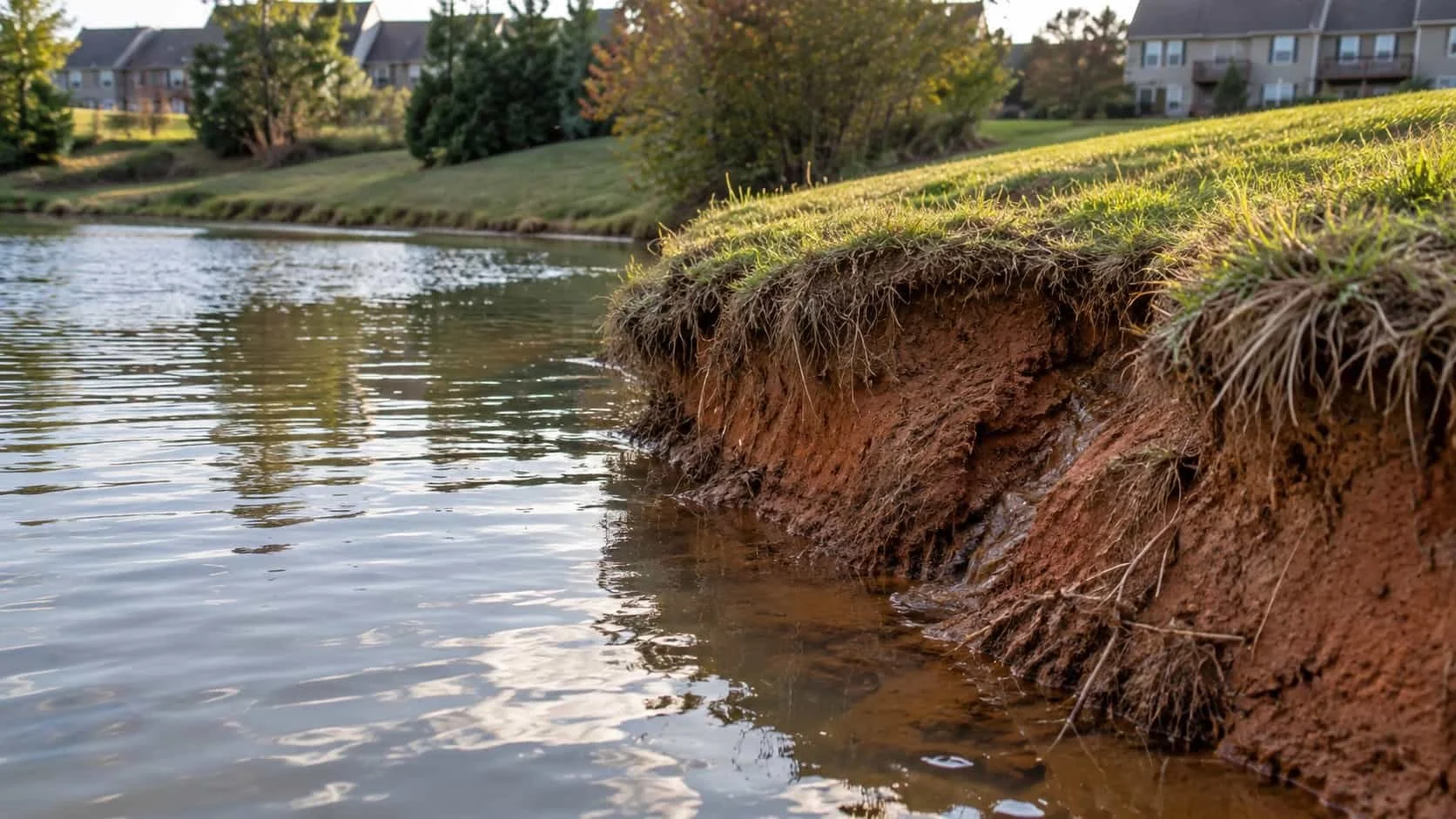
Pond banks erode from wave action, fluctuating water levels, concentrated inflow, steep slopes and turf mowed to the waterline. Fall is the best repair window in North Carolina because grading, seeding and shoreline planting can all establish roots before summer heat. Plants outperform riprap on most community ponds, and cost less.
On this page
What actually causes a pond bank to erode. The mowing problem, and a contradiction worth resolving. Why fall is the repair window. Plants or riprap. The riprap detail that decides whether it lasts. What North Carolina requires on a regulated pond. Whether you need a permit. What waiting costs you.
What actually causes a pond bank to erode?
Six things, and only one of them is weather. Clemson Cooperative Extension’s shoreline erosion guidance lists the mechanisms plainly, and most of them are decisions rather than acts of nature.
Wave action does the slow work. The simple lapping of ripples and the loosening of saturated soils pulls soil particles apart.¹ Water level fluctuation does more. The repeated rise and fall of water creates currents that pull soils away from the bank,¹ which is exactly what a stormwater pond does by design every time it fills and draws back down.
Concentrated inflow does the visible damage. Inlet pipes can erode deep gullies and holes, and concentrated sheet flow coming off a swale creates gullies and depressions.¹ Bank slope decides how fast all of it proceeds. Clemson is direct: steep banks with slopes greater than 3 to 1, meaning three feet of width for every foot of height, are almost certain to erode and undercut over time if they are not stabilized.¹
Then there are the two causes people do not expect. Concentrations of ducks and geese are the most common destabilizers of pond banks, because they eat shoreline vegetation and trample the bank.¹ And surface fountains agitate the water surface, creating more wave action.¹ The amenity a community installed to make the pond look better is, in a small way, eating the bank.
Muskrats are the fifth. North Carolina State Extension describes them digging burrows into the shoreline with a six to eight inch diameter entrance below the water line, often causing pond banks to collapse and dams to leak.² Clearwater Lake, Pond and Stormwater Management Services sees this most often on older community ponds around Statesville, Mooresville and Lake Norman, usually after the shoreline vegetation has already been cut back.
The mowing problem, and a contradiction worth resolving
The most common shoreline management approach in the Southeast is turf grass mowed to the water’s edge, and Clemson’s assessment of it is unsparing. This strategy provides very little structural integrity to the bank, because turf grass will not send roots down below the water surface where the most significant erosion is taking place.¹
The root depth comparison makes it concrete. North Carolina State Extension notes that while above ground stems and foliage slow surface water, it is the roots that provide the most stability, and that turf grass roots might only be 4 to 6 inches deep.³ Four inches of root is not holding a saturated bank against a rising and falling pond.
Here is the contradiction, and it is a real one in the published guidance. North Carolina State’s pond guide advises that keeping the pond edge mowed and controlling emergent vegetation will discourage muskrats from taking up residence.² Clemson says mowing to the water’s edge is a leading cause of bank erosion.¹ Both are correct within their own frame. The North Carolina guidance is written for farm ponds managed for fisheries. The Clemson guidance is written for stormwater ponds managed for water quality and bank stability.
For a regulated stormwater pond in North Carolina the question is settled by design requirement rather than preference, because the vegetated shelf is not optional. And for muskrats specifically, Clemson’s answer is that the only way to control them in stormwater ponds is to have them trapped.¹ Trapping solves the muskrat problem. Mowing the shelf solves nothing and creates a second problem.
Why is fall the right time to repair a pond bank?
Because the three parts of a bank repair have three different planting windows, and fall is the only season where they line up in the correct order.
Start with the shoreline plants. Clemson’s shoreline planting guidance states that the best time of year to tackle a shoreline planting is during fall or early spring, with plants spaced at 1.5 to 2 foot intervals, concentrating on the few feet of shoreline above and below the normal pond level, because that is the area most susceptible to erosion.⁴
Next the upland bank above the water. In the North Carolina Piedmont, tall fescue seeding runs September 1 to September 15, with the mountains and foothills starting August 15 and the sandhills and coastal plain running September 15 to October 15.⁵ The reason is the same reason fall works for the whole repair: spring or late winter seedlings are often less than satisfactory because the seedling roots do not have time to become well established before the heat and drought of summer.⁵
Finally the woody material. Live stakes, which are cuttings of native trees and shrubs that root after planting, go in during the dormant season between December 1 and April 1.⁶
So the sequence is: regrade and seed the upland bank in early September, plant the herbaceous shoreline zone through fall, and return in the dormant window for live stakes. By the time next summer’s heat arrives, every layer has had a full season of root growth. Start the same project in April and you are asking new roots to hold a bank through their first July.
One condition attaches to fall planting in North Carolina and it is not optional. North Carolina State’s wet pond plant guidance says planting should ideally happen in spring or autumn, with spring preferable due to wetter conditions and higher water levels, and that autumn planting or planting during drought may require irrigation to aid establishment.⁷ All plants need thorough watering for three to four weeks after installation,⁷ and the state stormwater manual directs watering twice weekly if needed until plants are established, commonly six weeks.⁸
If nobody will commit to six weeks of watering, wait for spring. A fall planting that is abandoned in October is a fall planting you buy again.
Plants or riprap?
Plants, for most community ponds, and the reasoning is mechanical rather than aesthetic. Clemson frames the choice as two strategies, emergent wetland plants or artificial materials such as riprap and bulkheads, and explains why plants work: the deep, robust root systems of these plants bind soils in the area where the majority of erosion is occurring, just below the water surface.¹
Riprap has a real place. North Carolina’s erosion control design manual lists shorelines subject to wave action among its appropriate applications, along with channel side slopes, culvert inlets and outlets, and streambanks.⁹ Where inflow is concentrated and fast, or where wave energy is genuinely high, stone is the honest answer.
But it is not a default. Georgia’s Department of Natural Resources places riprap revetments, bulkheads and seawalls under discouraged practices, noting they often contribute to erosion in other areas by altering water flow and sediment deposition upstream and downstream.¹⁰ Armor a bank and the energy does not disappear. It moves.
There is also a cost argument. North Carolina State’s stream repair guidance prices its three options as free for letting vegetation reestablish, roughly $5 per linear foot for planting native vegetation without grading, and roughly $25 per linear foot for grading and planting banks.³ Those are stream repair figures rather than pond figures, and they exclude riprap entirely, but the ratio is instructive. The soft options are not marginally cheaper. They are cheaper by an order of magnitude.
The soft toolkit is broader than plants alone. Erosion control matting, typically a biodegradable coconut coir mat or double net coconut blanket, is installed after grading and before planting.⁶ Coir fiber is biodegradable and typically deteriorates in three to five years in low energy environments, which is enough time for vegetation to establish.¹¹ That figure comes from New England coastal work rather than Southeastern freshwater, so treat it as a general range.
If you use riprap, what decides whether it lasts?
The filter blanket underneath it. This is the detail that separates riprap that works for decades from riprap that slumps into the pond in three years, and it is invisible once the job is done.
North Carolina’s erosion and sedimentation control design manual defines a filter blanket as a layer of material placed between the riprap and the underlying soil to prevent soil movement into or through the riprap, and states that filter blankets should always be provided where seepage is significant, or where flow velocity and duration of flow or turbulence may cause underlying soil particles to move through the riprap.⁹ Without it, water pulls the soil out from behind the stone and the stone follows.
The other specifications worth knowing before you accept a proposal. Stone should be hard and angular, of a quality that will not break down on exposure to water or weathering, with a specific gravity of at least 2.5. Riprap should be a well graded mixture with 50 percent by weight larger than the specified design size, with the largest stone about 1.5 times the median size. Minimum thickness should be 1.5 times the maximum stone diameter, and in no case less than 6 inches. And the toe of the slope should be keyed to a stable foundation, excavated to a depth about 1.5 times the design thickness.⁹
Federal guidance says the same thing about the toe from a different direction. The Natural Resources Conservation Service directs that toe erosion be stabilized, and that structural shoreline treatments be keyed in to a depth that prevents scour during low water.¹² Its practice standard also opens with the step almost everyone skips: assess the unstable site in enough detail to identify the causes contributing to the instability.¹² Armoring a bank without knowing why it failed produces an expensive repeat.
A properly designed and installed riprap installation requires very little maintenance, though it should be inspected periodically for scour or dislodged stones.⁹ The federal minimum expected life for shoreline protection practices is 20 years.¹³
What does North Carolina require on a regulated pond?
Specific numbers, and they are worth checking your pond against. On a permitted wet pond, the main pool must have a vegetated shelf around its perimeter with a minimum width of six feet and a slope no steeper than 6 to 1.⁸ That shelf must be planted with a minimum of three diverse species of herbaceous native vegetation, at a minimum density of 50 plants per 200 square feet of shelf area.⁸
The embankment rules are stricter and run the other way. The dam structure, including front and back embankment slopes, must be vegetated with non clumping turf grass, and trees and woody shrubs are not allowed.⁸ So the shelf gets planted and never mowed, and the dam gets mowed and never planted with anything woody. Communities routinely get this exactly backwards.
For erosion specifically, the maintenance table gives the trigger and the remedy. Where areas of bare soil or erosive gullies have formed, regrade the soil if necessary to remove the gully, then plant ground cover and water until established.⁸ Where additional protection is needed, the manual names reinforced turf matting or riprap.⁸ And where erosion or other damage has occurred at the outlet, the direction is to contact the state regional office.⁸
Inspection frequency sits in two places and they do not match. The wet pond chapter sets inspection once every three months plus an annual embankment inspection by a dam safety expert.⁸ The operation and maintenance chapter sets wet detention basins at monthly and within 24 hours after every water quality storm.¹⁴ That chapter also notes that erosion more often occurs in or around the inlet and outlet of stormwater control facilities and should be repaired as soon as possible.¹⁴ The defensible reading is monthly, quarterly at minimum, plus the post storm check.
Full component by component detail is in what retention pond maintenance actually includes, and if the ownership question is still open, start with who is actually responsible for your neighborhood pond.
Do you need a permit to fix a pond bank in North Carolina?
Sometimes, and the triggers are size, location and river basin.
The size trigger is land disturbance. An erosion and sedimentation control plan must be filed when a land disturbing activity will disturb more than one acre, submitted 30 or more days before the activity begins, and graded slopes must be vegetated or otherwise stabilized within 21 calendar days of completing a phase of grading.¹⁵ A general buffer must be retained along any natural watercourse or lake sufficient to contain visible sediment within the first 25 percent of the buffer strip nearest the disturbed area.¹⁵ Agricultural lands used for the production of plants and animals useful to man are exempt from the act.¹⁵
The location trigger is your river basin. North Carolina riparian buffer rules apply in the Neuse, Tar-Pamlico and Catawba basins, plus Randleman Lake, Jordan Lake and Goose Creek, and they protect vegetated areas adjacent to streams, lakes, reservoirs, ponds and estuaries.¹⁶ In the Tar-Pamlico rule, the combined buffer is 50 feet on all sides of the surface water, with Zone 1 extending 30 feet from the top of bank and required to remain undisturbed, and Zone 2 extending 20 more feet. Notably for repair work, grading and revegetating Zone 2 is allowed provided the health of the vegetation in Zone 1 is not compromised.¹⁷
The North Carolina buffer brochure lists ponds, including beaver ponds but not agricultural ponds, among covered waters.¹⁶ Whether a specific pond is covered is a site question worth confirming with the Division of Water Resources rather than assuming.
One more permission issue has nothing to do with the state. Clemson notes that activities such as planting plants or building bulkheads may be restricted by the terms of a stormwater easement, and that homeowners may be liable for damages and repairs for unpermitted activities inside one.¹ Before a resident improves the bank behind their own lot, somebody should read the easement.
What does waiting cost you?
Storage volume, first. Every foot of bank that erodes lands on the pond bottom, which means bank erosion and dredging are the same budget line separated by a few years. The muck side of that story is in why your pond smells in summer.
Then it costs you the dam. Muskrat burrows cause pond banks to collapse and dams to leak,² and undermining an embankment moves a landscaping problem into dam safety territory, where the fix is a specialist and a much larger number.
Then it costs downstream. North Carolina State’s stream guidance describes what happens when banks lack root reinforcement: unanchored soil continues to erode until the channel reaches material that can withstand the flows, creating a new and much larger source of sediment transported downstream, and notes that sediment is the largest type of pollution coming from urbanized areas.³
And it costs the compliance record. An eroding bank is a documented maintenance trigger in the state’s own manual, which means an inspector arriving at a pond with open gullies is looking at an unmet obligation rather than a cosmetic issue.
If you are weighing whether this is a job to hire out at all, we wrote the honest version in is it worth hiring a pond management company.
| Approach | Best suited to | Season to install | How it fails |
|---|---|---|---|
| Shoreline planting, herbaceous natives | Most community ponds, low to moderate wave energy | Fall or early spring, with watering committed | Abandoned before establishment, or mowed by a landscape crew |
| Reduced mow zone or planted buffer | Communities wanting a low cost first step | Any time, by changing the mowing contract | Reverts the first time a new crew takes over |
| Regrade plus seed and matting | Slopes steeper than 3 to 1, gullied banks | Grade and seed early September in the Piedmont | Seeded outside the window, or matting not keyed at the toe |
| Live stakes and bioengineering | Banks needing deeper woody root mass | Dormant season, December 1 to April 1 | Installed while in leaf, or too high above the water line |
| Coir logs and biodegradable matting | Protecting new plantings while they root | With the planting it protects | Material degrades before vegetation establishes |
| Riprap | Concentrated inflow points, genuine high energy | Any time, weather permitting | No filter blanket, or toe not keyed to stable foundation |
What causes pond bank erosion?
Six main causes. Wave action loosens saturated soil. Fluctuating water levels create currents that pull soil off the bank. Concentrated inflow from pipes and swales cuts gullies. Banks steeper than 3 to 1 are almost certain to erode and undercut without stabilization. Concentrated ducks and geese eat shoreline vegetation and trample the bank, which Clemson identifies as the most common destabilizer. Muskrats burrow six to eight inch entrances below the water line, collapsing banks and leaking dams.
When is the best time to repair a pond bank in North Carolina?
Fall, because the three planting windows line up in the right order. Shoreline plants go in during fall or early spring. Tall fescue seeding on the upland bank runs September 1 to 15 in the Piedmont, because spring seedlings do not establish roots before summer heat and drought. Live stakes go in during the dormant season, December 1 to April 1. Grade and seed in early September, plant the shoreline through fall, and return for live stakes in winter.
Should I use riprap or plants on my pond bank?
Plants, for most community ponds. Emergent wetland plants have deep root systems that bind soil in the zone just below the water surface where most erosion happens. Riprap is appropriate for concentrated inflow points and genuinely high energy shorelines, but Georgia's Department of Natural Resources lists riprap revetments and bulkheads among discouraged practices because armoring often shifts erosion elsewhere. Soft approaches are also dramatically cheaper: North Carolina State prices planting without grading at roughly $5 per linear foot against roughly $25 for grading and planting.
Can we just mow to the water's edge?
It is the most common approach and it provides very little structural integrity. Turf grass will not send roots down below the water surface where the most significant erosion is taking place, and turf roots may only reach 4 to 6 inches deep. On a permitted North Carolina wet pond the question is settled by design requirement, because a vegetated shelf at least six feet wide is required. Mow the upland bank and the dam. Do not mow the shelf.
Do I need a permit to repair a pond bank in North Carolina?
Possibly, on three separate triggers. Disturbing more than one acre requires an erosion and sedimentation control plan filed at least 30 days ahead, with graded slopes stabilized within 21 calendar days. Riparian buffer rules in the Neuse, Tar-Pamlico and Catawba basins, plus Randleman Lake, Jordan Lake and Goose Creek, protect vegetated areas next to ponds, with a 50 foot combined buffer in the Tar-Pamlico rule and an undisturbed 30 foot Zone 1. And a stormwater easement may separately restrict what a homeowner can do at the bank.
What are the holes in my pond bank?
Most likely muskrats. North Carolina State describes muskrats digging burrows into the shoreline with a six to eight inch diameter entrance below the water line, often causing pond banks to collapse and dams to leak. Clemson's position on stormwater ponds is that the only way to control muskrats is to have them trapped. If the burrowing is in a dam or embankment rather than a bank, treat it as a dam safety matter and get a specialist rather than filling the hole.
How wide does the planted shelf have to be?
On a permitted North Carolina wet pond, the vegetated shelf must be a minimum of six feet wide with a slope no steeper than 6 to 1, planted with a minimum of three diverse species of herbaceous native vegetation at a minimum density of 50 plants per 200 square feet of shelf area. Clemson's planting guidance adds that plants should sit at 1.5 to 2 foot intervals and that the effort should concentrate on the few feet of shoreline above and below the normal pond level.
Do you serve my area?
Clearwater serves the North Carolina Piedmont, including Charlotte Metro, Lake Norman, the Catawba Valley and the Piedmont Triad. Call (704) 450-1598 to confirm coverage for your community.
Sources
1. Clemson University Cooperative Extension, Water Resources, "Preventing and Repairing Shoreline Erosion," accessed September 8, 2026, https://www.clemson.edu/extension/water/stormwater-ponds/problem-solving/shoreline-erosion.html.
2. James A. Rice et al., Pond Management Guide, AG-424 (Raleigh: North Carolina Cooperative Extension Service, North Carolina Wildlife Resources Commission, and North Carolina Department of Environmental Quality), accessed September 8, 2026, https://content.ces.ncsu.edu/pond-management-guide.
3. Wendi Hartup, Mitch Woodward, Bill Lord, Mike Burchell, and Barbara Doll, Options for Backyard Stream Repair, AG-846 (Raleigh: North Carolina State Extension, August 8, 2018), accessed September 8, 2026, https://content.ces.ncsu.edu/options-for-backyard-stream-repair.
4. C. Guinn Wallover, "Plantings for Pond Shorelines," Clemson Home and Garden Information Center, April 8, 2019, accessed September 8, 2026, https://hgic.clemson.edu/plantings-for-pond-shorelines/.
5. North Carolina State Extension, North Carolina Extension Gardener Handbook, chapter 9, "Lawns," Table 9-4, accessed September 8, 2026, https://content.ces.ncsu.edu/extension-gardener-handbook/9-lawns.
6. Steve Pettis, "Small Scale Solutions to Eroding Streambanks," North Carolina Cooperative Extension, Henderson County Center, November 30, 2024, updated August 5, 2026, accessed September 8, 2026, https://henderson.ces.ncsu.edu/news/small-scale-solutions-to-eroding-streambanks/.
7. North Carolina State Extension, Plant Selection for Infiltrating Wet Ponds in North Carolina, AG-588-27, February 20, 2020, accessed September 8, 2026, https://content.ces.ncsu.edu/plant-selection-for-infiltrating-wet-ponds-in-north-carolina.
8. North Carolina Department of Environmental Quality, Stormwater Design Manual, C-3: Wet Pond, rev. April 18, 2017, accessed September 8, 2026, https://files.nc.gov/ncdeq/Energy Mineral and Land Resources/Stormwater/BMP Manual/C-3 Wet Pond 04-17-17.pdf.
9. North Carolina Sedimentation Control Commission, North Carolina Erosion and Sedimentation Control Planning and Design Manual, section 6.15, "Riprap," rev. January 2026, accessed September 8, 2026, https://www.deq.nc.gov/energy-mineral-and-land-resources/erosion-and-sediment-control/esc-design-manual.
10. Georgia Department of Natural Resources, Coastal Resources Division, Green Growth Guidelines, chapter 4, "Streambank and Shoreline Stabilization," 2nd ed. (2014), accessed September 8, 2026, https://coastalgadnr.org/sites/default/files/crd/CZM/GreenGrowth/.
11. Jennifer E. D. O'Donnell, Living Shorelines: A Review of Literature Relevant to New England Coasts (Storrs: University of Connecticut Department of Marine Sciences, 2016), accessed September 8, 2026, https://circa.uconn.edu/wp-content/uploads/sites/1618/2019/07/.
12. U.S. Department of Agriculture, Natural Resources Conservation Service, Conservation Practice Standard: Streambank and Shoreline Protection, Code 580, October 2020, accessed September 8, 2026, https://www.nrcs.usda.gov/sites/default/files/2022-10/Streambank_Shoreline_Protection_580_CPS_10_2020.pdf.
13. U.S. Department of Agriculture, Natural Resources Conservation Service, Streambank and Shoreline Protection (580) Conservation Practice Standard Overview, December 2012, accessed September 8, 2026, https://www.nrcs.usda.gov/sites/default/files/2022-10/Streambank_Shoreline_Protection_580_PO.pdf.
14. North Carolina Department of Environmental Quality, Stormwater Design Manual, A-7: SCM Operation and Maintenance, rev. February 11, 2018, accessed September 8, 2026, https://files.nc.gov/ncdeq/Energy Mineral and Land Resources/Stormwater/BMP Manual/A-7 Operation and Maintenance.pdf.
15. North Carolina Department of Environmental Quality, Division of Energy, Mineral and Land Resources, "Erosion and Sediment FAQs," accessed September 8, 2026, https://www.deq.nc.gov/about/divisions/energy-mineral-and-land-resources/erosion-and-sediment-control/erosion-and-sediment-faqs.
16. North Carolina Department of Environmental Quality, Division of Water Resources, "Riparian Buffer Protection Program," accessed September 8, 2026, https://www.deq.nc.gov/about/divisions/water-resources/water-quality-permitting/401-buffer-permitting-branch/riparian-buffer-protection-program.
17. North Carolina Administrative Code, 15A NCAC 02B .0259, "Tar-Pamlico River Basin: Nutrient Sensitive Waters," accessed September 8, 2026, https://www.deq.nc.gov/water-quality/surface-water-protection/401/buffer-rules/.