The short version: North Carolina State University research put routine wet pond maintenance at about $6,360 per acre of pond surface a year without mowing and $9,440 with mowing, in 2018 dollars, so adding mowing raises the cost by about half. A complete 2027 pond line adds three pieces most budgets miss: the annual inspection, power for aeration or fountains, and a sediment reserve for the forebay.
What should a retention pond cost to maintain each year?
North Carolina State University researchers interviewed private contractors for a University of North Carolina Water Resources Research Institute study,¹ and routine wet pond maintenance averaged about $6,360 per acre of pond surface a year without mowing and $9,440 with mowing, for ponds that averaged half an acre.² On a half-acre pond, that works out to roughly $3,180 to $4,720 a year, in 2018 dollars.¹ For a second yardstick, the EPA puts routine wet pond maintenance at about 3 percent of construction cost per year.³
Those are averages, not quotes. What moves your number is the site itself: how many stormwater devices you have, what type and size they are, how easy they are to reach, whether mowing is in the scope, and what your local program expects in reporting. A full 2027 pond line has four parts.
| Budget line | What it covers | How to size it |
|---|---|---|
| Routine care | Regular visits for trash and debris, vegetation, inlet and outlet checks, and mowing if it is in scope | A site walk and written scope; research average of about $6,360 to $9,440 per acre of pond surface a year, in 2018 dollars² |
| Annual inspection | A written condition report from a qualified inspector | Your local program's due date and who may sign the report⁴ |
| Power | Aerators and fountains | Rated kilowatts times hours a year times your rate; North Carolina's 2025 commercial average was 10.22 cents per kWh⁵ |
| Sediment reserve | Forebay cleanout, then eventual dredging | Cleanout estimate divided by the years until the forebay drops below 75 percent of design depth⁶ |
Research figures are planning benchmarks, not quotes. Your number depends on how many devices you have, their type and size, site access and whether mowing is included.
Why does mowing swing the number so much?
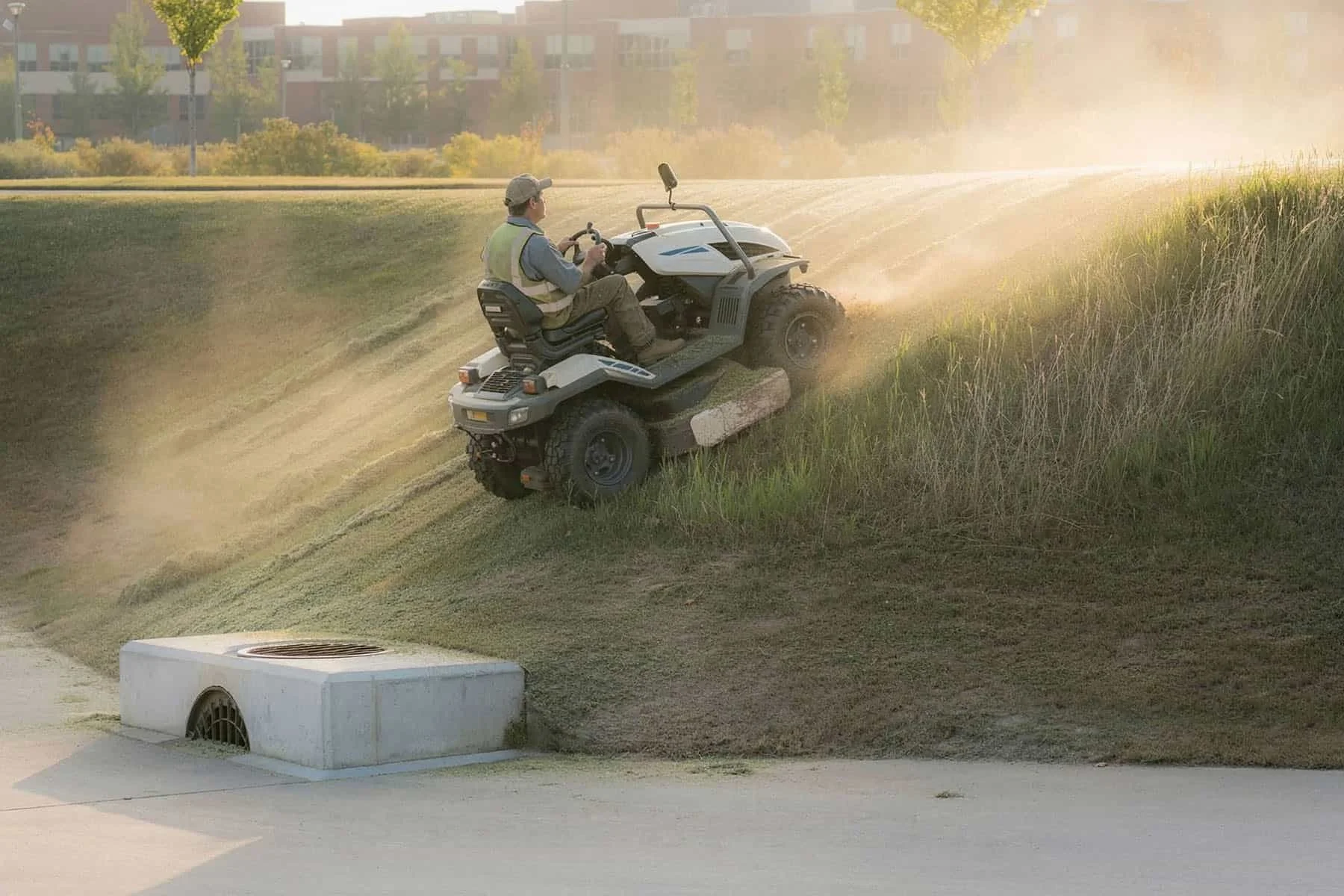
Because grass grows on its own schedule, and a stormwater device is often more lawn than water. In the North Carolina research, adding mowing raised the average routine cost of a wet pond by about half, from roughly $6,360 to $9,440 per acre a year.² The cost study found the same pattern: mowing and maintaining vegetative cover push costs up, and those tasks usually happen monthly.¹ A dry detention basin is essentially a lawn shaped like a bowl with an outlet at the bottom, so mowing is most of its routine care.
The budget trap is paying twice, or not at all. Plenty of boards already pay a landscaper to mow the common areas, then hire a pond company whose program also includes mowing. The reverse is worse. The landscaper skips the steep pond slopes because they are "the pond company's job," and the pond company never agreed to mow them. Put one sentence in each contract that says who mows the embankments and how often, and this line takes care of itself.
Line two: the annual inspection
A full maintenance program should include the annual inspection report. If your current vendor only mows, the inspection needs its own line, because someone qualified still has to walk the pond and write down what they find.
The paperwork is older than most boards realize. Under North Carolina's stormwater rules, a pond built to the state's design criteria comes with a recorded operation and maintenance agreement that requires the owner to maintain, repair or reconstruct it, and the owner has to keep maintenance records available on request.⁷ The state design manual recommends more for wet ponds: inspect quarterly and within 24 hours of any storm over an inch, and have a dam safety expert look at the embankment once a year.⁶
Local programs set the calendar. Charlotte requires an annual inspection report on each stormwater control measure, completed by a professional engineer, a registered landscape architect or an inspector certified through the city's program, and if the report never arrives the city can inspect, correct deficiencies and seek payment from the owner.⁴ Concord requires its annual inspections from a licensed professional engineer inside a spring window, March 15 to May 15 for 2026.⁸ If your inspection lands in spring, the money for it has to be in the budget you adopt this fall. Here is what a full SCM inspection covers.
Line three: power for aeration and fountains
Aerators and fountains bill every month, whether anyone looks at them or not. North Carolina's average commercial electricity price was 10.22 cents per kilowatt-hour in 2025, and the average residential price was 14.00 cents.⁵ At the commercial rate, every kilowatt of equipment running around the clock adds about $895 a year. On a residential-rate meter, the same kilowatt runs about $1,226.
Size your own line in one line of math. Take the motor's rated input in kilowatts from its nameplate or manual, multiply by the hours it runs in a year, then multiply by your rate. A fountain on a timer that runs 12 hours a night costs half as much as one that never shuts off. If you are wondering whether that fountain does any real oxygen work, our pond aeration guide and fountain repair and winter care guide cover both, and service details live on our aeration and fountains page.
Line four: the sediment reserve
This is the line that becomes a special assessment when nobody funds it. North Carolina's stormwater design manual calls sediment removal usually the largest single cost of maintaining a stormwater control measure and says the money should be set aside in advance.⁹ The same manual suggests an escrow account that can only be spent on sediment removal, major repair or reconstruction, funded in a subdivision by the developer at first and then by regular homeowners' association contributions.⁹
The forebay sets the clock. The state calls for a wet pond's forebay to be cleaned out once sediment cuts its depth below 75 percent of design depth.⁶ North Carolina Cooperative Extension researchers found forebays typically need to be dipped every 5 to 10 years, and as often as once a year when there is active construction upstream.¹⁰ The cheap way to know where you stand is to record the forebay's depth at the same time every year.¹⁰ Divide the estimated cleanout cost by the years left before the forebay reaches that 75 percent mark, and you have an annual reserve contribution instead of a surprise.
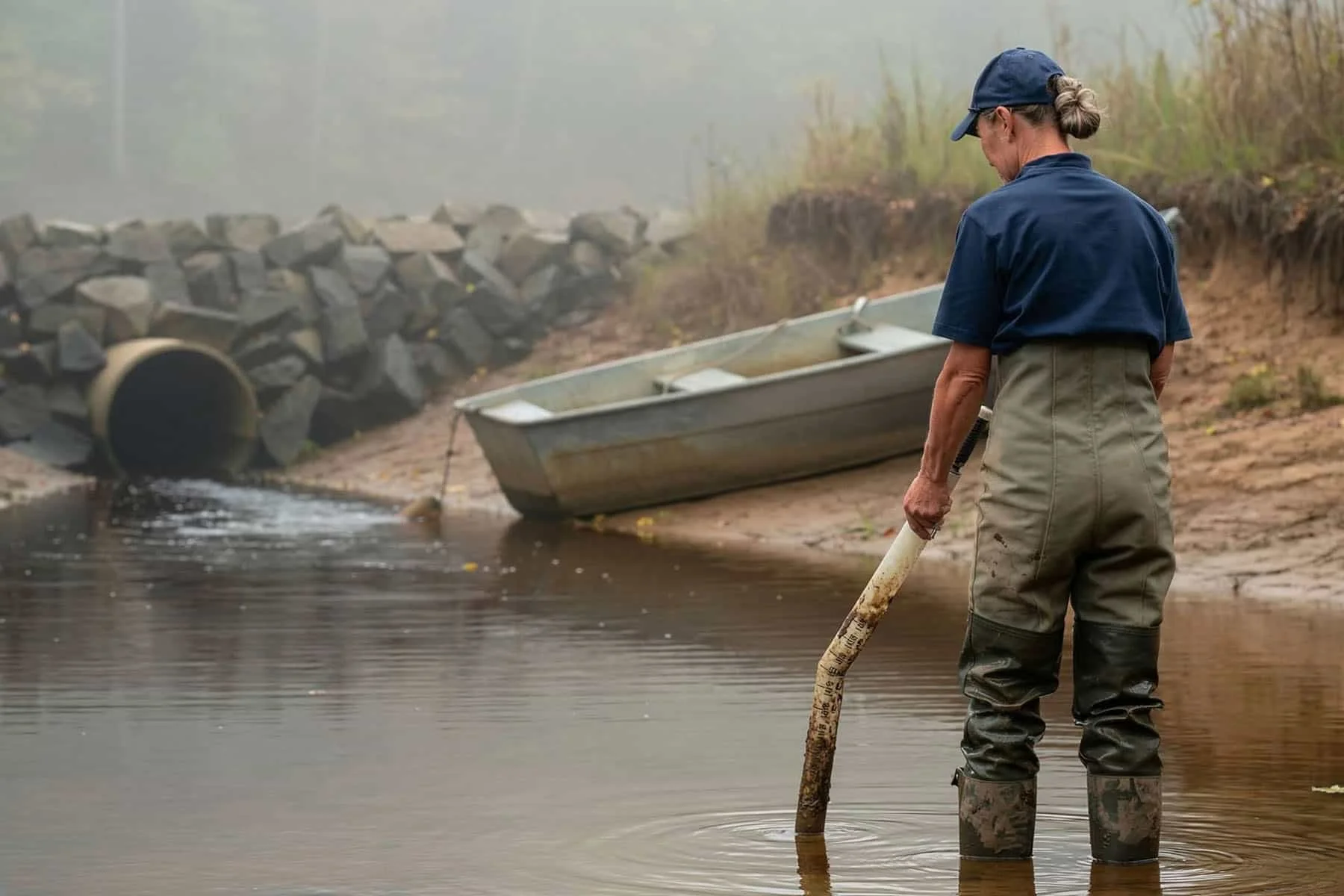
Nobody can price that cleanout honestly sight unseen; the state manual itself says sediment removal costs are too site specific to estimate well.⁹ Our pond dredging cost guide explains what sets that number and why the forebay is the inexpensive version.
What happens when the pond line gets cut?
The bill gets bigger, not smaller. The North Carolina cost study found restorative maintenance tends to cost much more than routine and proactive work, and that it is more economical to maintain a device routinely than to wait until it stops functioning.¹ The research team's own example is a 0.2-acre bioretention cell: about $2,480 a year to maintain routinely, against roughly $91,000 to fully restore one.² That is about 37 years of routine care spent at once.
Wet ponds fail more quietly, then all at once. North Carolina Cooperative Extension notes that most wet pond maintenance is simple and inexpensive, but without it the pond's performance declines.¹⁰ The same publication describes muskrat burrows as a problem that usually shows up only after neglect, and at worst those holes can lead to dam failure.¹⁰ When the deferred list has already grown, our repairs and restorations team handles the catch-up work.
How does a North Carolina HOA board adopt the pond budget?
For most planned communities created on or after January 1, 1999, the North Carolina Planned Community Act sets the process.¹¹ Within 30 days of adopting a proposed budget, the board sends every lot owner a summary and notice of a ratification meeting held 10 to 60 days after mailing. No quorum is required, and the budget is ratified unless a majority of all lot owners, or a larger vote set in the declaration, rejects it.¹² Condominium associations follow a parallel rule.¹³
The detail boards miss sits at the end of that statute. If owners reject the proposed budget, the last ratified budget stays in force.¹² If last year's budget never had a pond line, a rejected 2027 budget keeps it that way. Give the pond its own line with a one-sentence scope, so owners can see exactly what they are ratifying. Communities created before 1999 should check their declaration with the association's attorney or manager, since the Act applies to them differently.¹¹ For who owns the pond in the first place, see who is actually responsible for your neighborhood pond.
What does a sample 2027 pond line look like?
Take a typical Piedmont HOA with one half-acre wet pond out front, mowed as part of the pond program, and one 0.2-acre bioretention cell by the amenity center. Using the North Carolina research figures:²
Routine care, wet pond with mowing: about $4,720 a year at the research average
Routine care, bioretention cell: about $2,480 a year in the research team's example
Annual inspections: their own line, unless the maintenance program includes them
Power: one 1-kilowatt aerator running year-round, about $895 at the 2025 average commercial rate
Sediment reserve: the estimated forebay cleanout cost divided by the years until the forebay reaches its cleanout trigger
That puts routine care near $7,200 a year in 2018 dollars, before power and the reserve contribution, and a current quote for your site will reflect today's costs. Set that against the homes that face the water, and the line reads less like an expense and more like protection for the community's best view. More on that math in HOA retention pond maintenance and property value.
Getting a real number for your property
Clearwater Lake, Pond and Stormwater Management Services serves HOAs, commercial properties and property management portfolios across the North Carolina Piedmont from our Statesville headquarters, including Lake Norman, the Charlotte Metro, the Catawba Valley and the Piedmont Triad. A site walk tells us how many devices you have, what type they are, how hard they are to reach and who mows what, which are the things that actually set the price. See how we work with HOAs and communities and property management companies, or read what retention pond maintenance actually includes.
Get a 2027 pond number built for your property, not an average.
Call (704) 450-1598 or request service at clearwaterlpm.com.
How much does retention pond maintenance cost per year in North Carolina?
Is there a rule of thumb for annual pond maintenance cost?
Why does mowing change the cost so much?
How often does a pond forebay need to be cleaned out?
Does North Carolina require an annual pond inspection?
How does an HOA board in North Carolina adopt its budget?
Sources
- North Carolina State University and Water Resources Research Institute of the University of North Carolina. Maintenance Costs of Stormwater Control Measures (SCMs) in North Carolina. UNC-WRRI Report 491. Raleigh: NC WRRI, 2021. Accessed October 22, 2026. repository.lib.ncsu.edu.
- Waickowski, Sarah, William Hunt, and William Lord. "Costs of Maintaining Stormwater Control Measures." Slide presentation, Low Impact Development Basics for Water Quality Protection workshop, NC Coastal Reserve Coastal Training Program, September 2, 2026. Raleigh: North Carolina State University, Department of Biological and Agricultural Engineering; hosted by North Carolina Department of Environmental Quality. Accessed October 22, 2026. deq.nc.gov.
- U.S. Environmental Protection Agency. Stormwater Best Management Practice: Wet Ponds. EPA-832-F-21-031BB. Washington, DC: Office of Water, December 2021. Accessed October 22, 2026. epa.gov.
- City of Charlotte. Post-Construction Stormwater Regulations Administrative Manual, Section 12. June 2023 version, effective June 5, 2023. Accessed October 22, 2026. charlottenc.gov.
- U.S. Energy Information Administration. "Table 2.10. Average Price of Electricity to Ultimate Customers by End-Use Sector, by State, 2025 and 2024." In Electric Power Annual 2025. Washington, DC: EIA, October 21, 2026. Accessed October 22, 2026. eia.gov.
- North Carolina Department of Environmental Quality. "C-3. Wet Pond." In NCDEQ Stormwater Design Manual. Raleigh: Division of Energy, Mineral, and Land Resources, revised November 23, 2020. Accessed October 22, 2026. deq.nc.gov.
- North Carolina Office of Administrative Hearings. "15A NCAC 02H .1050 MDC for All Stormwater Control Measures," items (11) and (12). North Carolina Administrative Code. Effective January 1, 2017. Accessed October 22, 2026. reports.oah.state.nc.us.
- City of Concord. "SCM Inspections." Concord Stormwater. Accessed October 22, 2026. concordnc.gov.
- North Carolina Department of Environmental Quality. "A-7. SCM Operation and Maintenance." In NCDEQ Stormwater Design Manual. Raleigh: Division of Energy, Mineral, and Land Resources, revised February 11, 2018. Accessed October 22, 2026. deq.nc.gov.
- Hunt, William F., and Bill Lord. Maintenance of Stormwater Wetlands and Wet Ponds. Urban Waterways, AGW-588-07. Raleigh: North Carolina Cooperative Extension Service, 2006. Accessed October 22, 2026. ces.ncsu.edu.
- North Carolina General Assembly. "§ 47F-1-102. Applicability." North Carolina General Statutes, Chapter 47F, North Carolina Planned Community Act. Accessed October 22, 2026. ncleg.gov.
- North Carolina General Assembly. "§ 47F-3-103. Executive Board Members and Officers," subsection (c). North Carolina General Statutes, Chapter 47F, North Carolina Planned Community Act. Accessed October 22, 2026. ncleg.gov.
- North Carolina General Assembly. "§ 47C-3-103. Executive Board Members and Officers," subsection (c). North Carolina General Statutes, Chapter 47C, North Carolina Condominium Act. Accessed October 22, 2026. ncleg.gov.