Lake Water Quality Improvement: What Actually Works for North Carolina Lakes
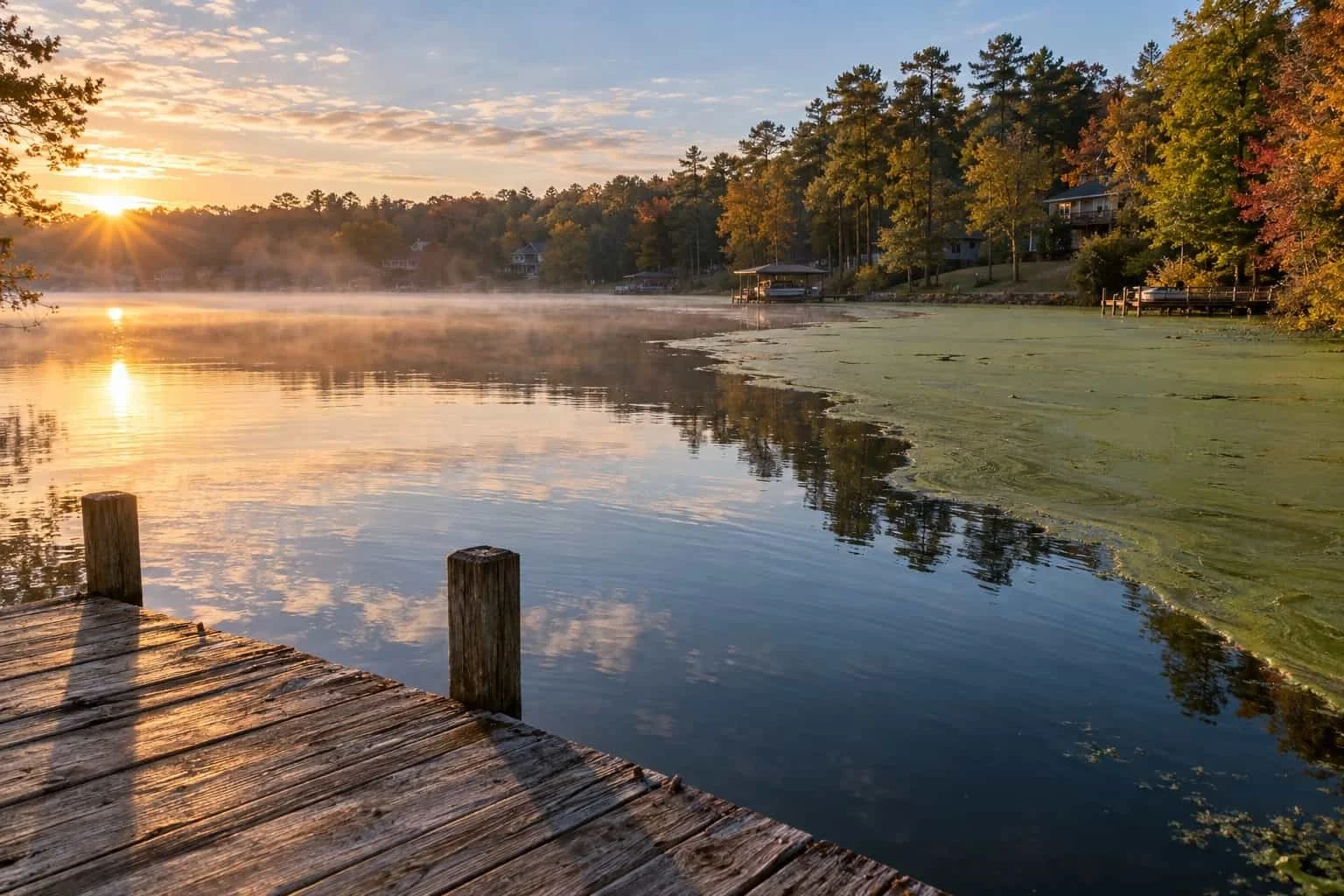
Lake water quality improvement comes down to one job: starve the algae. Green water, murky water, odor, fish kills and runaway weeds are symptoms. The cause underneath almost all of them is too much phosphorus and nitrogen, washing in from the watershed and coming back up from the lake bottom. The national picture is not encouraging. In the U.S. Environmental Protection Agency's 2022 National Lakes Assessment, 50 percent of lakes rated poor for phosphorus and 47 percent rated poor for nitrogen.¹. The fix is a plan, not a product. Cut nutrients at the source, stop the lake from feeding itself, treat what is already growing in measured doses, and test the water so you know it is working. This guide walks through each step for lake owners, HOA boards and golf course superintendents across the North Carolina Piedmont, from Lake Norman and the Charlotte metro to the Catawba Valley and the Piedmont Triad. If your lake is already showing the signs, request a free lake assessment or call (704) 450-1598.
What Causes Poor Lake Water Quality?
Almost every lake water quality problem traces back to nutrients. The EPA puts it plainly: waters with high levels of nutrients from fertilizers, septic systems, sewage treatment plants and urban runoff "may have high concentrations of chlorophyll a and excess amounts of algae." Chlorophyll a is the standard measure of how much algae and cyanobacteria are growing in the water.². The algae problem is getting more toxic, not less. In the same national survey, chlorophyll a rated poor in 49 percent of lakes, and microcystins, a family of cyanobacterial toxins, were detected in 50 percent of lakes. That detection rate rose almost 30 percentage points between the 2017 and 2022 surveys. Most detections stayed below the EPA recreational criterion, but open-water microcystins still exceeded it in 2 percent of lakes, about 5,360 lakes nationwide.¹
Nutrients from the watershed
Everything that happens on the land around a lake ends up in it. Lawn fertilizer, grass clippings, leaf litter, pet waste, failing septic systems and eroding banks all wash in with stormwater. Waterfowl add more than most owners expect. At Wintergreen Lake in Michigan, more than 6,500 Canada geese and 4,200 ducks supplied 70 percent of all the phosphorus entering the lake from outside sources.³ That was a heavily used migratory stop, not a typical Piedmont lake, but it shows why a resident flock is a water quality issue and not just a sidewalk issue. See our guide to Canada goose control for North Carolina ponds.
Nutrients from the lake bottom
A lake can keep feeding its own algae long after the runoff is fixed. In summer, lakes and ponds stratify into a warm upper layer and a cool bottom layer, and the bottom layer runs out of oxygen. Without oxygen, organic sediment releases the phosphorus it has been storing back into the water. Clemson Cooperative Extension notes that oxygenating bottom sediments "helps slow the release of nutrients from organic sediments that contribute to algae blooms."⁴ Lake scientists call this internal loading. It is the reason a lake can stay green for years after a neighborhood stops overfertilizing.
Sediment and shoreline erosion
Muddy water is a nutrient problem too. Phosphorus rides on soil particles, so every bank that sheds red clay into the lake delivers fertilizer along with it. Erosion also fills coves, shrinks depth and builds the muck layer that drives internal loading. Our lake shoreline erosion restoration work and the pond bank erosion repair guide cover the fixes.
What Is the Best Way to Improve Lake Water Quality?
The best way to improve lake water quality is to combine source control with in-lake treatment, then measure the results. No single product does it. Aeration without watershed work leaves the inflow untouched. Watershed work without in-lake treatment leaves years of stored phosphorus in the sediment. The six methods below have real evidence behind them, listed roughly in the order a good plan uses them.
1. Cut nutrients at the source
A vegetated buffer along the shoreline is the cheapest water quality tool a lake owner has. NC State University research found that a grass buffer removes approximately 60 percent of the sediment, and captures the phosphorus attached to it, within the first 15 feet.⁵ NC State Extension reports that riparian buffers remove approximately 50 percent of total phosphorus in general, and that well-maintained grass buffers can remove as much as 90 to 95 percent of sediment.⁶
Stop mowing to the waterline. Leave an unmowed strip along the bank and let it grow tall.
Keep fertilizer, clippings and leaves out of the water. Blow them back onto the lawn, never toward the shoreline or a storm drain.
Make the bank less inviting to geese. Geese favor open, mowed lawn that runs to the water. A tall buffer takes that away.
Fix eroding banks and inflow channels. Sediment is a phosphorus delivery system.
Check septic systems near the shoreline. A failing drain field is a direct nutrient line into the lake.
2. Stop the lake from feeding itself
Aeration attacks internal loading directly. A bottom-diffused aeration system circulates the water column, keeps oxygen at the sediment surface and slows the phosphorus release that fuels summer blooms.⁴ It also protects fish on the summer nights when oxygen would otherwise crash before dawn. For system types, sizing and cost, read our pond aeration and lake aeration guide, or see the aeration systems Clearwater designs and installs.
3. Lock up the phosphorus already in the lake
Alum treatment binds phosphorus in the water and caps the sediment so it stops releasing more. The North American Lake Management Society calls alum "a safe and effective lake management tool."⁷ Results last for years, not weeks. An analysis of 114 lakes treated with aluminum found improvements lasted 11 years on average, with deep, stratified lakes averaging 21 years and shallow, frequently mixed lakes averaging 5.7 years.⁸
Alum is a dosed treatment, not a guess. The dose comes from lab data on water and sediment phosphorus. NALMS notes that applications may be effective for 5 to 15 years and that, because watershed phosphorus control "seldom goes far enough," repeat applications will likely be necessary.⁷ That is why alum works best inside a plan that also cuts the inflow.
4. Treat algae and weeds in measured doses
Killing too much algae or weed growth at once can cause the fish kill you were trying to prevent. Decaying plants consume oxygen as they break down. Southern Regional Aquaculture Center guidance is specific: "Treating only one-fourth to one-third of the total surface area of a pond at one time can minimize the risk of depleting dissolved oxygen."⁹ On a lake, that means sectioned treatments spaced over weeks and timed to water temperature and oxygen readings.
Sectioned, targeted treatment is how Clearwater approaches lake algae control and lake weed control. For identification help, see how to get rid of pond weeds in North Carolina and our visual guide to North Carolina pond plants.
5. Use biological control where it fits
Triploid grass carp can control submerged weeds for years with no chemical input, but North Carolina regulates them. The North Carolina Wildlife Resources Commission allows only triploid grass carp certified as sterile. Owners of private ponds under 10 acres stocking no more than 150 fish can use the receipt from a licensed distributor as their stocking permit. Stocking more than 150 fish, or any pond larger than 10 acres, requires a permit through the district fisheries biologist, and there is no fee for it.¹⁰ Clemson Extension reports that most submerged weeds can be controlled with 20 to 25 triploid grass carp per acre of vegetation.¹¹
Grass carp are a weed tool, not an algae tool, and they eat their favorite plants first. Overstocking can strip a lake of the native vegetation that competes with algae for nutrients, so the stocking rate should be set by someone who has surveyed the lake.
6. Remove sediment when it is the real problem
When muck has filled the coves, no treatment substitutes for taking it out. Dredging restores depth and removes stored phosphorus along with the sediment. It is the most expensive step, and the one most often delayed by doing the first five well. Our guide to pond dredging cost in North Carolina covers permits, spoil handling and budgeting.
How to Monitor Lake Water Quality
If you are not measuring, you are guessing. Five measurements tell you most of what you need to know about a lake, and two of them cost almost nothing to collect. The table below uses ranges from the Carlson Trophic State Index and North Carolina's surface water standards. The state standards are written for public waters, but they are the most practical yardstick for a private or HOA lake too.
| Measure | What it tells you | Moderate-nutrient range | Problem range |
|---|---|---|---|
| Secchi depth (clarity) | How far light reaches, which tracks algae and suspended sediment | 2 to 4 meters (about 6.5 to 13 feet)¹² | Under 1 meter (about 3 feet)¹² |
| Total phosphorus | The main fuel for algae in most freshwater lakes | 12 to 24 µg/L¹² | Above 48 µg/L¹² |
| Chlorophyll a | How much algae is growing right now | 2.6 to 7.3 µg/L¹² | Above 40 µg/L exceeds the North Carolina standard¹³ |
| Dissolved oxygen | Whether fish can live there, top to bottom | Daily average of at least 5.0 mg/L (North Carolina standard)¹³ | Below 5 mg/L stresses fish; below 3 mg/L cannot support them¹⁴ |
| pH | Chemical balance, which swings with heavy algae growth | 6.0 to 9.0 (North Carolina standard)¹³ | Outside 6.0 to 9.0 |
Secchi depth is the cheapest number in lake management. A weighted black-and-white disk on a marked line, lowered until it disappears, gives you clarity in seconds. It is tied to everything else: on the Carlson Trophic State Index, each 10-unit step represents a halving or doubling of Secchi depth, and a doubling of total phosphorus often corresponds to a halving of Secchi depth.¹² Read it monthly from the same spot at the same time of day, and log it.
Oxygen and temperature need a profile, not a surface reading. A surface sample can look fine while the bottom third of the lake has no oxygen at all. In summer, take readings every few feet from surface to bottom. Lab samples for total phosphorus and chlorophyll a are worth pulling at least in spring and late summer, so you can compare the start of the season with its worst point. Report blooms that look like spilled paint or scum. The North Carolina Division of Water Resources takes algal bloom reports through an online form and tracks them on its public Fish Kill and Algal Bloom Dashboard.¹⁵ Keep people and pets out of the water until the bloom is identified.
How Long Does It Take to Improve Lake Water Quality?
Expect a lake to respond in seasons when you treat the lake, and in years when you only treat the watershed. An analysis of long-term data from 35 lakes that cut their nutrient inputs found that internal loading delayed recovery, and most lakes took 10 to 15 years to settle at a new, lower phosphorus level.¹⁶. North Carolina's own reservoirs show the same slow arc. Jordan Lake has rated eutrophic or hyper-eutrophic consistently since it was impounded in 1983.¹⁷ High Rock Lake on the Yadkin River is impaired for chlorophyll a, turbidity and pH, and state regulators are still drafting nutrient rules for its watershed.¹⁸ In-lake tools are what close that gap. Aeration and alum work on the stored phosphorus that causes the lag. That is why a plan that pairs them with source control changes the water in the near term instead of waiting a decade for the watershed to catch up.
Why Lake Water Quality Is a Property Value Issue
Buyers can see water quality, and they price it. A study of toxic algae and home sales around Ohio lakes found value losses of 11 to 17 percent for homes near an affected lake, rising above 22 percent for homes directly on it. At Grand Lake St. Marys, losses for near-lake homes exceeded $51 million, which the authors note dwarfs the $26 million the State of Ohio spent on cleanup.¹⁹ For an HOA, that puts lake management on the asset protection line of the budget, not the landscaping line. The same logic drives our work for HOA communities and golf courses and resorts. For the retention pond side of the equation, see HOA retention pond maintenance and property value.
How Do Lake Management Companies Improve Water Quality?
A lake management company improves water quality by diagnosing first, treating the cause second and proving the result with data. In practice it looks like this:
Assess. Test clarity, oxygen profiles, phosphorus and chlorophyll a. Walk the shoreline and inflows. Identify weeds and algae by species.
Plan. Rank the nutrient sources, decide what belongs in the watershed and what belongs in the lake, and set targets you can measure.
Treat. Install or repair aeration, apply sectioned algae and weed treatments, stock grass carp where permitted, and schedule alum or dredging when the data supports it.
Prove it. Re-test on a schedule and report the numbers, so the board or owner sees the trend instead of taking anyone's word for it.
That is the approach behind Clearwater's lake management services across Lake Norman, Charlotte, the Catawba Valley and the Piedmont Triad. Smaller water bodies get the same process through our pond management services. Your lake is telling you something every time it turns green. Let Clearwater measure it, find the cause and fix it. Call (704) 450-1598 or request service at clearwaterlpm.com.
What is the best way to improve lake water quality?
What causes poor lake water quality?
How long does it take to improve lake water quality?
How do lake management companies improve water quality?
Is alum safe for lakes?
Do I need a permit to stock grass carp in North Carolina?
What should I test to monitor lake water quality?
How do I report an algae bloom in North Carolina?
Sources
- U.S. Environmental Protection Agency. "National Lakes Assessment 2022: Key Findings." National Aquatic Resource Surveys. Last updated August 25, 2026. Accessed October 2026. epa.gov
- U.S. Environmental Protection Agency. "Indicators: Chlorophyll a." National Aquatic Resource Surveys. Last updated December 22, 2025. Accessed October 2026. epa.gov
- Manny, Bruce A., W. C. Johnson, and R. G. Wetzel. "Nutrient Additions by Waterfowl to Lakes and Reservoirs: Predicting Their Effects on Productivity and Water Quality." Hydrobiologia 279/280 (1994): 121-32. doi.org/10.1007/BF00027847
- Clemson Cooperative Extension. "Aeration, Circulation, and Fountains." Carolina Clear Stormwater Ponds. Accessed October 2026. clemson.edu
- Osmond, Deanna, Mike Burchell, and Erin Rivers. "Agricultural Riparian Buffers." AG-439-38. NC State Extension, 2017, revised May 6, 2022. Accessed October 2026. content.ces.ncsu.edu
- Osmond, D. L. "Riparian Buffers and Controlled Drainage to Reduce Agricultural Nonpoint Source Pollution." Technical Bulletin 318. NC State Extension, 2002. Accessed October 2026. content.ces.ncsu.edu
- North American Lake Management Society. "The Use of Alum for Lake Management." NALMS Position Statement. Adopted February 26, 2004. Accessed October 2026. nalms.org
- Huser, Brian J., Sara Egemose, Harvey Harper, Michael Hupfer, Henning Jensen, Keith M. Pilgrim, Kasper Reitzel, Emil Rydin, and Martyn Futter. "Longevity and Effectiveness of Aluminum Addition to Reduce Sediment Phosphorus Release and Restore Lake Water Quality." Water Research 97 (2016): 122-32. doi.org/10.1016/j.watres.2015.06.051
- Murphy, Tim R., Michael P. Masser, and James L. Shelton. "Aquatic Weed Management: Herbicides." SRAC Publication No. 361. Southern Regional Aquaculture Center, hosted by Oklahoma State University Extension. Accessed October 2026. extension.okstate.edu
- North Carolina Wildlife Resources Commission. "Fish Stocking and Grass Carp Possession Permits." NC Wildlife. Accessed October 2026. ncwildlife.gov
- Whetstone, Jack M., and Mac Watson. Revised by W. Cory Heaton. "Biological Control of Aquatic Weeds." HGIC 1715. Clemson Cooperative Extension Home and Garden Information Center, 2015. Accessed October 2026. hgic.clemson.edu
- North American Lake Management Society. "Trophic State Equations." The Robert Carlson Secchi Dip-In. Accessed October 2026. nalms.org
- North Carolina Administrative Code. 15A NCAC 02B .0211, "Fresh Surface Water Quality Standards for Class C Waters." North Carolina Office of Administrative Hearings. Accessed October 2026. reports.oah.state.nc.us
- U.S. Environmental Protection Agency. "Indicators: Dissolved Oxygen." National Aquatic Resource Surveys. Last updated February 24, 2026. Accessed October 2026. epa.gov
- North Carolina Department of Environmental Quality, Division of Water Resources. "Algal Blooms." NCDEQ. Accessed October 2026. deq.nc.gov
- Jeppesen, Erik, Martin Søndergaard, Jens Peder Jensen, Karl E. Havens, Orlane Anneville, Laurence Carvalho, Michael F. Coveney, et al. "Lake Responses to Reduced Nutrient Loading: An Analysis of Contemporary Long-Term Data from 35 Case Studies." Freshwater Biology 50, no. 10 (2005): 1747-71. doi.org/10.1111/j.1365-2427.2005.01415.x
- North Carolina Department of Environmental Quality, Division of Water Resources. "Jordan Lake Nutrient Strategy." NCDEQ. Accessed October 2026. deq.nc.gov
- North Carolina Department of Environmental Quality, Division of Water Resources. "High Rock Lake Nutrient Management Strategy." NCDEQ. Accessed October 2026. deq.nc.gov
- Wolf, David, and H. Allen Klaiber. "Bloom and Bust: Toxic Algae's Impact on Nearby Property Values." Ecological Economics 135 (2017): 209-21. doi.org/10.1016/j.ecolecon.2016.12.007