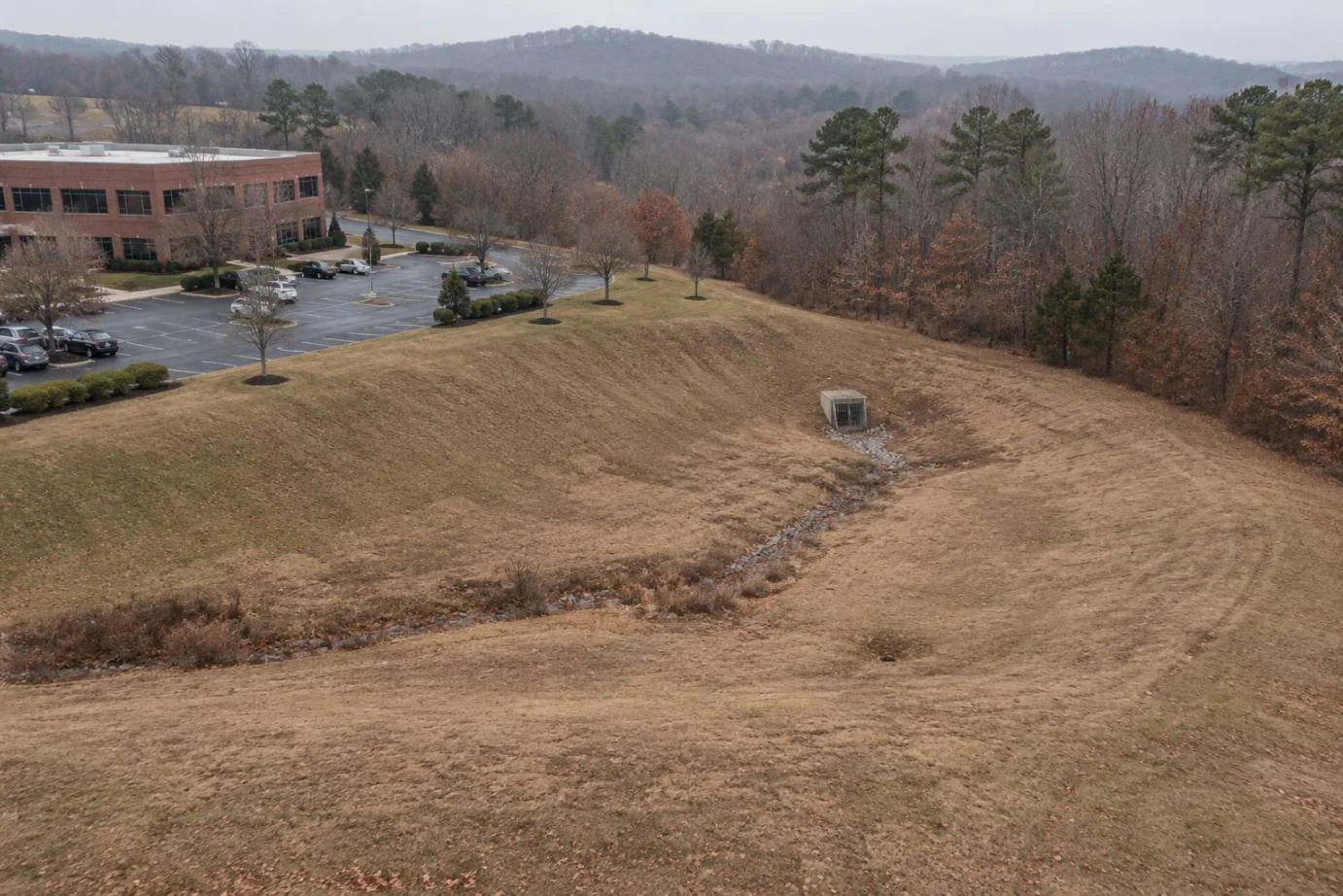
Dry detention basin maintenance in North Carolina comes down to three jobs: keep the turf near six inches, keep trees and woody brush off the embankment and basin floor, and keep the outlet open so the basin drains on schedule. Winter is the best time for the heavy part. Leaves are down, saplings stand out, clogged orifices are visible, and the work is done before spring inspections.
A dry detention basin is the grassy bowl at the back of the office park, beside the big-box parking lot, or behind the gym on a school campus. It sits empty most of the year, so it drops off the list until a storm leaves water standing for a week or an inspector flags sweetgum saplings on the dam. This guide from Clearwater Lake, Pond and Stormwater Management Services covers what the state design manual asks of a dry basin, the winter work that heads off spring problems, and who should handle each part.
What is a dry detention basin, and how is it different from a wet pond or an infiltration basin?
A dry detention basin holds stormwater for a short time after a storm, then drains almost completely dry. The North Carolina Department of Environmental Quality (NCDEQ) says its primary purpose is to attenuate and delay runoff peaks, and the design volume must draw down within two to five days.¹ The same chapter calls the dry pond a secondary stormwater control measure (SCM), because the overall pollutant removal of dry extended detention basins is low.¹ In plain terms, its job is flood control: catch the surge off the roofs and parking lots, then let it go slowly.
A wet pond keeps a permanent pool of water year-round. An infiltration system captures runoff and lets it soak into the soil, and its lowest point must sit at least two feet above the seasonal high water table.² The maintenance follows the design. A dry basin's typical problems are woody brush, clogged outlets and lost storage, and that is where this guide focuses. For a side-by-side look at how commercial owners run both types, see how commercial properties manage stormwater ponds.
What does the NCDEQ Stormwater Design Manual say about dry pond maintenance?
Chapter C-12 of the NCDEQ Stormwater Design Manual, last revised in November 2020, gives dry pond owners a short, specific list. Once the basin is established, inspect it quarterly and within 24 hours after every storm over 1.0 inch, keep the vegetation in and around the basin at about six inches, and have a dam safety expert inspect the embankment at least once a year.¹
The embankment rule. Design standard MDC 9 says the dam, including the front and back embankment slopes, is planted with non-clumping turf grass, and trees and woody shrubs are not allowed.¹ The chapter's sample maintenance provisions then spell out the fixes:
Shrubs on the embankment. Remove them immediately. If a tree has started to grow there, consult a dam safety specialist to remove it.¹
Standing water. Water standing more than 5 days after a storm means checking the outlet structure for clogging, and calling an appropriate professional if the cause is a design issue.¹
Sediment. Sediment above the original design storage depth in the forebay or main treatment area is removed and disposed of away from streams, and the source is found and fixed where possible.¹
Bare soil and gullies. Regrade if needed, plant ground cover, and water until it is established.¹
Local operation and maintenance agreements in the Piedmont borrow this language almost word for word. The City of Kannapolis dry extended detention agreement, for example, tells owners that when shrubs or trees start to grow on the embankment, they remove them immediately.³ Your recorded agreement is the document that governs your basin, so pull it out before you hire anyone. Any stormwater BMP maintenance program should start from it.
Why is winter the best time for detention basin maintenance?
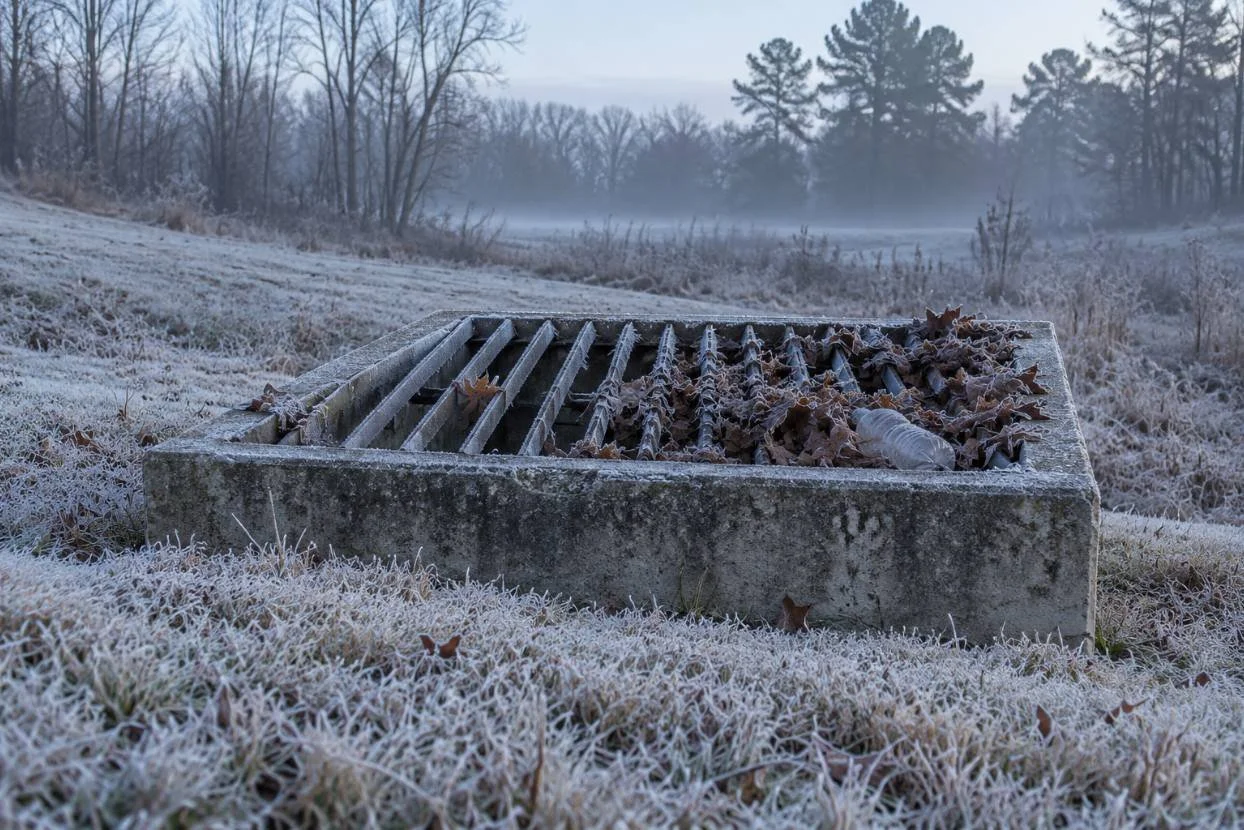
Because you can see everything. Leaves are off the hardwoods, the turf is dormant, and the saplings, vines and outlet clogs that hide under summer growth are in plain view. Haywood County Cooperative Extension makes the same point about farm ponds: winter is a good time to inspect levees because the vegetation has died back.⁴
Timing also matters because woody growth compounds. The Federal Emergency Management Agency's technical manual on plants and earthen dams warns that woody vegetation can become quite dense and relatively large within the first two to three growing seasons if it is not controlled, and notes that controlling vegetation annually is relatively inexpensive.⁵ A first-year seedling comes out with loppers. Three seasons later it is a tree, and under the state manual a tree on the embankment means calling a dam safety specialist.¹
Spring inspections follow. State rules require local stormwater programs to make each SCM owner submit an annual maintenance inspection report, and each program sets its own timing.⁶ In 2026, the City of Concord required annual inspections to be completed between March 15 and May 15 by a North Carolina licensed Professional Engineer, and inspections submitted before March 15 had to be redone with updated photos.⁷ Statesville wants the report before the anniversary of the final construction inspection and as-built certification.⁸ Charlotte ties it to each SCM's anniversary date,⁹ and Mooresville owners file by the deadline on their annual inspection reminder.¹⁰ Concord requires at least four photos per inspection, and Statesville and Mooresville require photos of key components.⁷,⁸,¹⁰ Work finished in December or January means the inspector photographs a basin that already works. Our SCM inspections and compliance page explains how that annual visit runs.
What belongs on a winter detention basin checklist?
Walk the system in the order water moves: inlets, forebay, basin floor, low-flow channel, outlet structure, emergency spillway and discharge point. Charlotte's dry detention guide, dated March 2026, puts these tasks on a quarterly and after-heavy-rain schedule.¹¹ The table below is the winter version, and the notes after it explain each step.
Winter dry detention basin checklist
| Component | What to look for | Typical fix |
|---|---|---|
| Embankment slopes | Saplings, shrubs, vines, briars; any tree | Cut small woody growth now; call a dam safety specialist for any tree |
| Basin floor | Woody growth, weeds, trash, ruts | Remove woody growth and trash; pull weeds by hand or wipe on herbicide |
| Outlet structure and orifice | Leaf mats, trash, sediment at the opening | Clean out; dispose of sediment away from streams |
| Trash rack or screen | Debris mat, bent or missing bars | Clear debris; send broken bars to a qualified vendor |
| Low-flow channel | Sediment, debris, scour | Clear sediment and debris; repair scour |
| Forebay and main basin | Sediment near or past design depth | Find the source; remove and dispose of sediment properly |
| Side slopes and perimeter | Bare soil, gullies | Regrade, plant ground cover, water until established |
| Basin floor after rain | Water standing more than 5 days | Check the outlet for clogging; call a professional if it is a design issue |
| Emergency spillway | Brush, debris, slumps, displaced riprap | Clear, repair and restore the armor |
| Outlet discharge point | Erosion or damage below the pipe | Repair and improve the flow dissipation structure |
Built from NCDEQ Stormwater Design Manual chapter C-12, Table 1,¹ the City of Charlotte Dry Detention Maintenance Guide (March 2026),¹¹ and the Town of Mooresville Stormwater Facility Maintenance Manual.¹² Your recorded operation and maintenance agreement governs your basin.
Cut woody growth everywhere. Charlotte's guide tells owners to remove woody vegetation from inside the basin and from both sides of the embankment.¹¹ Saplings, briars and vines come out now. Anything with a real trunk on the dam goes to a dam safety specialist.
Clear the outlet, orifice and trash rack. Small sites need small orifices, and EPA notes those are prone to clogging; it points to designs such as a reverse-slope pipe or a weir with a trash rack.¹³ NCDEQ's general maintenance chapter singles out floating debris, which can clog outlet devices and risers.¹⁴ After leaf drop, pull the leaf mat and trash off the rack and out of the orifice.
Open the low-flow channel. NCDEQ allows a sinuous low-flow channel through the basin to carry dry-weather flows and minor storm flows.¹ Where one exists, clear sediment and debris from it and note any scour, because a blocked channel spreads water across the floor.
Find the sediment. Compare what you measure with the design storage depth on your plans. Start at the forebay, the cell built to catch floating material and heavy sediment first.¹¹ EPA's fact sheet ties forebay cleanout to a 50 percent loss of forebay capacity, typically every 2 to 7 years.¹³ Red clay washing in from upstream construction shows up there first.
Repair erosion and bare spots. Gullies on side slopes, washouts at pipe ends and patches where turf failed all get regraded and stabilized. Seeding or sodding dead or damaged ground cover is an annual task in EPA's maintenance schedule.¹³ Stabilize the soil now and finish seeding when the planting window opens.
Check for standing water. A small pool right at the outlet can be part of the design, since NCDEQ calls for a small permanent pool near the outlet orifice to reduce clogging.¹ Water across the floor days after rain is different. Charlotte says none should remain more than 5 days after a storm,¹¹ and EPA notes that standing water lasting more than 3 days makes ideal mosquito breeding ground.¹³
Walk the emergency spillway. It only works when it is clear, so look for brush, debris, slumping and displaced riprap. NCDEQ recommends at least one foot of freeboard above the maximum stage elevation,¹ and Mooresville's annual report requires photos of the emergency spillway, both embankment slopes and the outlet structure.¹⁰
How short should detention basin grass be, and how often should it be mowed?
About six inches. NCDEQ's dry pond chapter says vegetation in and around the basin is maintained at approximately six inches,¹ and Charlotte's guide sets a range of 4 to 6 inches.¹¹ Neither sets a fixed number of mowings per year. Charlotte lists mowing among its quarterly and after-heavy-rain tasks, and EPA lists mowing side slopes as standard maintenance.¹³
Mowing does more than keep the basin tidy. NCDEQ's maintenance chapter notes that consistent mowing of the embankment controls stray seedlings that take root.¹⁴ Mow when the floor is firm enough to avoid rutting, and do not scalp the slopes. A healthy, dense stand of low-growing grass is exactly what dam safety guidance wants on an embankment.⁵
Why can't trees stay on a detention basin embankment?
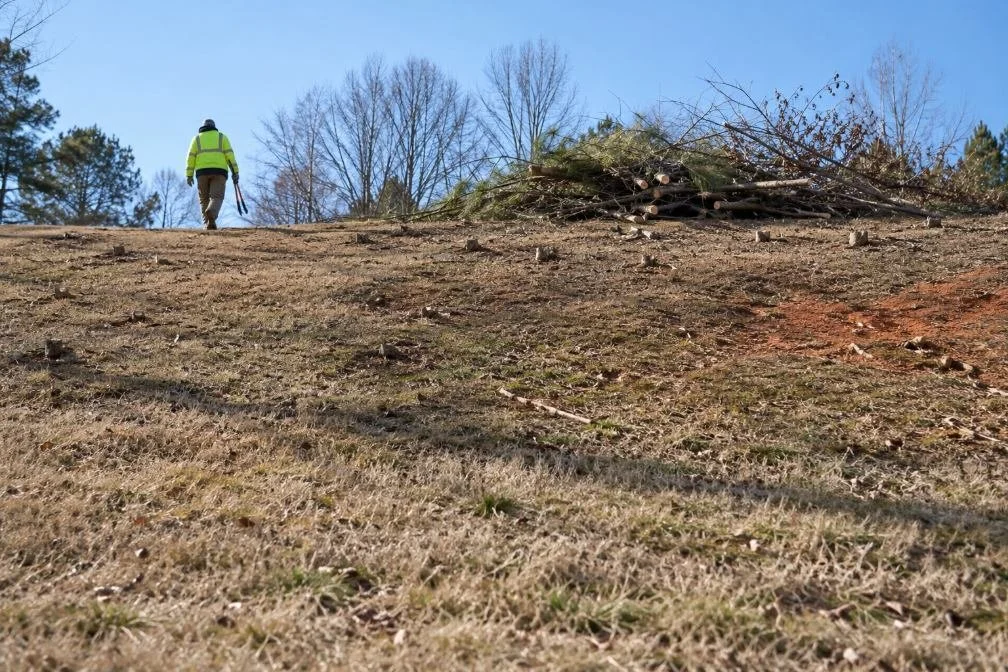
Because roots become leaks. The state manual does not allow trees or woody shrubs on a dry pond's dam,¹ and NCDEQ's maintenance chapter warns that young trees and bushes in embankments are destabilizing and may result in premature failure if left unchecked.¹⁴
FEMA's dam owner manual, developed with the Association of State Dam Safety Officials, is blunt: trees and woody vegetation have no place on the embankment slopes of an earthen dam. It lists the reasons:⁵
Tree roots loosen the soil of the embankment slope.
Decaying roots leave seepage paths and internal erosion.
Trees that blow over pull out root balls, leaving large voids and less freeboard.
Trees and brush attract burrowing animals.
Trees, brush, briars and vines hide the problems an inspector needs to see.⁵
That is also why removal method matters. Small saplings can simply be cut. FEMA's manual separates clearing, which cuts growth without removing stumps and roots, from grubbing, which removes stumps, root balls and lateral roots, and says remediation should follow properly designed plans.⁵ On a dry pond, NCDEQ's answer for a tree on the embankment is to consult a dam safety specialist.¹ Because NCDEQ treats the embankment as a dam structure, the same inspection logic applies as for a pond dam. Our pond dam inspection guide walks through what an inspector checks.
What does ignoring a dry basin cost?
More than the winter cleanup would have. Charlotte Storm Water Services warns that neglected SCMs can lead to costly repairs, localized flooding, or pollutants reaching waterways.¹⁵ The failures tend to stack:
Clogged outlet. The basin holds water instead of draining, the floor stays soft, and standing water past 3 days becomes mosquito habitat.¹³
Sediment buildup. Every inch of silt is storage the basin no longer has. NCDEQ calls sediment removal usually the largest single cost of maintaining an SCM facility.¹⁴
Woody growth left for years. A sapling job becomes tree removal on a dam, and FEMA's manual calls for remediation to follow properly designed plans.⁵
Downstream damage. When discharges cause erosion or sedimentation downstream, NCDEQ's sample provisions tell owners to contact the local NCDEQ Regional Office.¹
A deficient annual report. In Charlotte, the inspecting professional has to submit a corrective plan for review before the anniversary date.⁹
If a notice has already arrived, start with notice of violation response. To budget the sediment and inspection lines before the board or owner signs off, see what retention pond maintenance costs in North Carolina.
Who should handle detention basin maintenance: the landscaper, an SCM specialist, or an engineer?
Usually all three, each on a different job. Maintenance is usually the owner's responsibility,¹⁴ and the annual report is the owner's to file,⁶ so the real question is who does which piece.
Landscaper or facilities crew. Mowing to height, trash pickup and routine looks. Mooresville's maintenance manual says routine inspections can be done by owners, landscapers or contract workers, but difficult or potentially dangerous tasks, such as fixing broken trash rack bars, belong with a qualified vendor.¹² Charlotte suggests asking your landscaper to add SCM checks to routine visits.¹⁵
SCM maintenance specialist. Woody vegetation removal on slopes, outlet and trash rack clearing, sediment measurement, erosion repair and the records. North Carolina State University's SCM Inspection and Maintenance Certification page puts it plainly: SCMs are not managed as standard landscape features. The certification lasts up to three years and does not replace a PE or RLA license.¹⁶
Engineer or dam safety specialist. The annual embankment inspection, trees on the dam, standing water caused by a design problem, and the annual report wherever your city requires a licensed professional to sign it.
Office parks, retail centers, industrial sites and managed portfolios each run this split a little differently. See how it works for office parks, retail centers, industrial and distribution sites and property managers.
The plan is simple. Walk the basin after leaf drop, cut the woody growth, clear the outlet, measure the sediment and stabilize bare soil, then let your inspector see a basin that already works.
Want your detention basin walked, cleared and documented before inspection season?
Call (704) 450-1598 or request service at clearwaterlpm.com.
Frequently Asked Questions
Can we plant ornamental trees or shrubs in a dry basin for curb appeal?
Not on the embankment or in the basin itself. NCDEQ's dry pond standard calls for non-clumping turf grass on the dam and does not allow trees or woody shrubs there,¹ and its maintenance chapter says tall maturing trees, for the most part, have no place in an SCM, with buffers as the exception.¹⁴ If the property wants more green, the landscaped buffer outside the basin is the place to discuss it, and your approved plans control what is allowed.
Can our landscaper sign the annual inspection report?
It depends on the city. Mooresville accepts annual inspections from a registered Professional Engineer, landscape architect or surveyor, or from someone holding a current SCM Inspection and Maintenance Certification from North Carolina State University.¹⁰ Charlotte allows a Professional Engineer, a Registered Landscape Architect, or an individual who completed a city-approved certification program.⁹ Concord requires a North Carolina licensed Professional Engineer.⁷ Check your city's rule well before inspection season.
How do we measure sediment in a dry basin?
Compare the current depth with the design storage depth on the approved plans. NCDEQ calls for removal once sediment exceeds the original design storage depth.¹ The Kannapolis agreement flags sediment once it has reduced the depth to 75 percent of the original design depth, and it warns that the measuring device should not readily sink into the accumulated sediment, or the reading will be off.³ Mark the measuring spot so next year's reading is comparable.
Should we spray herbicide on weeds in the basin?
Spraying is not the first choice. NCDEQ's sample maintenance provisions for dry ponds say to remove weeds by hand, and if a pesticide is used, to wipe it on rather than spray it.¹ Charlotte's dry detention guide also prefers hand removal.¹¹ Wiping keeps the product on the target plant and off the turf you need to hold the slopes. Ask whoever handles your basin to note any treatment in the maintenance records.
What is the difference between the forebay and the main basin?
The forebay is the first cell water enters. Charlotte's guide describes it as the section that removes floating material and heavy sediment, while the outlet structure controls how fast water leaves and the main basin holds water to slow runoff.¹¹ NCDEQ says forebays trap sediment, simplify maintenance and extend the life of dry ponds, and recommends them particularly for dry ponds that treat 20,000 or more cubic feet.¹ A clean forebay protects storage in the main basin.
Do muskrats or beavers matter in a dry basin?
Yes, when they work on the embankment. NCDEQ's dry pond provisions list muskrat or beaver activity on the embankment as a problem and call for a professional to remove the animals and repair any holes or erosion.¹ FEMA's dam owner manual adds that trees and brush attract burrowing animals,⁵ which is one more reason to keep the slopes in turf. Report any new holes in the slope to whoever handles your annual inspection.
Sources
1. North Carolina Department of Environmental Quality. "C-12. Dry Pond." In NCDEQ Stormwater Design Manual. Raleigh: North Carolina Department of Environmental Quality, Division of Energy, Mineral and Land Resources, revised November 23, 2020. https://www.deq.nc.gov/energy-mineral-and-land-resources/stormwater/bmp-manual/c-12-dry-pond-11-20-2020/download.
2. North Carolina Department of Environmental Quality. "C-1. Infiltration System." In NCDEQ Stormwater Design Manual. Raleigh: North Carolina Department of Environmental Quality, Division of Energy, Mineral and Land Resources, revised November 20, 2020. https://www.deq.nc.gov/energy-mineral-and-land-resources/stormwater/bmp-manual/c-1-infiltration-system-11-20-2020/download.
3. City of Kannapolis. "Dry Extended Detention Basin Operation and Maintenance Agreement." Kannapolis, North Carolina: City of Kannapolis Engineering Department, n.d. Accessed October 28, 2026. https://kannapolisnc.gov/Portals/0/Kannapolis/Departments/Engineering/Documents/SCM/BMPMan-OMA-DryDetention-20080206-DWQ-SPU.pdf.
4. Haywood County Center, North Carolina State Extension. "North Carolina Farm Pond Management Calendar." North Carolina State University. Accessed October 28, 2026. https://haywood.ces.ncsu.edu/farm-pond-management/north-carolina-farm-pond-management-calendar/.
5. Federal Emergency Management Agency. Technical Manual for Dam Owners: Impacts of Plants on Earthen Dams. FEMA 534. Washington, DC: Federal Emergency Management Agency, September 2005. https://www.mass.gov/doc/fema-publication-534/download.
6. North Carolina Administrative Code. Title 15A, Chapter 02, Subchapter H, Rule .1017. Effective July 3, 2012; readopted effective January 1, 2017. Raleigh: North Carolina Office of Administrative Hearings. http://reports.oah.state.nc.us/ncac/title%2015a%20-%20environmental%20quality/chapter%2002%20-%20environmental%20management/subchapter%20h/15a%20ncac%2002h%20.1017.pdf.
7. City of Concord. "SCM Inspections." Concord Stormwater Services. Accessed October 28, 2026. https://concordnc.gov/Departments/Stormwater/Stormwater-Control-Measures/SCM-Inspections.
8. City of Statesville. "Stormwater Maintenance and Annual Inspections." Accessed October 28, 2026. https://www.statesvillenc.net/stormwater-maintenance.
9. City of Charlotte. Post-Construction Stormwater Regulations Administrative Manual. June 2023 version, effective June 5, 2023. Charlotte, North Carolina: Charlotte Storm Water Services. https://www.charlottenc.gov/files/sharedassets/city/services/stormwater/documents/regulations/post-construction-administrative-manual-city-of-charlotte-udo.pdf.
10. Town of Mooresville. "Post Construction SCM Information." Mooresville Stormwater Division. Accessed October 28, 2026. https://mooresvillenc.gov/government/departments/stormwater/post-construction_bmp_forms.php.
11. City of Charlotte and Mecklenburg County Storm Water Services. "Dry Detention Maintenance Guide." Charlotte, North Carolina, March 2026. https://www.charlottenc.gov/files/sharedassets/city/v/4/services/stormwater/documents/regulations/scm-maintanence/dry-detention-maintenance-guide.pdf.
12. Town of Mooresville. Stormwater Facility Maintenance Manual: Private Stormwater Facilities. 2015 edition, updated August 2021. Mooresville, North Carolina: Town of Mooresville. https://cms5.revize.com/revize/mooresvillenc/Site%20Documents/Stormwater/StormwaterFacilityMaintenanceGuide%282021edit%29.pdf.
13. U.S. Environmental Protection Agency, Office of Water. Stormwater Best Management Practice: Dry Detention Ponds. EPA-832-F-21-031A. Washington, DC: U.S. Environmental Protection Agency, December 2021. https://www.epa.gov/system/files/documents/2021-11/bmp-dry-detention-ponds.pdf.
14. North Carolina Department of Environmental Quality. "A-7. SCM Operation and Maintenance." In NCDEQ Stormwater Design Manual. Raleigh: North Carolina Department of Environmental Quality, revised February 11, 2018. https://deq.nc.gov/media/10110/download.
15. City of Charlotte. "SCM Maintenance." Charlotte Storm Water Services. Accessed October 28, 2026. https://www.charlottenc.gov/Services/Stormwater/Stormwater-Regulations/SCMmaintenance.
16. North Carolina State University, Department of Biological and Agricultural Engineering. "SCM Inspection and Maintenance Certification." North Carolina State Extension Workshops and Conferences. Accessed October 28, 2026. https://bae.ncsu.edu/workshops-conferences/stormwater-bmp.