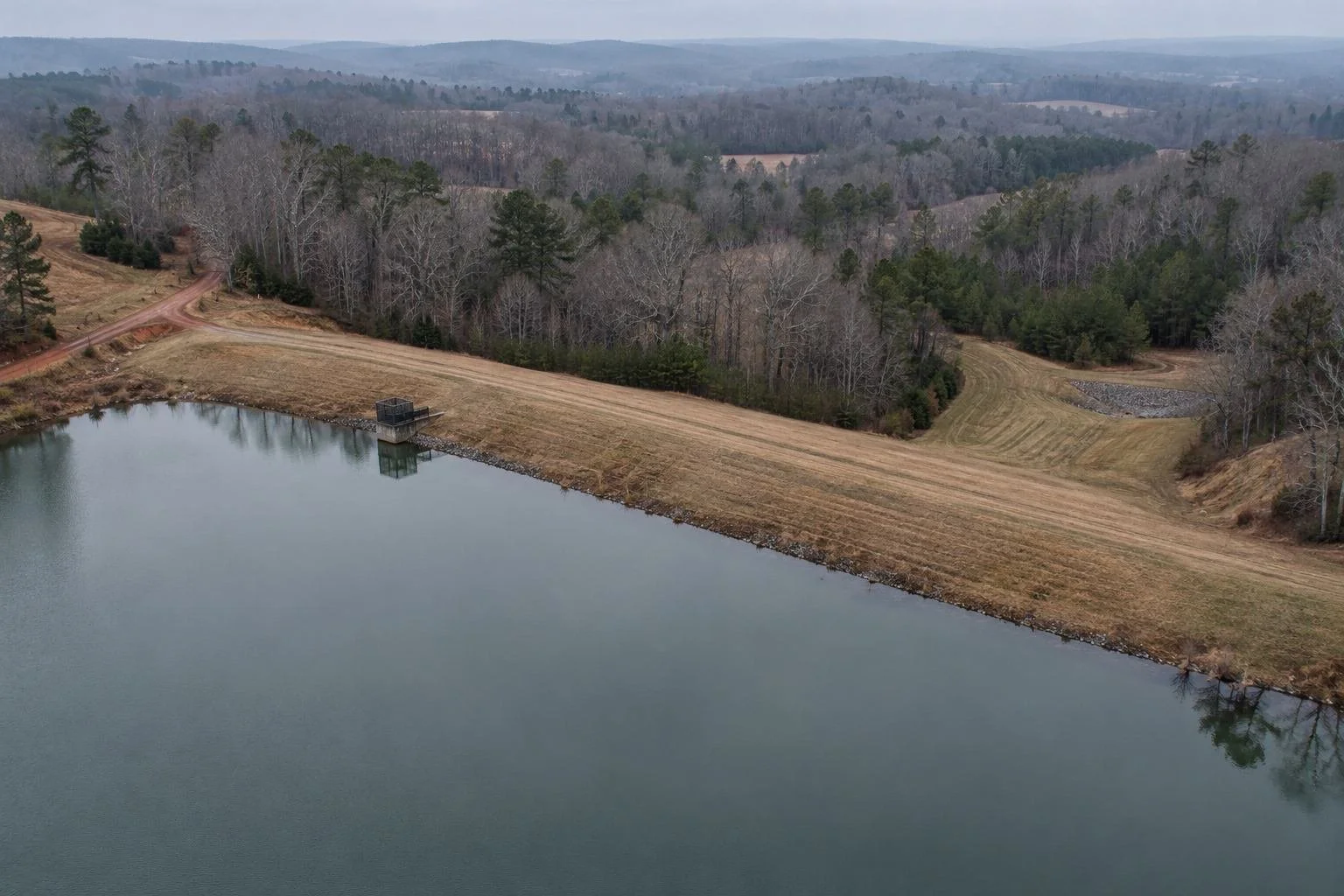
You only know by walking it, and winter is the best time. Dormant grass and bare hardwoods expose the embankment, so wet spots, burrows, cracks and saplings are easy to see.¹ Walk the crest, both slopes, the toe and the spillways. Mowing, clearing small woody growth and unclogging trash racks are owner jobs. Muddy seepage, boils, sinkholes, wide cracks and large trees need a licensed engineer.
Why is winter the best time to inspect a pond dam?
Because you can finally see it. The North Carolina State Extension farm pond calendar for Haywood County names winter as a good time to inspect levees, since the vegetation has died back.¹ In winter a Piedmont pond dam in Iredell, Rowan or Guilford County looks its plainest: tan fescue, bare oaks, red clay showing wherever the cover is thin. The slope that hid a burrow under knee-high summer growth now shows it from the crest.
Dams are also in the news. North Carolina documented 41 state-regulated dams that failed or had significant damage from Hurricane Helene.² In July 2026 the General Assembly gave NCDEQ $20 million to repair or remove aging dams, and every dam the budget names is in western North Carolina.³ The state has at least 7,000 dams, 23 percent rated high hazard.³ A farm pond outside Statesville is not a mountain reservoir after a hurricane. Still, it is a reason to look.
Clearwater Lake, Pond and Stormwater Management Services cares for ponds and lakes across the North Carolina Piedmont, including private residential ponds, farm and large land ponds and community stormwater ponds. The walk-through below is one every owner can do once a year, in winter, before the next big rain.
What are the parts of a pond dam?
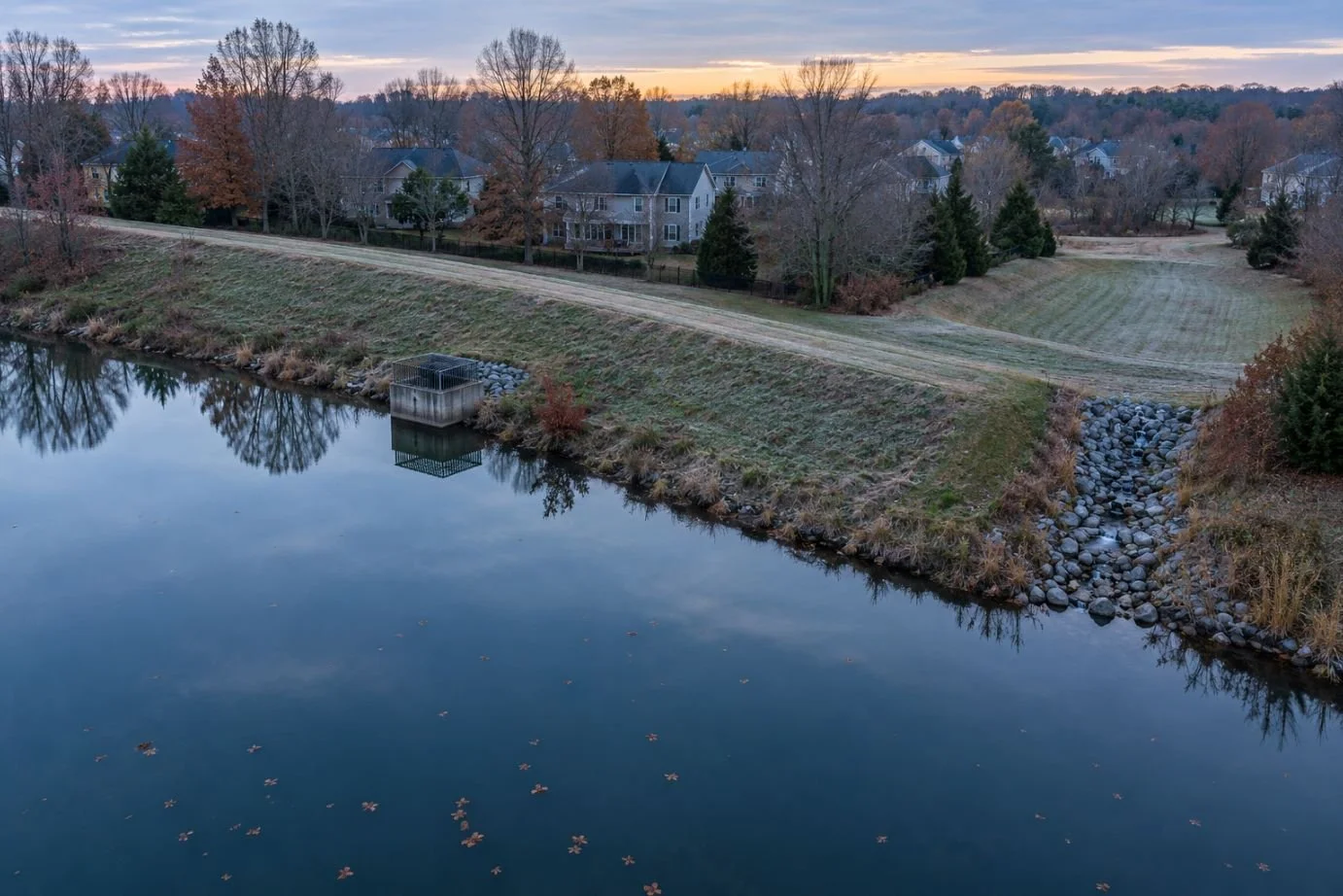
A pond dam is an earthen embankment with a pipe through it and an escape route around it. Learn these names and any inspection report becomes readable.
Crest. The top of the dam, graded to drain toward the pond, not down the back slope.⁴
Upstream slope. The water side. Wind waves erode it, a process the state dam manual calls beaching.⁴
Downstream slope. The dry back face, where seepage and slides tend to show up.⁴
Toe. Where the downstream slope meets natural ground. Dam height is measured from the crest down to the toe.⁴
Principal spillway and riser. The principal spillway carries normal flows and small floods. Water enters the riser, a vertical inlet topped by a trash rack, and runs through the dam in a pipe called the barrel or conduit.⁴
Outlet pipe. Where the barrel exits near the toe. Severe undermining here can displace the pipe and trigger slides.⁴
Emergency spillway. A low channel around the end of the dam that carries extreme storm flow so water does not go over the top. Keep it free of trees, brush and structures.⁵
Drain. A valve that lowers the pond for repairs and emergencies, ideally behind a grate or trash rack.⁵
What should you look for on a winter dam walk?
Look for anything wet, sunken, cracked, dug, woody or blocked. Walk the crest first, then the upstream slope at the waterline, then the downstream slope, then the ground beyond the toe and the corners where the dam meets the hillside, because seepage can surface anywhere on the back face, past the toe or along the abutments.⁴ Finish at both spillways.
Bring a phone and a bucket. Take dated, labeled photos from the same spots every visit, as the state dam manual recommends. If water is running anywhere, time how long it takes to fill a bucket of known size, and compare readings taken under similar pond levels and rainfall.⁴
Walk it twice. Do the baseline walk in a dry week, then check the spillways during or right after a winter rain. The manual says to check trash racks frequently during and after storms, because a plugged inlet cuts spillway capacity.⁴
Pond dam warning signs: what they may mean and what to do
| Warning sign | What it may mean | What to do |
|---|---|---|
| Soft wet area, lush dark green grass or cattails on the back slope or beyond the toe | Seepage through or under the dam | Photo it, flag its edges, time any flow with a bucket, recheck often and after rain; call a professional if it grows |
| Muddy or cloudy water leaving the slope, toe or the area around the outlet pipe | Piping: water carrying soil out of the dam | Treat as an emergency; call a dam engineer now and follow emergency steps |
| Boils: water bubbling up at or beyond the toe | Seepage under pressure beneath the dam | Get professional advice immediately |
| Sinkhole or depression on the crest, slopes or over the pipe | Piping has begun, or soil is washing into the pipe | Do not just fill it; lower the pond if you can and call an engineer |
| Cracks wider than a quarter inch, or arc-shaped cracks | Settlement, or a slide or slump starting | Engineer review; monitor frequently; lower the pond if a slide develops |
| Bulges, slumps or sliding on a slope | Slope failure underway | Lower the pond and call an engineer |
| Gullies or rills on slopes or in the emergency spillway | Concentrated runoff or spillway scour | 12 inches deep or less: smooth, reseed, add matting; deeper: engineer |
| Burrows at or below the waterline or on the back slope | Muskrats, beavers or groundhogs opening seepage paths | Remove animals legally, mud-pack and compact the hole, reseed |
| Saplings, brush, vines or trees on the dam | Future root seepage paths and uprooting voids; hidden defects | Under 6 inches: cut flush, treat stump; larger: engineer-planned removal |
| Rusted riser, open pipe joints, leaks at the outlet | Corrosion or joint separation letting soil and water move | Professional repair; engineer for barrel replacement |
| Trash rack or spillway blocked by leaves, limbs or beaver cuttings | Reduced spillway capacity in a storm | Clear from safe footing; check during and after storms |
| Pond level dropping with no drought to explain it | Seepage or a leaking pipe or drain | Monitor frequently and get professional help |
Compiled from the North Carolina dam manual, Clemson Extension's owner checklist and NCDEQ's trees on dams memo.⁴,⁶,⁷ On a state-regulated dam, contact NCDEQ Dam Safety before any repair.
Three signs deserve plain words.
Muddy water. Seepage carrying soil is evidence of piping, water eroding a tunnel through or under the dam.⁴ Clear seepage is something to measure. Muddy seepage is something to act on.
Sinkholes. A sinkhole on the embankment is a sign piping has begun, and a depression over the buried pipe may mean soil is washing into it.⁴
Pipe joints and rust. Conduit problems occur most often at joints, where open seams let soil erode or water leak. Corrosion speeds up where pipe stays wet, which is why the manual prefers non-corrosive pipe.⁴
Which warning signs mean you call someone today?
Four signs point to a dam that may be failing: muddy water flowing from the downstream slope or toe, cracks or depressions forming on the dam or spillway, movement or sliding on the slope, and water flowing over the top or rising fast toward it.⁴ The North Carolina dam manual gives the response.
Call 911 and the State Warning Point at 1-800-858-0368, and activate the dam's Emergency Action Plan if it has one.⁴
Warn people downstream to move out, and tell them the dam is failing, not that flooding is expected. The manual is specific about that wording.⁴
If it is safe, open the drain valve or gates to lower the pond.⁴
Do not stack sandbags on the crest to buy height. The manual warns those raises are risky and can fail.⁴
Should you cut down trees growing on a pond dam?
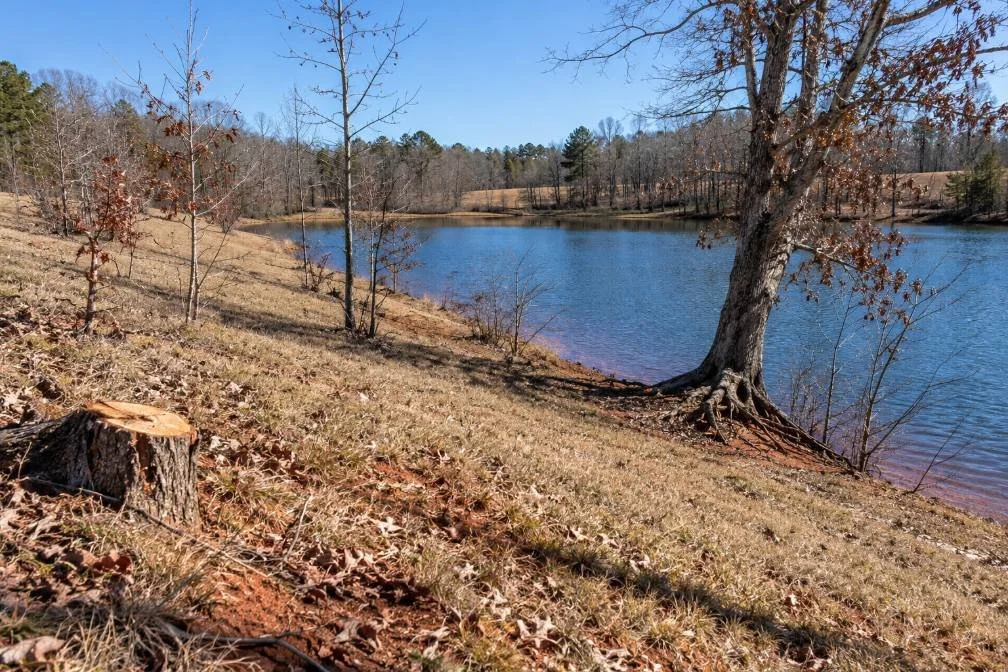
Yes: small ones now, large ones with a plan. Trees do not hold a dam together. FEMA's technical manual on plants on earthen dams says tree roots loosen embankment soil, decaying roots create seepage paths and internal erosion, uprooted trees leave large voids and reduced freeboard, and woody growth hides problems from inspectors while attracting burrowing animals.⁸
The North Carolina line is 6 inches. NCDEQ's 2022 dam safety memo calls for removing all trees, brush and woody vegetation from every part of the dam and within 15 feet of it.⁷ Trees under 6 inches in diameter at breast height can be cut flush as maintenance, with the stump treated with a tree herbicide such as triclopyr; Clemson Extension adds that the product should be approved for aquatic sites.⁷,⁶ Larger trees need complete removal by excavation, roots included, and on a state-regulated dam that means plans, supervision and certification by a North Carolina licensed professional engineer.⁷
Why not just cut the big one? A stump left in the dam rots, and rotting roots can open seepage paths that lead to piping, so the state manual calls for removing the stump and as much root as practical, then refilling with compacted earth.⁴ Auburn's pond-building guide names the other risk: a large tree that blows over can tear out its roots and compromise the dam.⁹ On an exempt farm pond the same physics apply, even when no permit does.
How should you mow and manage grass on a pond dam?
Keep a dense, low stand of grass and mow it at least once a year. FEMA calls a healthy, dense stand of low-growing grass a desirable condition on earthen dams, and notes that waist-high grass still hinders inspection.⁸ North Carolina's dam manual sets once a year as the minimum for embankment slopes and vegetated earth spillways.⁴ A last cut in late fall sets up a clean winter walk.
Skip the ground covers and the cattle. Crown vetch and sericea lespedeza are no longer acceptable on North Carolina dams because they hide the surface. Keep tractors off slopes steeper than 2.5 horizontal to 1 vertical, and keep livestock off the embankment.⁴ Shoreline mowing is a different question, covered in the pond bank erosion repair guide.
What do muskrats and beavers do to a pond dam?
Muskrats dig, beavers plug, and either can cost you the dam. North Carolina State Extension's stormwater pond maintenance guide warns that muskrats sometimes burrow around and through dams, and at worst the holes can lead to dam failure.¹⁰ The state dam manual is blunter: damage from just one hole can lead to failure, so dens should be eliminated without delay.⁴
Fixing a burrow. Remove the animal first. North Carolina State Extension says muskrats should be trapped during the regular season unless you get a depredation permit from the North Carolina Wildlife Resources Commission.⁵ Then mud-pack the burrow, compact the entrance and revegetate; riprap over a filter layer discourages new digging.⁴ A burrow that runs deep or lines up with a wet spot on the back slope is an engineer's call.
Beavers. Beavers pack cuttings into primary and emergency spillways. The manual recommends removing cuttings routinely, running electrified wire around the inlet, and trapping in season.⁴ In counties enrolled in the state's Beaver Management Assistance Program, landowners can get USDA Wildlife Services help at a reduced cost share.¹¹
What can you fix yourself, and what needs a licensed engineer?
Owners can handle surface maintenance. Anything involving the inside of the dam, the pipe through it, or a state-regulated structure belongs with a licensed professional engineer.
Owner jobs. Mowing, reseeding bare spots, cutting woody growth under 6 inches flush and treating stumps, clearing trash racks and spillways from safe footing, and keeping photo and seepage records.⁷
Owner jobs, with limits. Clemson Extension says to smooth and reseed erosion 12 inches deep or less, and to bring a professional engineer in for anything deeper.⁶
Engineer jobs. Trees over 6 inches, muddy seepage, boils, sinkholes, slides, cracks wider than a quarter inch, riser or barrel replacement, and any repair on a state-regulated dam.
Stuck valves. Clemson's checklist says a drain valve that does not work should only be exercised under the direction of a professional engineer.⁶
For seepage, sinkholes or cracking on a dam that is not state-regulated, Clemson's advice is to lower the water level and get professional repair help.⁶ Between the two lists sits hands-on work: rebuilding eroded slopes, armoring a wave-battered face, burrow repair and outlet work. Clearwater's repairs and restorations work covers outlet structures, risers, spillways and pipes, and shoreline erosion restoration handles the waterline.
If a repair means draining the pond, plan around it. Draining and drying the bottom is the most economical way to remove sediment, so the pond dredging cost guide is worth a read while the water is down.⁵ A drained pond also needs a fish restocking plan.
Is your pond dam regulated by the state of North Carolina?
Maybe, and height alone does not settle it. Under the Dam Safety Law of 1967, the NCDEQ Dam Safety Program provides oversight to more than 3,000 dams statewide.¹² The statute exempts a dam under 25 feet tall or holding less than 50 acre-feet, unless the state determines its failure could cause loss of life or significant property damage downstream.¹³ It also exempts a single private owner's dam that protects only that owner's property and threatens no life or property below, plus certain federally built, NRCS-assisted and registered agricultural water dams.¹³
Hazard follows what is downstream. North Carolina sorts dams into Class A, low hazard; Class B, intermediate hazard; and Class C, high hazard, where failure will likely cause loss of life or serious damage to homes, businesses, important utilities or major roads.¹⁴ A pond built in a pasture decades ago can have a subdivision below it today, which is why NCDEQ asks owners of regulated dams to review their inundation maps yearly for downstream changes.¹⁵
Emergency Action Plans. Every jurisdictional high and intermediate hazard dam needs an Emergency Action Plan with emergency conditions, response actions, notification procedures and a downstream inundation map, updated and resubmitted every year.¹⁵ Unsure where your dam stands? NCDEQ publishes a dam inventory map and answers jurisdiction questions at damsafety@deq.nc.gov.¹²,¹⁵ Either way, dam owners, not NCDEQ, decide whether a dam is repaired or breached.³
What does an HOA or golf course owe its stormwater pond embankment?
At least one expert look a year. NCDEQ's design manual chapter on wet ponds says a dam safety expert should inspect the embankment once a year.¹⁶ The same chapter says to remove shrubs on the embankment immediately, consult a dam safety specialist before removing a tree, and bring in a professional for muskrat or beaver activity and the holes and erosion it leaves.¹⁶
North Carolina State Extension's wet pond maintenance guide adds two habits: inspect the dam once a year and remove all shrubs and trees from the top and both faces, and inspect the outlet after every rain over 2 inches. It also warns that dam failure can be catastrophic when homes, businesses or roads are downstream.¹⁰ In a Huntersville or Concord subdivision, they usually are.
Fold the embankment into routines the community already runs: retention pond management for ongoing care, SCM inspections and compliance for permit reports, and the storm-ready drainage checklist before heavy weather. Golf courses can use the same walk on every impoundment.
Want your pond dam walked this winter, while the grass is down and the problems are easy to see?
Call (704) 450-1598 or request service at clearwaterlpm.com.
Frequently Asked Questions
Is a little seepage through a pond dam normal?
Not something to ignore, and one look cannot tell you how serious it is. North Carolina's dam manual says to record where it exits, how much flows, its color, the size of the wet area and the plants growing there, then watch for increases or soil in the water.⁴ A wet spot that holds steady with clear water calls for measuring and monitoring. Growing, cloudy or muddy flow calls for a professional now, because soil in the flow is the signature of piping.
Can I plant shrubs or flower beds on my pond dam to dress it up?
Keep the landscaping off the embankment. FEMA's manual on plants on earthen dams calls grasses and shallow-rooted native vegetation the most desirable cover.⁸ North Carolina's dam manual says trees and brush should not be permitted on embankment surfaces or vegetated earth spillways.⁴ Put ornamental beds on the hillside beyond the 15-foot clear zone NCDEQ uses around regulated dams.⁷ A clean, mowed grass slope is the curb appeal.
What grass should go on a pond dam in North Carolina?
A dense, low-growing perennial grass you can mow. North Carolina's dam manual recommends 100 percent Kentucky 31 fescue for vegetated earth spillways, seeded at 3 pounds per 1,000 square feet with lime, fertilizer and mulch, and rules out crown vetch and sericea lespedeza because they hide problems.⁴ On a bare patch, Clemson Extension suggests a soil test and an erosion control blanket while new grass takes hold.⁶
Can I drive a truck or tractor across the top of my pond dam?
Yes, if the crest was built for it and you keep it in shape. North Carolina State Extension suggests a crest 12 to 16 feet wide on dams used for vehicle traffic.⁵ Fill ruts before they hold water, since the state dam manual says the crest should drain toward the pond, not over the back slope.⁴ Stay off a soft, saturated crest after heavy rain, when tires cut the deepest ruts.
Who is responsible for inspecting my pond dam, the state or me?
You are, for anything that happens between state visits. The Dam Safety Law requires periodic inspection of dams under state jurisdiction, but the law does not apply at all to exempt dams, which covers many small farm and backyard ponds.⁴,¹³ For maintenance, monitoring and repairs, the owner carries the load. A once-a-year winter walk with dated photos is the cheapest insurance an owner has.
Can I drain the pond or breach the dam instead of fixing it?
Sometimes, and for an aging pond nobody uses it can be the sensible choice. On a state-regulated dam, a breach or removal needs an approved application, and NCDEQ charges a nonrefundable fee of 2.25 percent of the project's construction cost.¹² A breached dam generally no longer needs an Emergency Action Plan, but a drained dam that could fill again still does.¹⁵ On an exempt pond, have an engineer plan the release so it does not damage property downstream.
Sources
1. North Carolina Cooperative Extension, Haywood County Center. "North Carolina Farm Pond Management Calendar." North Carolina State Extension. Accessed October 28, 2026. https://haywood.ces.ncsu.edu/farm-pond-management/north-carolina-farm-pond-management-calendar/
2. Igelman, Jack. "'Not a Silver Bullet.' NC Dams Problematic During Helene Flooding, Future Role Unclear." Carolina Public Press, via WFAE, June 2, 2025. https://www.wfae.org/energy-environment/2025-06-02/not-a-silver-bullet-nc-dams-problematic-during-helene-flooding-future-role-unclear
3. Myers, Katie. "$20M for Dam Safety Goes to DEQ for Structures Impacted by Helene." BPR News, via WUNC, July 14, 2026. https://www.wunc.org/2026-07-14/20m-for-dam-safety-goes-to-deq-for-structures-impacted-by-hurricane-helene
4. North Carolina Department of Environment and Natural Resources, Division of Land Resources, Land Quality Section. Dam Operation, Maintenance, and Inspection Manual. Raleigh, 1985, revised 2007. https://deq.nc.gov/media/10451/download
5. North Carolina State Extension. Pond Management Guide. AG-424. Raleigh: North Carolina State University. Accessed October 28, 2026. https://content.ces.ncsu.edu/pond-management-guide
6. Clemson Cooperative Extension. "Pond Owner Assessment Checklist for Earthen Embankment Dams." Clemson, SC: Clemson University. Accessed October 28, 2026. https://www.clemson.edu/extension/water/files/pond-owner-assessment-checklist.pdf
7. Colley, Josh. "Guidance Memo: Trees on Dams." Memorandum to all regional engineers and staff, North Carolina Department of Environmental Quality, Dam Safety Program, May 23, 2022. https://deq.nc.gov/energy-mineral-and-land-resources/guidance-memo-trees-dams/open
8. Federal Emergency Management Agency. Technical Manual for Dam Owners: Impacts of Plants on Earthen Dams. FEMA 534. Washington, DC: FEMA, 2005. https://www.mass.gov/files/documents/2016/08/pl/fema-publication-534.pdf
9. Hyde, Chris, and Perry Oakes. Pond Building: A Guide to Planning, Constructing, and Maintaining Recreational Ponds. ANR-1114. Revised by Russell Wright. Auburn, AL: Alabama Cooperative Extension System, August 2023. https://www.aces.edu/blog/topics/fish-water/pond-building-pond-maintenance/
10. Hunt, William F., and Bill Lord. Maintenance of Stormwater Wetlands and Wet Ponds. AGW-588-07. Raleigh: North Carolina Cooperative Extension Service, August 2006. https://brunswick.ces.ncsu.edu/wp-content/uploads/2013/04/Wetland-and-Pond-Maintenance-2006.pdf
11. North Carolina Wildlife Resources Commission. "Beaver Management Assistance Program (NCWRC, USDA, DOT)." Accessed October 28, 2026. https://www.ncwildlife.gov/wildlife-habitat/species/beaver/bmap
12. North Carolina Department of Environmental Quality, Division of Energy, Mineral, and Land Resources. "Dam Safety." Accessed October 28, 2026. https://www.deq.nc.gov/about/divisions/energy-mineral-and-land-resources/dam-safety
13. North Carolina General Statutes. Chapter 143, Section 143-215.25A. Dam Safety Law of 1967. Accessed October 28, 2026. https://www.ncleg.gov/EnactedLegislation/Statutes/HTML/BySection/Chapter_143/GS_143-215.25A.html
14. North Carolina Administrative Code. Title 15A, Subchapter 02K, Section .0105, "Classification of Dams." Via Justia Regulations. Accessed October 28, 2026. https://regulations.justia.com/states/north-carolina/title-15a/chapter-02/subchapter-k/section-0100/section-02k-0105
15. North Carolina Department of Environmental Quality, Division of Energy, Mineral, and Land Resources. "Planning for a Dam Emergency." Dam Safety Program. Accessed October 28, 2026. https://www.deq.nc.gov/about/divisions/energy-mineral-and-land-resources/dam-safety/planning-dam-emergency
16. North Carolina Department of Environmental Quality. "C-3. Wet Pond." In NCDEQ Stormwater Design Manual. Revised November 23, 2020. https://deq.nc.gov/media/17537/download